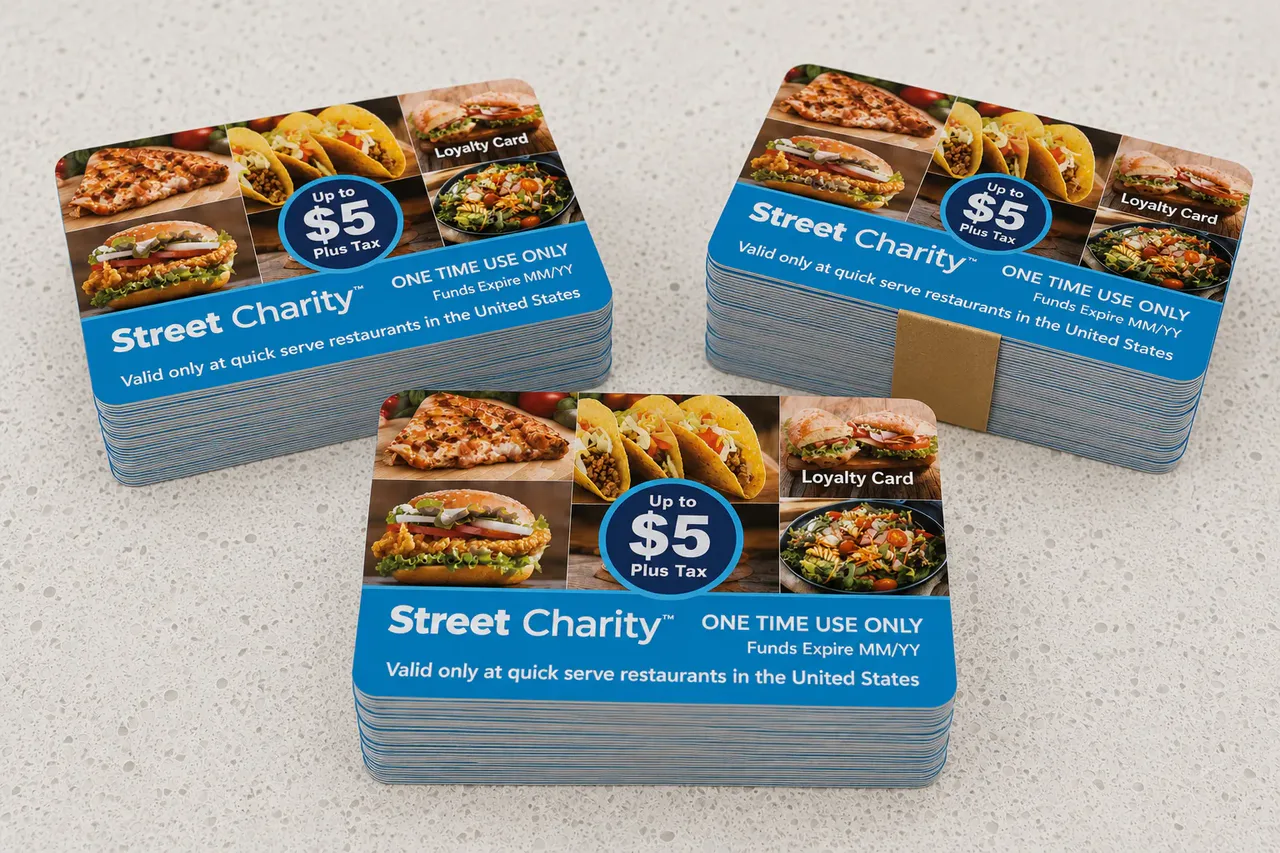
CPI Card Group is using a hunger-relief programme to demonstrate a different use for prepaid technology: small food allowances distributed on paper cards. On April 21, 2026, it announced a donation of 25,000 cards and a monetary contribution to Street Charity's national expansion. The announcement concerns a contribution to the programme, not a disclosed commercial order. [S01]
Street Charity distributes $5 cards for eligible US quick-service restaurants. CPI is helping move the programme from plastic to single-use paper, with a carrier that holds multiple cards and services for personalisation and fulfilment. [S01]
The supplier, the charity and the issuer have different roles
CPI manufactures payment cards and provides packaging and fulfilment services to programme operators. Its prepaid business includes cards restricted to selected merchants, as well as retail gift products. The Street Charity format therefore uses capabilities that the company already sells into the payments market. [S03]
The division of responsibility matters. Central Bank of Kansas City issues the card, which operates on the Discover network. CPI supplies the physical product and supporting operations; it is not the institution issuing the spending balance. The card excludes cash withdrawals and ATM use, and the programme says its funds are not FDIC insured. [S01]
Street Charity, an Atlanta nonprofit, distributes through organisations and individual donors. Its model uses existing restaurants to prepare and serve meals, avoiding the need for the charity to operate a kitchen for every location it reaches. That moves much of the practical work from food logistics to card delivery and permitted acceptance. [S02]
A small balance still has a delivery cost
The programme's published cost breakdown separates the $5 balance from 64 cents for tax and $1.35 for printing, packaging, processing and related administration, producing a stated $6.99 total. Its bulk ordering interface rounds the donor price to $7 per card. These are programme-wide charges, not a disclosure of CPI's margin. [S02]
That distinction makes the partnership more revealing than the donation count alone. With a low-value allowance, the cost of putting a usable card into someone's hands can be material relative to the food budget. A multi-card carrier and bulk fulfilment address that operating problem; the announcement does not quantify the savings from switching materials. [S01]
CPI's wider personalisation service supports both scheduled bulk mailings and individual orders, with account tools for inventory and order tracking. Applying that infrastructure to a nonprofit can make a relatively small payment practical to distribute repeatedly. It also provides a visible example of the supplier's capabilities outside conventional bank-card issuance. [S04]
What the partnership can establish
For CPI, the commercial value may lie in demonstrating a restricted-spend product and building relationships with programme buyers. That is an interpretation of the supplier's role, not evidence that the donation will generate a particular return. Neither partner disclosed a contract value, unit margin or future purchasing commitment.
For Street Charity, success means more than issuing cards. The useful measures are delivered balances, actual meal purchases, total fulfilment cost and what happens to value left unused. Its website says cards expire after six months and unused balances return to the charity for further support. That policy describes the programme's handling of residual value; it does not show how much of the initial rollout has been redeemed. [S02]
In this article

Suzie Elis
Suzie Elis covers gift card products, digital gifting and distribution for Gift Card News.