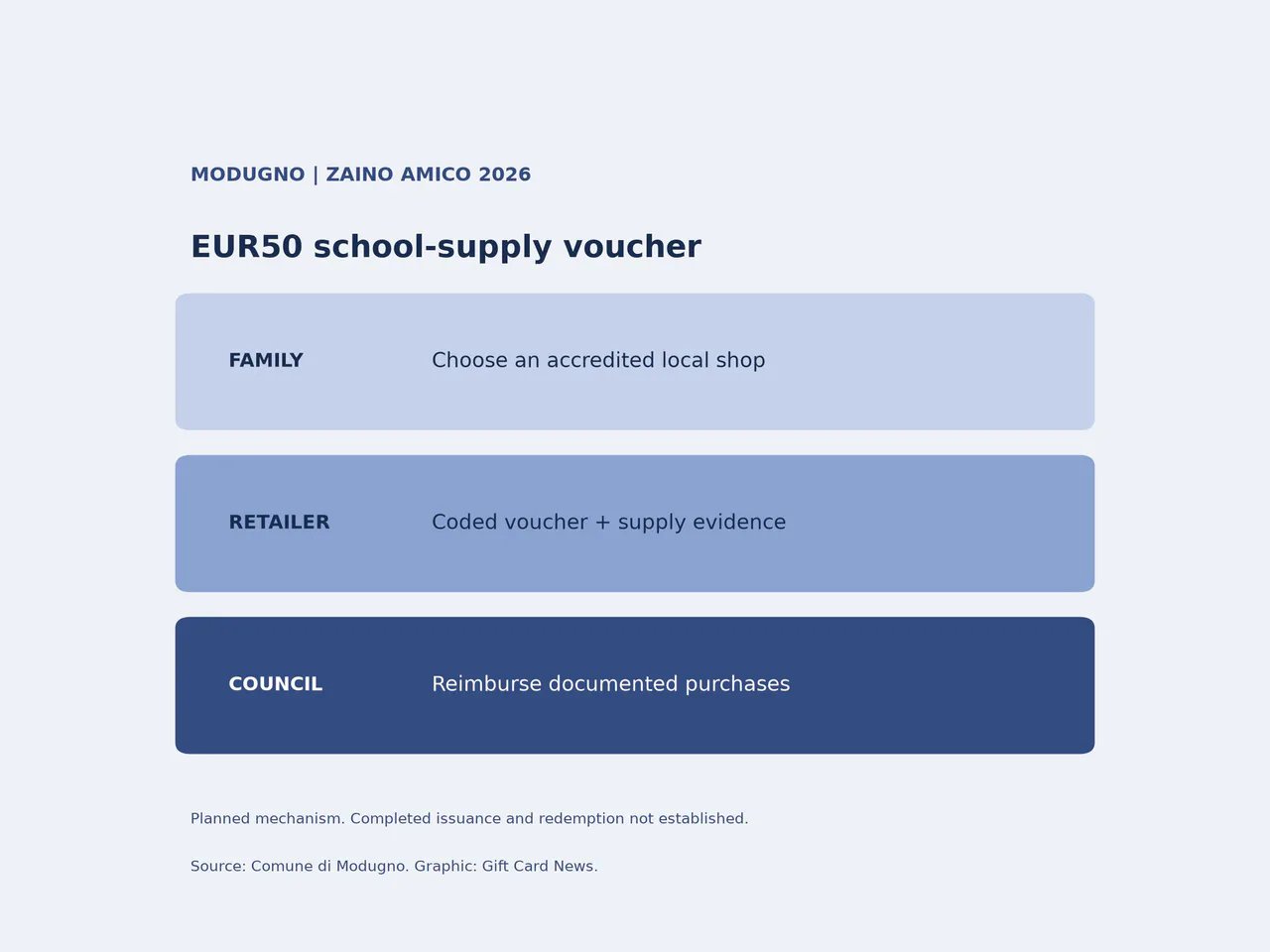
Italy’s Comune di Modugno has authorised EUR50 school-supply vouchers per eligible student and opened recruitment of local stationery and book shops. The council approved Zaino Amico 2026 on September 25; merchant enrolment was announced October 6. [S01][S02]
A higher eligibility ceiling with the same EUR50 award
The programme directs purchasing value to accredited local retailers. Eligibility covers resident pupils in primary and secondary education whose families meet an ISEE means-test threshold of EUR5,000. The council’s decision makes allocations dependent on available funding, without establishing a total number of vouchers. [S01]
The means-test ceiling is higher than in the previous annual call: EUR4,000 in the 2025 family rules and EUR5,000 in the September 2026 council criteria. That is a EUR1,000, or 25%, increase in the permitted ISEE indicator. Both cycles specify a EUR50 award per eligible student. This widens the stated financial eligibility threshold without establishing how many more students will be funded. [S01][S05]
Zaino Amico ISEE eligibility ceilings
The 2025 family call set a EUR4000 ISEE ceiling. The council decision and merchant rules for 2026 set EUR5000. The voucher remains EUR50 per eligible student.
EUR
Tap or hover for details. All values are also available in the data table.
Sources
ISEE is the means-test indicator, not a cash benefit or programme budget. The higher ceiling does not establish an increase in funded students or spending; current allocations remain limited by available resources.
Show data tableHide data table
| Category | Maximum eligible ISEE |
|---|---|
| 2025 family call | 4,000 EUR |
| 2026 council criteria | 5,000 EUR |
The funding limit precedes retailer reimbursement
The previous cycle shows why eligibility and funding need to be distinguished. Modugno’s decision published October 6, 2025 recorded 129 applications: 100 were classified as funded, 11 were eligible but could not be funded, and 18 were ineligible. The 2025 call had a EUR5,000 allocation. Those dated records explain the practical significance of a funding limit; they do not establish the 2026 budget or predict this year’s demand. [S05][S06]
The 2025 application decision illustrates the funding constraint
The October 6, 2025 published decision classified 129 applications: 100 funded, 11 eligible but unfunded, and 18 ineligible.
applications
Tap or hover for details. All values are also available in the data table.
Source
Historical 2025 application classifications, subject to the decision’s appeal window. These are not 2026 forecasts, completed voucher redemptions, merchant payments or school-retention outcomes.
Show data tableHide data table
| Category | Applications at the October 2025 decision |
|---|---|
| Funded applications | 100 applications |
| Eligible but unfunded | 11 applications |
| Ineligible applications | 18 applications |
Participating shops must undertake to issue and manage vouchers with a unique alphanumeric code, intended to support traceability and prevent counterfeiting. Families select an accredited shop; the municipality then provides that retailer with its assigned beneficiaries. [S03][S04]
The EUR50 covers stationery, textbooks and teaching materials. Purchasers pay any excess directly, and eligible spending must occur by December 31. Retailers subsequently submit beneficiary declarations and evidence of supplied goods to obtain municipal reimbursement. The documents do not identify a digital-wallet operator. [S03]
The 2026 merchant rules contain an unresolved reimbursement-date inconsistency. Article 6 lists invoice deadlines in November and December 2026, followed by January 20, 2026 as the final deadline, which precedes the October 2026 call. The reviewed source does not resolve that year; it is not silently treated as January 2027. [S03]
Merchant applications were due at noon on October 16. The rules place the family application notice after establishment of the approved retailer list. These steps establish a planned voucher acceptance and settlement network, rather than completed issuance, redemption or measured school-retention outcomes. [S02][S03]
In this article

Suzie Elis
Suzie Elis covers gift card products, digital gifting and distribution for Gift Card News.