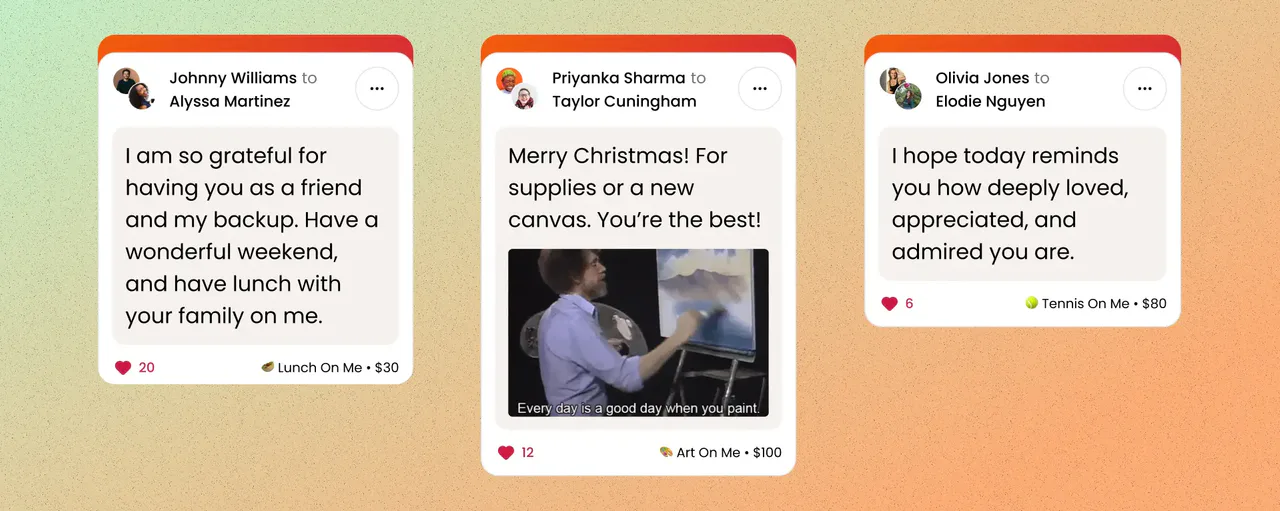
On Me announced Social Gifting on March 23, 2026, adding a curated public gift feed to its homepage and product pages. The company said the feature would roll out that week, with senders deciding whether to keep a gift private or make it public. [S01]
A gift card business built around interests
On Me groups gift cards around interests and occasions, with spending available across relevant participating merchants. Its company story places personal meaning at the centre of that model: the sender can choose a category suited to the recipient without selecting the exact item they should buy. [S03]
The company identifies Sutton Bank as the issuer of its Mastercard cards. It also discloses that it may receive commissions from retail partners. Those arrangements put the consumer gifting interface on top of card issuance and merchant relationships; they do not disclose the margin earned on any individual gift. [S03]
A public feed adds another role for that interface. Previous gifts can demonstrate how to turn an interest or occasion into a purchase, giving a visitor examples at the point where they are deciding what to send.
The controls are different for sender and recipient
Show data tableHide data table
| Control | What the announcement says |
|---|---|
| Private gift | The gift remains between sender and recipient. |
| Public gift | The gift can appear in the public feed; the recipient may remove their name. |
| Feed selection | The company curates which gifts appear and says messages are anonymized. |
Source: the launch announcement. Anonymisation is the company’s description of its process, not an independently tested guarantee. [S01]
On Me’s current terms add a material distinction: new accounts default to public visibility for gifts received, while the sender must explicitly designate a gift public. Recipients can untag themselves, removing their identity while the gift content may remain. [S02]
The terms also allow public gift content to be used in marketing and distributed outside the service. They retain rights over content previously made public after subsequent changes. These are the current published terms, rather than evidence of the exact wording presented at the March launch. [S02]
A customer-acquisition mechanism
The business logic is that an existing transaction can help generate the next one. A prospective sender sees a concrete gift and the message that gave it meaning, rather than only a catalogue description. That could reduce the effort of choosing and encourage a recipient to become a sender.
For On Me, customer-created examples can therefore become marketing assets as well as records of gifts. The opportunity is lower dependence on producing every example itself or paying to introduce each new shopper. Neither a reduction in acquisition cost nor an increase in repeat purchasing was disclosed with the launch.
That potential benefit carries an operating obligation: deciding which examples are appropriate to display and making the visibility choices intelligible. A recipient may welcome a gift while having a different view from the sender about appearing publicly alongside it.
The announcement contains no conversion results or independent test of the claimed anonymisation. Its significance is the addition of a discovery loop around the payment product. Whether that loop builds repeat use depends on both the usefulness of the examples and users’ confidence in how their messages are handled.
In this article

Emma Carter
Emma Carter covers retail, e-commerce and the gift card shopping experience for Gift Card News.