Businesses adding eSIMs to a digital product need to decide whether they want API control over the customer journey or a ready-made branded storefront. In an August 24, 2026 comparison of eight providers, zendit sets out the trade-offs for resellers, fintechs, travel platforms and enterprises.
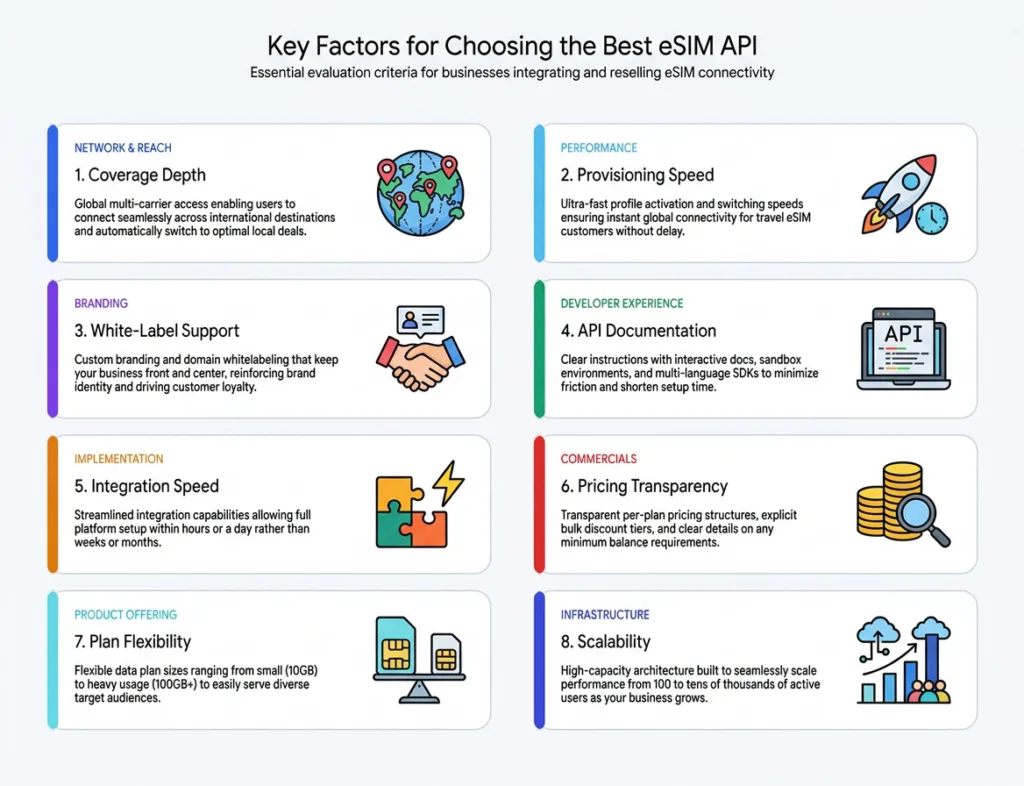
The article notes that an eSIM API is designed to help businesses purchase and/or resell eSIM to their customers without having to set up their infrastructure. It recommends considering factors such as coverage depth, provisioning speed, white-label support, API documentation quality, integration speed, pricing transparency, flexibility, and scalability when choosing an eSIM API provider.
In that comparison, zendit describes its own API as covering 193 carriers across 194 countries, with instant provisioning and a white-label storefront option. It positions the offering for businesses that want eSIMs alongside other digital products such as prepaid utilities and gift cards.
Other eSIM API providers reviewed in the article include eSIM Access, Airalo for Business, CELITECH, 1GLOBAL, OmaxTelecom, eSIM Go, and Telnyx. Each provider has its unique features and is suited for different business needs, such as travel eSIM usage, reselling, or enterprise provisioning.
The article also explains the difference between an eSIM API and a white-label eSIM platform, noting that an eSIM API gives developers the infrastructure needed to integrate eSIM functionality into an existing website or application, while a white-label eSIM platform offers a ready-made, branded solution for businesses that want to sell eSIMs under their name without building the tech stack from scratch.
To choose the best eSIM API, the article recommends considering factors such as API or white-label solution, enterprise usage or reselling, general or specific usage, and specific countries. It also suggests evaluating the provider's coverage, API capabilities, pricing structure, provisioning process, and scalability before making a decision.
The guide also recommends assessing migration effort before switching providers, including existing customers, integrations and data. Coverage, provisioning, pricing and support need to match the intended markets as well as the reseller's development resources.
Sources and documents
Collapse
In this article

Oliver Reed
Oliver Reed covers industry acquisitions, investment and market research for Gift Card News.