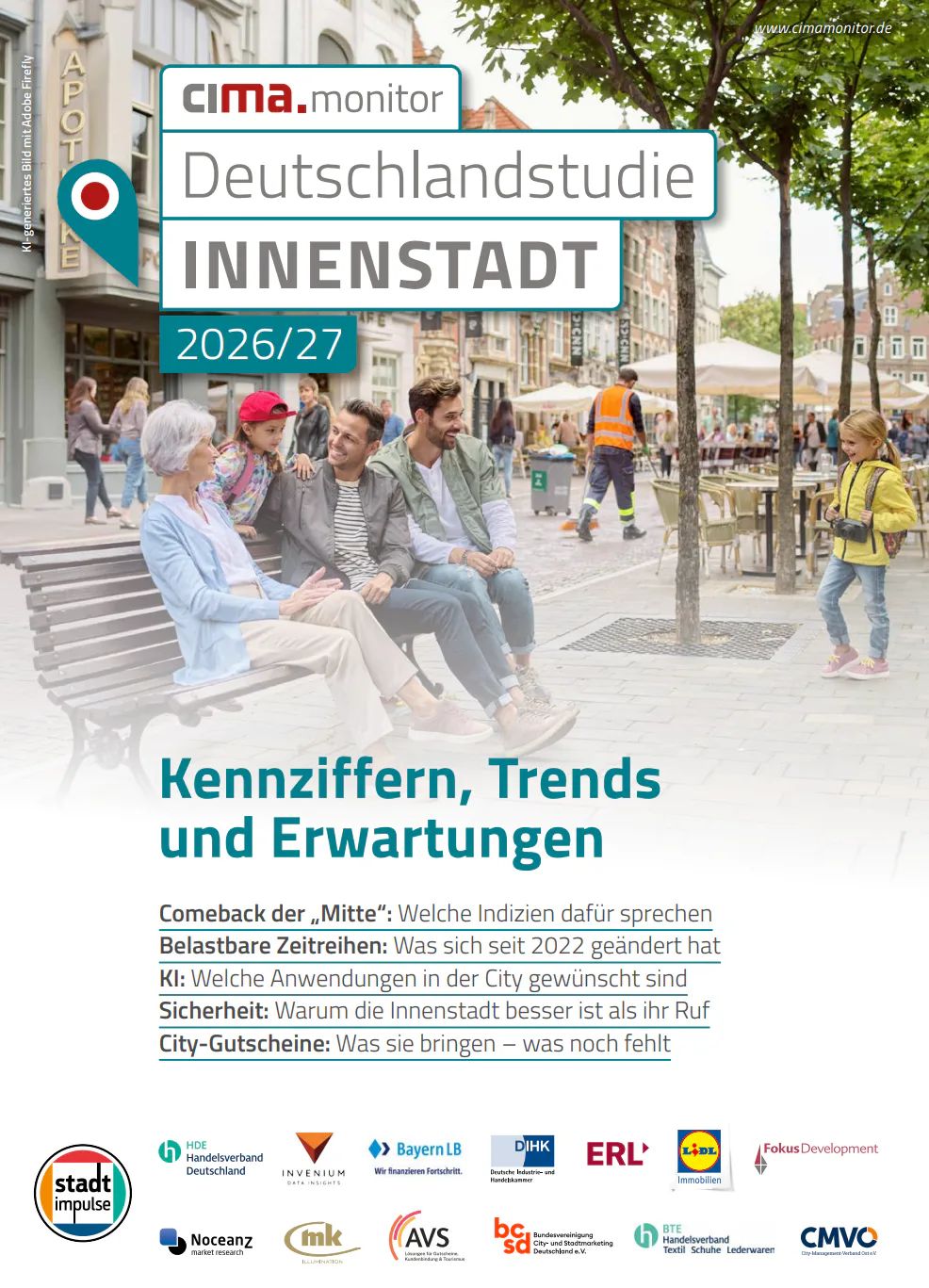
More than half of respondents in CIMA's new German city-center study were unfamiliar with city gift vouchers, leaving a substantial awareness gap for programs intended to retain spending in local businesses. CIMA published the 2026/27 edition on September 23. [S01]
In the survey of 5,079 people, 50.7% said they did not know about city vouchers, 29.9% knew of them without using them and 19.4% used them. The analysis includes employer-funded local benefit cards alongside consumer vouchers, provided redemption is restricted to businesses in the local network. [S02]
Awareness and merchant choice
Among 4,092 non-users, 40.1% said they did not know enough about the offers and 38% cited a lack of need or interest. Smaller proportions identified network limitations: 13.2% said there were too few acceptance points and 12.3% found the selection of businesses unattractive. Respondents could select more than one reason.
Merchant variety also mattered to people already using the products. In a separate base of 987 users, 60.6% wanted a mixture of local businesses and chains, 48% wanted a broad choice of sectors, and 38.6% valued use in hospitality and leisure. These findings make the composition of an acceptance network relevant alongside its headline merchant count.
For program operators, the two sets of answers identify different tasks. Non-users frequently need a clearer explanation of the offer, while existing users value the places where their balance can be spent. The survey does not establish which intervention would produce the largest increase in actual purchases.
Selected reasons for not using city vouchers
Share of 4,092 non-users selecting each reason; multiple answers allowed.
% of non-users
Tap or hover for details. All values are also available in the data table.
Source
Selected reasons from one multiple-response question; percentages need not sum to 100. Self-reports do not establish which intervention causes adoption. Fieldwork May-June 2026; question-specific uncertainty and response rate are not disclosed.
Show data tableHide data table
| Category | Reported estimate or value |
|---|---|
| Do not know offers well enough | 40.1 % of non-users |
| No need or interest | 38.0 % of non-users |
| Too few acceptance locations | 13.2 % of non-users |
| Unattractive merchant choice | 12.3 % of non-users |
Visits are not the same as additional sales
CIMA reports that 68.5% of users said vouchers brought them into the city center somewhat or substantially more often. In a multiple-response question with 964 participants, 44.5% reported visiting more shops, 37.3% spending longer, and 19.4% spending more money; 17.8% reported no change.
The distinction matters for claims about local economic impact. More visits or longer stays can be useful indicators for city managers, but they do not establish how much spending was additional or diverted from another local business. The report presents respondents' descriptions of their behavior, rather than transaction-level evidence of a causal sales increase.
Reported changes when using city vouchers
Share of 964 users selecting each behaviour in the survey.
% of responding users
Tap or hover for details. All values are also available in the data table.
Source
Multiple responses and self-reported behaviour. This is not a causal sales lift, euro spending total or transaction audit. The 964-person base differs from the 987 users in other questions; recruitment and representativeness are study-reported.
Show data tableHide data table
| Category | Reported estimate or value |
|---|---|
| Visit more shops | 44.5 % of responding users |
| Spend more time | 37.3 % of responding users |
| Spend more money | 19.4 % of responding users |
| No difference | 17.8 % of responding users |
NoceanZ conducted the online interviews in May and June 2026 among residents aged 16 and over, recruited through multiple panels. The full report describes the sample as representative by age, gender and federal state, but does not disclose question-specific confidence intervals or a response rate. Its findings provide evidence about awareness, preferences and reported behavior at that time, rather than a measurement of gift-card sales across Germany. AVS, a commercial voucher provider, is among the study partners. [S02]
In this article

Oliver Reed
Oliver Reed covers industry acquisitions, investment and market research for Gift Card News.