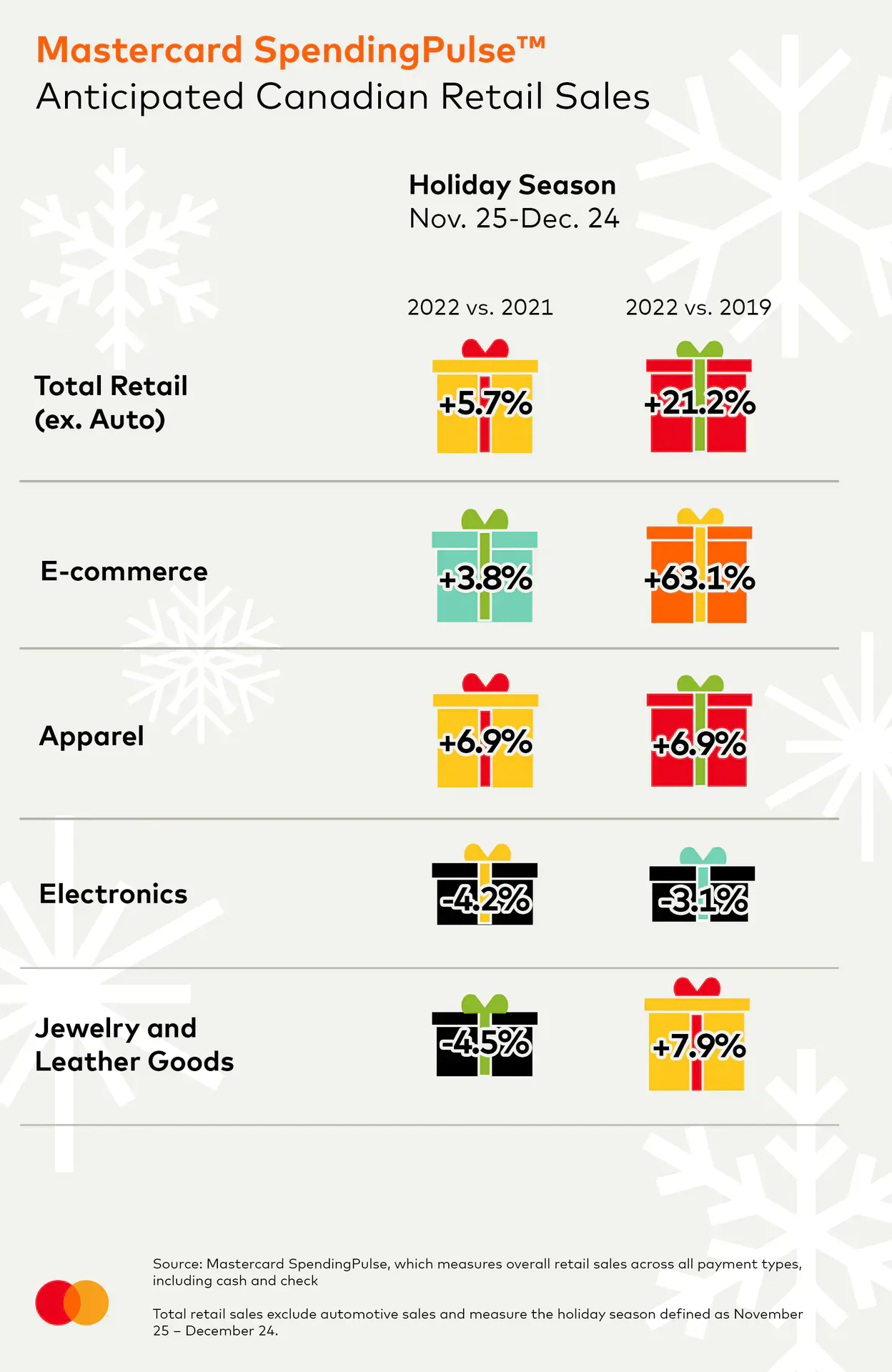
Mastercard projected that Canadian retail spending excluding vehicles would rise 5.7% between November 25 and December 24, 2022. Its November 17 outlook expected online sales to increase 3.8% over the same holiday period a year earlier.
The forecast emphasized a return to late gift buying as supply constraints eased and consumers regained more freedom to visit stores. Mastercard expected spending to increase 24% on December 23 and 17.5% on Christmas Eve compared with the corresponding days in 2021.
SpendingPulse combines Mastercard network activity with estimates for other payment methods. The comparison below retains the original release period and definitions; it describes retail spending rather than gift-card sales, redemption or Mastercard revenue. The public release does not give the underlying transaction count, model parameters or uncertainty intervals.
Canada late-Christmas shopping forecasts for 2022
Forecast published November 17, 2022 for December 23 and December 24, 2022, each compared with its corresponding day in 2021.
% year-over-year spending growth
Tap or hover for details. All values are also available in the data table.
Source
Daily total retail spending forecasts excluding automotive, not adjusted for inflation. Each bar is a year-over-year spending change for the named day, not a share of seasonal sales, a calendar duration or a measured result.
Show data tableHide data table
| Category | % year-over-year spending growth |
|---|---|
| December 23 | 24.0 % year-over-year spending growth |
| Christmas Eve | 17.5 % year-over-year spending growth |
Jewelry and leather goods were among the categories expected to benefit from last-minute purchases. Clothing and electronics were also projected to attract gift shoppers close to Christmas, even though electronics spending was forecast to fall on Black Friday and Boxing Day.
Mastercard said higher interest rates and other economic pressures were encouraging shoppers to stretch budgets. Its SpendingPulse projections included multiple payment methods and were not inflation-adjusted. The announcement set out expectations for specific dates in 2022 rather than confirmed sales outcomes.
In this article

Suzie Elis
Suzie Elis covers gift card products, digital gifting and distribution for Gift Card News.