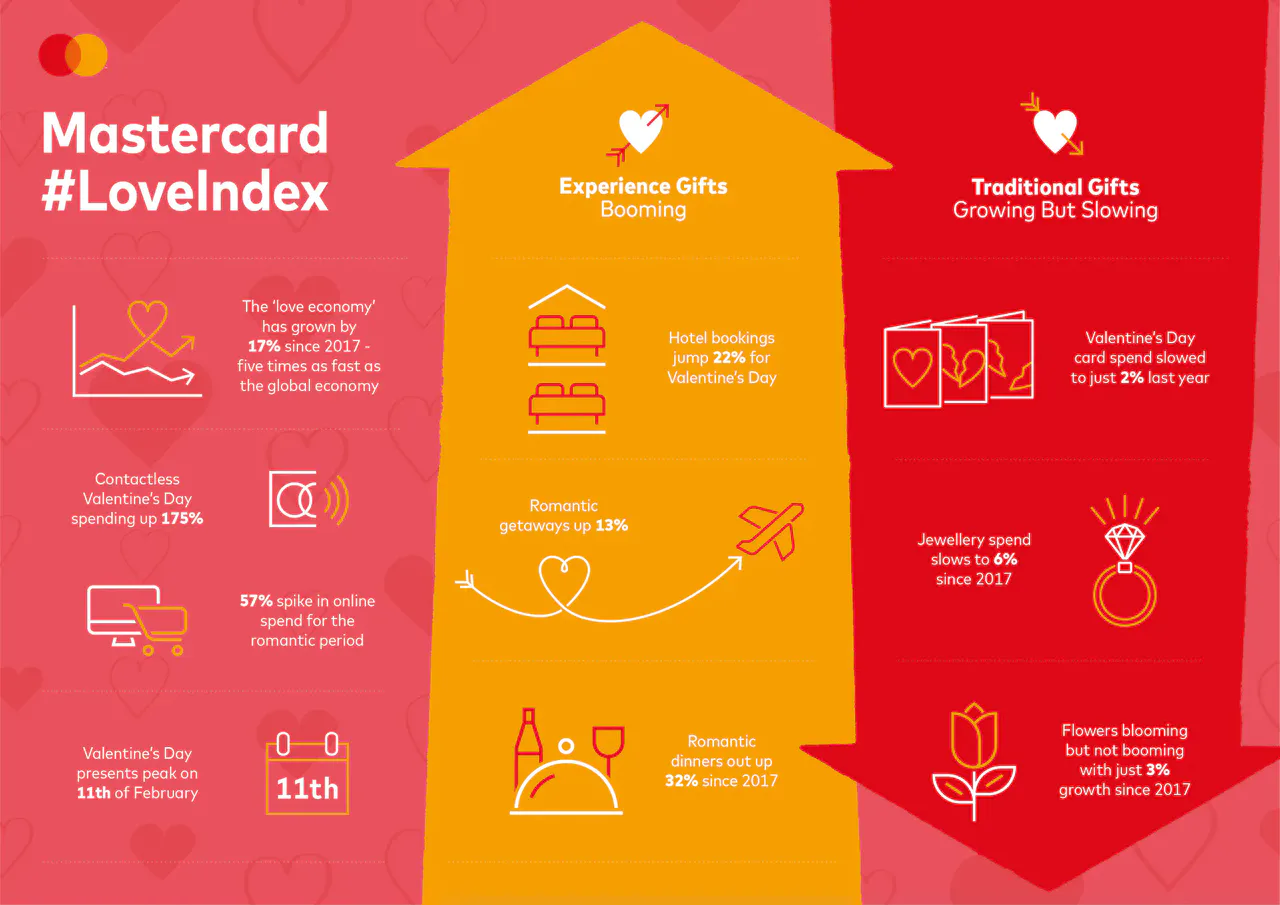
Mastercard's Love Index, published on February 12, 2020, reported a 17% rise in Valentine's-period spending across the study's three-year comparison. It analyzed credit, debit and prepaid card transactions in 53 territories during February 11–14 in 2017, 2018 and 2019.
Mastercard interpreted the findings as a shift toward experience gifts. It reported hotel bookings up 22% and flights up 13%, without clearly specifying whether those booking changes measured number or value. Its explicitly labelled spending comparisons were restaurants up 16%, jewelry up 6% and flowers up 3%. Those category figures provide a consistent spending-value comparison.
The comparison uses the original release's explicitly labelled spending changes across the February 11-14 windows in 2017 and 2019. Mastercard did not disclose the transaction count, territory weighting, currency-conversion method or inflation adjustment. Separate Greek reporting covers a local subset of the same study and is not an independent replication.
Valentine-period spending growth by selected category
February 11-14, 2019 compared with February 11-14, 2017; published February 12, 2020.
% spending-value growth
Tap or hover for details. All values are also available in the data table.
Source
Spending value over the historical 2017-2019 comparison, not transaction-count growth, gift-card spending or 2020 results. Currency and inflation treatment are not disclosed.
Show data tableHide data table
| Category | % spending-value growth |
|---|---|
| Restaurants | 16 % spending-value growth |
| Jewelry | 6 % spending-value growth |
| Flowers | 3 % spending-value growth |
The release also reported online growth of 57% and contactless growth of 175%, but the original materials disagree on the measures. The text calls them online transactions and the share of offline contactless transactions, while the infographic labels them spending. Their precise units remain unresolved, so they are not used in the spending comparison.
Buying also moved earlier in the period: the busiest day was February 11 in 2019, compared with February 12 in 2018 and February 13 in 2017. The figures describe those historical dates and should not be read as results for Valentine's Day 2020.
In this article

Oliver Reed
Oliver Reed covers industry acquisitions, investment and market research for Gift Card News.