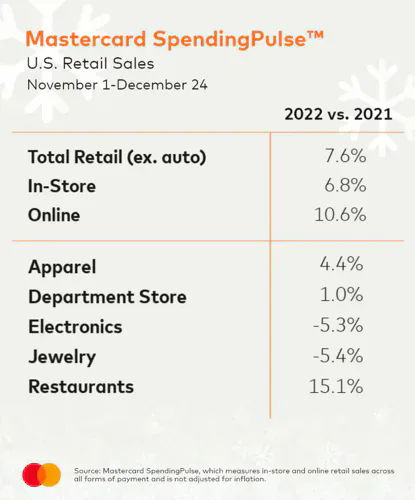
Mastercard's preliminary SpendingPulse results showed U.S. holiday retail spending rose 7.6% between November 1 and December 24, 2022. The estimate excluded vehicle sales, covered all payment methods and was not adjusted for inflation.
Online sales increased 10.6% compared with the same period in 2021. E-commerce accounted for 21.6% of retail spending, up from 20.9% a year earlier. Mastercard associated the increase with convenience and shoppers' access to promotions.
SpendingPulse combines Mastercard network activity with estimates for other payment methods. The comparison below retains the original release period and definitions; it describes retail spending rather than gift-card sales, redemption or Mastercard revenue. The public release does not give the underlying transaction count, model parameters or uncertainty intervals.
Online share of US holiday retail spending
November 1-December 24 in 2020, 2021 and 2022, as reported in the preliminary December 26, 2022 release.
% of retail spending
Tap or hover for details. All values are also available in the data table.
Source
Share of total retail spending excluding automotive in the same holiday window. These are spending shares, not growth rates; the source is not inflation-adjusted. The 2022 release is preliminary and does not isolate gift-card purchases or redemptions.
Show data tableHide data table
| Category | % of retail spending |
|---|---|
| 2020 | 20.6 % of retail spending |
| 2021 | 20.9 % of retail spending |
| 2022 | 21.6 % of retail spending |
Black Friday was the highest-spending day of the season, recording 12% year-on-year growth. December Saturdays also attracted substantial shopping. Restaurant spending rose 15.1%, reflecting demand for gatherings and experiences alongside gift purchases.
Mastercard economist Michelle Meyer said inflation had led consumers to seek discounts and make trade-offs within gift budgets. Adviser Steve Sadove described a heavily promotional season. The December 26 figures measured nominal spending, so the increase should not be read as an equivalent rise in items purchased.
In this article

Daniel Brooks
Daniel Brooks covers payment networks, financial technology, payment security, gift card fraud and PCI DSS for Gift Card News.