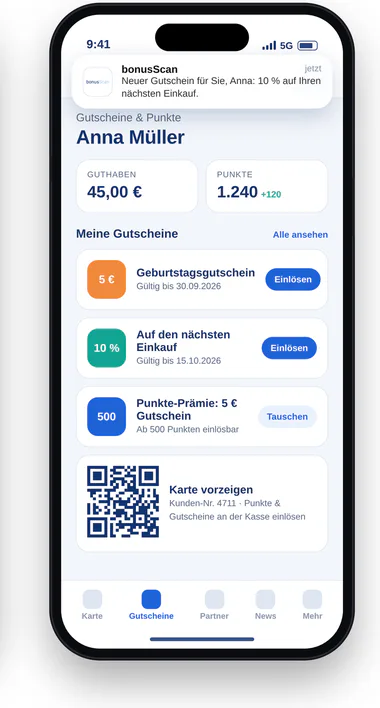
Syrcon says 90.4% of 6,587 sampled city-voucher redemptions took place at a different business from the one that originally sold the voucher. The German operator disclosed the bonusScan figures on September 28, alongside a separate breakdown of employer-funded balances. [S01]
Cross-merchant transactions represented 82.8% of redeemed value. The difference matters: the share of transactions changing merchants was higher than the share of money doing so. Neither percentage measures extra consumer spending caused by the voucher programme.
Employer funding supplies a substantial share
For Biberach, Güstrow and Lennestadt, Syrcon reports that 164 employers loaded cards for 2,097 employees. Those loads totalled EUR759,000 out of EUR1.59 million across the programmes, a share the company rounds to 48%. [S01]
Loading and redemption measure different stages of the commercial process. Employer funding places value into the local system; the redemption data describes where value is subsequently used. The disclosed figures do not match the employer loads to particular purchases or demonstrate that all loaded balances were spent.
Syrcon describes bonusScan as supporting local vouchers through cards and an app, with settlement between participating businesses. In such a network, the selling outlet and the redeeming merchant can be different businesses. The reported transaction pattern illustrates that distinction in the operator's own sample.
Employer funding within three city programmes
Employer loads are included in the total shown, so the bars must not be added.
EUR
Tap or hover for details. All values are also available in the data table.
Source
Nested values for Biberach, Güstrow and Lennestadt. Loaded balances are not actual redemptions or additional local spending. Exact 12-month boundaries and an independent audit are not disclosed.
Show data tableHide data table
| Category | Employer funding within three city programmes |
|---|---|
| All loaded value | 1,590,000 EUR |
| Employer-funded value (included) | 759,000 EUR |
Provider observations have limits
The company describes the evaluations as covering twelve-month periods, with a September 2026 reference date, but does not specify exact start and end dates. It provides no comparable prior-year series or independent audit of the transaction figures. [S01]
These are operational observations from the provider's systems, rather than a representative estimate for all German city-voucher programmes. They show where sampled redemptions occurred and how selected balances were funded. They cannot establish how much spending was newly generated, retained from online competitors or shifted between local merchants.
The source reports a 96.2% cross-merchant redemption share for Biberach, compared with 90.4% across its disclosed sample. Biberach is part of that wider sample, not an independent comparison group, and its separate transaction count is not given. The variation illustrates why a selected provider sample should not be treated as a national programme average. [S01]
Cross-merchant redemption share in disclosed samples
Same transaction measure; Biberach is included within the overall sample.
% of redemption transactions
Tap or hover for details. All values are also available in the data table.
Source
Overlapping populations, not independent groups or a causal comparison. Exact measurement dates and the Biberach denominator are absent. Transaction shares differ from shares of redeemed euros and do not measure additional spending.
Show data tableHide data table
| Category | Cross-merchant redemption share in disclosed samples |
|---|---|
| Overall sample (6,587 redemptions) | 90.4 % of redemption transactions |
| Biberach subset (size not disclosed) | 96.2 % of redemption transactions |
The same source also discusses CIMA's separate city-centre survey. Syrcon's transaction figures and employer-load data have their own bases; they should not be merged with survey respondents' reported shopping behaviour.
In this article

Maya Bennett
Maya Bennett covers customer loyalty, employee rewards and incentive programmes for Gift Card News.