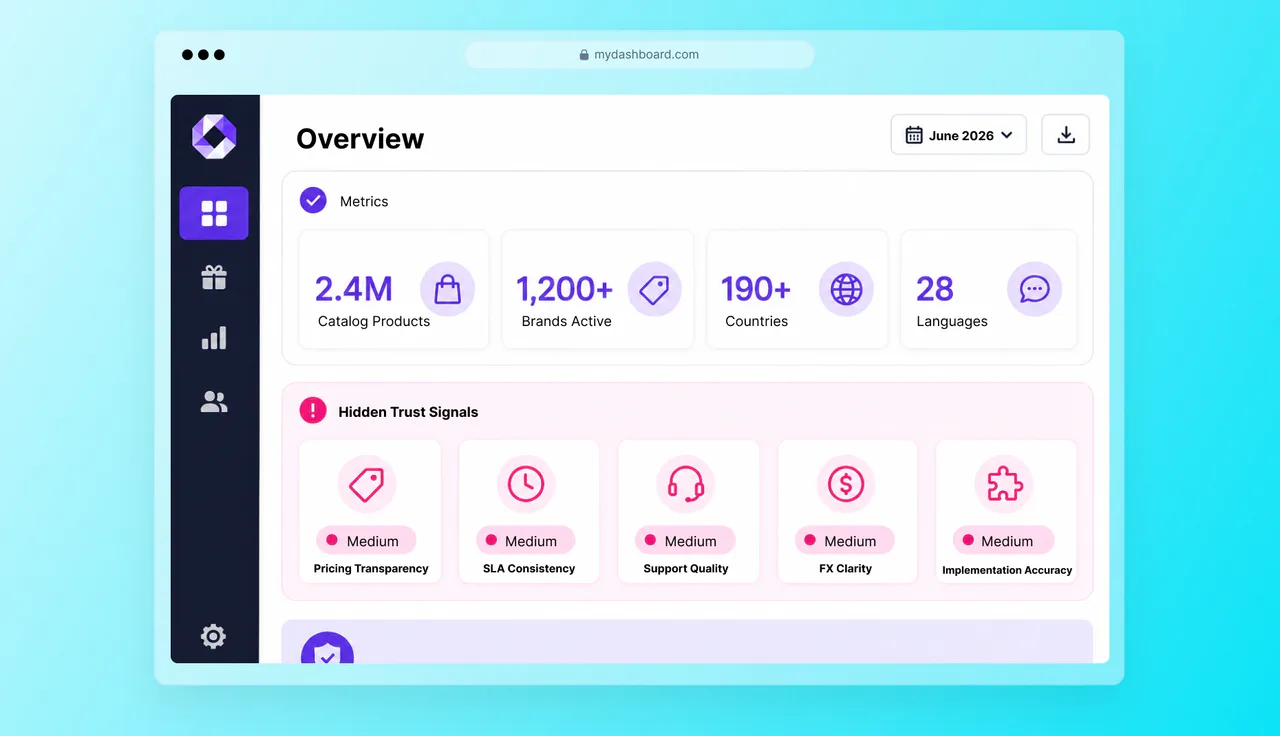
Runa’s May 28 argument for changing reward providers focuses on what happens after the contract is signed: unreliable gift card availability, unclear currency costs and slow support. The company presents those recurring problems as reasons an employee engagement platform may reconsider its supplier, even when the original integration still functions. [S01]
It is a commercially pointed argument from a business competing for those contracts. Winning a reward platform can give a supplier access to repeated purchases across several employer clients. Keeping that platform depends on more than the number of merchant logos in a demonstration.
Expansion beyond a gift card catalogue
Runa raised £26 million in November 2022 while still known as WeGift. The announcement said the funding would support its network, new markets and product development, with particular attention to North America. [S02]
The background matters because Runa is selling shared infrastructure, rather than a retailer’s own card programme. Its opportunity grows when a client routes more reward types and markets through the same relationship.
Runa’s current public description says pricing depends on payout volume and type. [S03] Its March 2026 platform terms allow agreed service fees, distinguish those from digital-asset value and permit changes to asset pricing and availability. [S04]
That makes the commercial agreement central to any comparison. A broad promise of transparent pricing is not itself a rate card. The cost of a programme depends on the reward selected, the amount ordered, funding and currency arrangements, and the contract actually accepted.
The cost of staying and the cost of moving
The May commentary acknowledges that migration entails integration, retraining and catalogue changes. It also accepts that a reliable incumbent may remain the sensible choice. [S01]
This is the important tension for a buyer. Replacing a supplier creates visible project costs. Staying with one can create less visible work, such as repeated reconciliation or troubleshooting. Neither side of that comparison should be assumed to be zero.
Runa’s own historical API migration documentation provides a concrete example of transition work. In 2024 it told clients that development was required, with account balances and recent reporting history moving to the new system. [S05]
That was an internal platform migration, not evidence about the cost of switching from a competitor. It nevertheless shows why technical continuity, financial records and staff access are separate parts of an infrastructure change.
Reliability becomes part of the platform’s promise
An engagement platform puts its own reputation in front of the employee. If a gift card cannot be claimed at an important moment, the employee is unlikely to separate the employer, the engagement application and the underlying distributor neatly.
The potential benefit of a stronger supplier relationship is therefore fewer failed experiences and less operational rework. The potential cost is dependence on another provider’s catalogue, contract and service performance.
Runa’s article describes that buying decision; it does not document a wave of named customers leaving competitors or establish that switching necessarily improves results. Its most substantive point is that the economics of reward distribution continue after implementation, through every order and every support case.
In this article

Suzie Elis
Suzie Elis covers gift card products, digital gifting and distribution for Gift Card News.