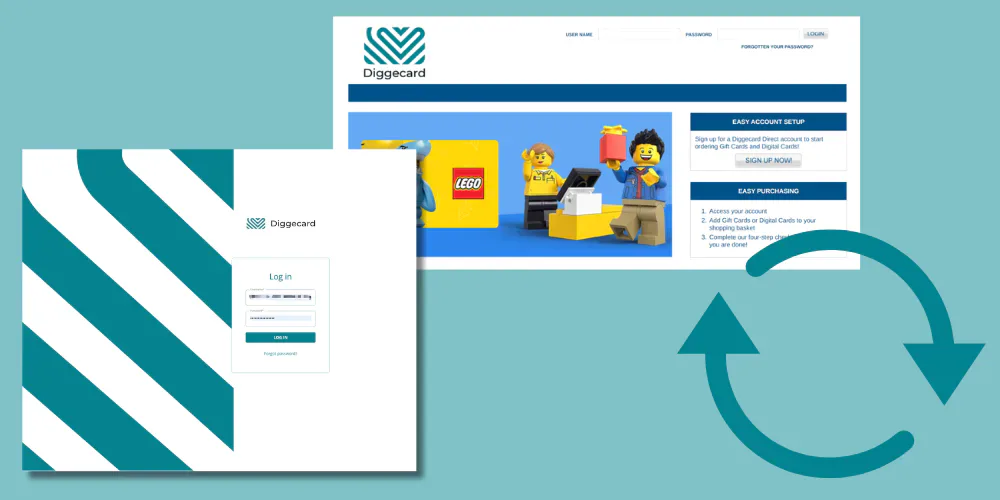
Diggecard announced on June 10, 2026, that it would retire Diggecard Direct by the end of the month and move business customers to its Customer Portal. The change combines account management and gift card ordering tools in a replacement interface, with some capabilities requiring activation. [S01]
The immediate issue for customers is continuity: an account existing in the new portal does not necessarily mean every ordering function has been enabled. Behind that operational detail is a familiar supplier decision about how much service to handle through staff and how much to put into customers’ hands.
A distributor with several fulfilment models
Diggecard supplies physical and digital gift cards to businesses and agencies running rewards, incentives and benefit programmes. Its business services include bulk delivery to one recipient, personalised delivery to end recipients, API fulfilment and blank physical cards loaded on demand. Those are different fulfilment processes, even when the underlying retail brand is the same. [S02]
A portal for that business needs to do more than display a catalogue. It sits between the buyer’s approved account, the products that buyer can order and the delivery method used for a campaign. Combining those functions can make repeat purchasing easier, but only if the permissions match the customer’s existing needs.
What was available and what needed activation
The migration notice says portfolio browsing, requests to add products, downloadable brand assets, help and contact tools were already available. Bulk physical and digital ordering, individual digital fulfilment and physical-card loading or top-ups were listed as capabilities customers could request. Diggecard said most customers had been set up but should confirm access. [S01]
This is a controlled migration rather than a promise that every feature automatically appears for every user. That distinction matters for agencies preparing a campaign against a fixed delivery date. A missing permission can interrupt an otherwise routine order even where registration is complete.
The commercial reason to consolidate
Diggecard describes the investment as a way to improve functionality and self-service. The underlying operating logic is that repeatable tasks, such as finding product assets or placing a standard order, do not always need an account manager to relay them. [S01]
If customers can complete more of those tasks themselves, the supplier can potentially handle additional ordering activity without an equivalent increase in manual servicing. Staff may then spend more time on exceptions or programme development. The company has not published a cost-saving figure or a measured reduction in support requests.
The transition also creates work for both sides. Customers must confirm that their ordering routines function in the new environment; Diggecard must support account activation and exceptions. Consolidation has an initial servicing cost before any efficiency benefit can be realised.
The June notice did not quantify customer adoption, transaction growth or the migration’s financial return. Its significance is the replacement of an ordering channel at the centre of the B2B relationship. Whether the investment improves that relationship will be visible in reliable fulfilment and fewer avoidable interruptions, not simply in the number of features listed.
In this article

Maya Bennett
Maya Bennett covers customer loyalty, employee rewards and incentive programmes for Gift Card News.