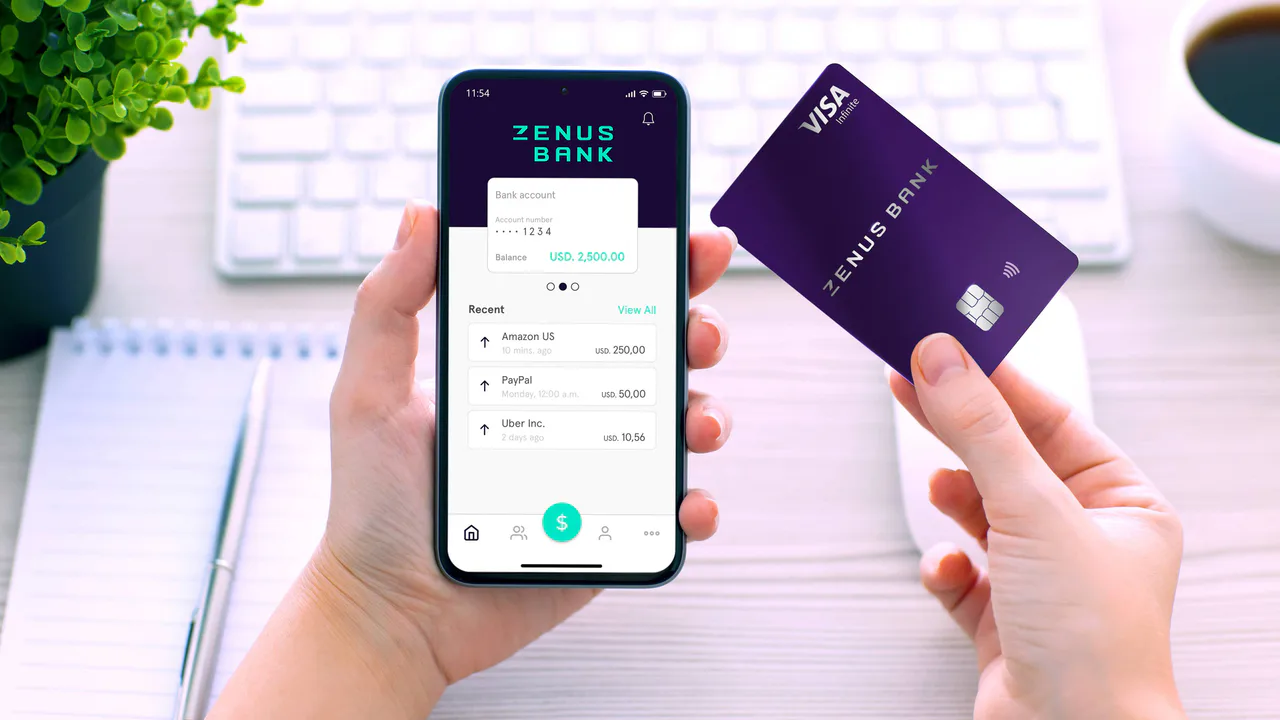
Zenus Bank announced on July 22, 2025 that its dedicated retail banking platform would close on October 22, 2025. The original announcement paired that timetable with a commitment to continue serving institutional and fintech partners, concentrating the business on accounts, payments, card issuance and compliance infrastructure delivered to other organizations.
The distinction remains important when reading older material about the bank. A historical account of opening a Zenus retail account belongs to a different distribution model from a current institutional program using Zenus infrastructure. The bank can move behind a partner's brand while still providing the underlying financial service.
Zenus's later 2026 report shows why a change in distribution should be distinguished from the people ultimately using the service. In the portfolio covered from September 2025 to August 2026, individual accounts represented 93.5% of end-user accounts, with corporate and other non-individual accounts accounting for 6.5%. End-user usage analysis, page 16.
Individuals still account for 93.5% of end-user accounts
The 2026 portfolio is measured at end-user level within the institutional and partner-led model.
%
Tap or hover for details. All values are also available in the data table.
Source
This measures the end-user account base, not the bank's direct institutional customer count. It does not imply that the former dedicated retail platform remained open.
Show data tableHide data table
| Category | Share of end-user accounts |
|---|---|
| Individual accounts | 93.5% |
| Corporate and other non-individual accounts | 6.5% |
CEO José A. Díaz-Ortiz framed the July 2025 decision as a concentration on scalable financial infrastructure for businesses worldwide. His account linked the withdrawal of the direct retail platform to investment in the services institutional and fintech partners already used. Source announcement.
The infrastructure strategy preceded the retail deadline
The move did not begin with the closure notice. Core banking provider Tuum announced on October 16, 2024 that Zenus had gone live with its Accounts and Payments modules, integrated with the bank's technology and existing vendors. The stated purpose was to let banks, fintechs, super apps and businesses embed U.S. banking services in their own offerings.
That chronology helps explain the transition: building and commercializing an institutional platform, then setting a deadline for withdrawing the direct retail channel, are separate milestones. It would be inaccurate to treat the October 2025 closure date as the day the infrastructure business was invented or as evidence that the underlying bank ceased operating.
Tuum described the implementation as supporting opportunities across more than 120 countries at the time of its 2024 announcement. Zenus used a figure above 130 countries in the July 2025 closure release. These are dated statements of service reach, rather than directly comparable counts of active customers or local banking licenses.
The 2026 report measures the geographic composition of the resulting portfolio separately from the older service-reach announcements. Asia represents 42.75%, followed by Latin America and Europe. These are shares of the reported portfolio, rather than a count of markets where a service could be offered. Regional portfolio breakdown, page 14.
Asia is the largest region in the reported portfolio
The geographic analysis describes where accounts are represented during the 2026 reporting period.
%
Tap or hover for details. All values are also available in the data table.
Source
Uses the report's regional breakdown on page 14. Asia and Oceania are shown separately; this differs from the Asia-Pacific grouping used in the gender analysis.
Show data tableHide data table
| Category | Share of portfolio |
|---|---|
| Asia | 42.75% |
| Latin America | 20.09% |
| Europe | 19.36% |
| Middle East and Africa | 9.29% |
| North America | 7.21% |
| Oceania | 1.30% |
What changes when the bank moves behind another brand
Show data tableHide data table
| Direct retail platform | Partner-led infrastructure model |
|---|---|
| A customer enters through the bank's own retail experience. | A customer may enter through a fintech or other partner's product. |
| The bank manages its own retail distribution proposition. | The bank supplies agreed banking capabilities for the partner's proposition. |
| The visible product is the account and its direct customer journey. | The purchased capabilities can include accounts, payment access, issuing and controls. |
| A platform closure requires instructions for direct account users. | A partner relationship requires defined responsibilities, records and continuity arrangements. |
This changes the route to the customer, rather than making the banking responsibilities disappear. An app may provide account access, a processor may handle card messages and a bank may maintain the account and regulatory controls. The precise allocation depends on the arrangement, so the brand seen on a screen cannot by itself establish where money is held or who must resolve a payment problem.
The enterprise services retained by Zenus are connected but distinct. An account organizes balances and payment activity. BIN sponsorship supports a card program using the bank's issuing relationship. A payment connection moves value through an enabled network. A fintech may need several of these services together, while still managing its own product and customer communications.
The individual end-user base in that later report is concentrated among younger and working-age adults: 44.2% are aged 18 to 30 and 38.2% are aged 31 to 45. The figures describe who is reached through the current model and do not attribute demographic changes to the retail-platform closure. Individual age profile, page 17.
82.4% of individual end-users are aged 18 to 45
The age profile describes the individual users reached through the bank's current model.
%
Tap or hover for details. All values are also available in the data table.
Source
2026 report age bands reproduced as published. This is a profile of users, not evidence that the retail exit caused a demographic change.
Show data tableHide data table
| Category | Share of individual end-users |
|---|---|
| 18-30 | 44.2% |
| 31-45 | 38.2% |
| 46-59 | 13.7% |
| 60+ | 3.9% |
The commercial agreement makes the retained banking relationship concrete
Zenus's commercial client agreement, effective July 23, 2025, says the account supports holding, sending and receiving money. It requires identification and verification, allows the bank to determine eligibility, and sets conditions under which deposits or payments may be held, rejected or returned. That is a more concrete description of the retained banking relationship than the umbrella term banking-as-a-service.
The agreement also explains the bank's full-reserve approach: customer deposits are not lent to other customers. It says account balances do not earn interest and identifies account fees as part of the commercial offering. Those public account terms do not disclose the pricing or contractual structure of every institutional program.
The regulatory identity remains material through the distribution change. Zenus's legal disclosures identify it as an International Financial Entity under OCIF supervision in Puerto Rico, license IFE-061. The bank states that it is not FDIC-insured. Full-reserve operation and federal deposit insurance describe different protections, and that distinction belongs in a clear description of any underlying banking arrangement.
The reported card portfolio gives another view of the capabilities distributed through the bank's infrastructure. Visa Debit Classic makes up 65.5%, while the three credit categories together make up the remaining 34.5%. The report identifies credit purchasing, signature and classic products separately. Card portfolio composition, page 13.
Debit cards lead a portfolio that also includes three credit products
The report identifies the product composition of the card portfolio supported by Zenus infrastructure.
%
Tap or hover for details. All values are also available in the data table.
Source
Shares describe card products in the reported portfolio. They do not establish which products are available to every partner or country, or how any credit program is funded.
Show data tableHide data table
| Category | Share of card portfolio |
|---|---|
| Visa Debit Classic | 65.5% |
| Visa Credit Purchasing | 19.7% |
| Visa Credit Signature | 13.9% |
| Visa Credit Classic | 0.9% |
The institutional operating model in 2026
By June 11, 2026, the bank's Celent award announcement described a $75 billion annualized payment-volume run rate, a network of more than 1,300 financial institutions and partners, and access to embedded U.S. accounts in over 180 countries. It also reported partner onboarding below one week and more than 6,000 monthly compliance investigations.
These figures provide operating context for the partner-led model. They do not establish revenue, profit or an audited annual payment total. Nor should the newer country figure be divided by the older figures to manufacture a growth rate: the releases do not provide a common definition, a consistent eligible-country list or an active-customer count for such a calculation.
What the disclosures do show is the bank's continuing emphasis on onboarding institutions and supporting services they distribute. The relevant proof points have moved toward the ability to get a partner operating, maintain controls across payment activity and deliver the banking capabilities its product requires.
The responsible-banking analysis also distinguishes reach from representation. Its 2026 gender indicator reports women's share of individual end-users within each region, ranging from 20.3% in Latin America and the Caribbean to 9.1% in the Middle East and Africa. This adds a demographic perspective to the bank's partner-led distribution. Regional gender indicator, page 41.
Women's representation varies across regional end-user bases
The report's gender indicator shows the share of women among individual end-users within each region.
%
Tap or hover for details. All values are also available in the data table.
Source
Each value uses the individual end-user base in that region as its denominator. These are representation measures, not a measured effect of the platform closure or proof of financial-inclusion outcomes.
Show data tableHide data table
| Category | Women among individual end-users |
|---|---|
| Latin America and Caribbean | 20.3% |
| Europe | 16.7% |
| North America | 15.2% |
| Asia-Pacific | 11.3% |
| Middle East and Africa | 9.1% |
Why bank-fintech responsibilities deserve attention
The importance of that operating structure extends beyond Zenus. In their July 2024 industry statement on third-party deposit arrangements, the Federal Reserve, FDIC and OCC discuss how fragmented functions and insufficient access to records can make it difficult for a bank to identify its obligations and preserve end-user access.
The bank account, the record of each customer's balance and the service handling a disputed payment need to remain connected. Continuity arrangements also need to preserve the information required to operate the service if a technology provider becomes unavailable. Those responsibilities become part of the product when banking is distributed through another company.
The FDIC's explanation of banking through third-party apps likewise stresses identifying the bank behind an interface and understanding the conditions attached to insurance claims. It reinforces the importance of describing the customer-facing brand and the underlying financial arrangement together.
The relevance to rewards and prepaid programs
For an incentive or disbursement provider, the partner model offers a way to combine customer distribution with underlying banking and card services. Zenus's current card proposition describes U.S.-originated Visa programs, BIN sponsorship and a choice of processor. Those capabilities are relevant to evaluating issuing infrastructure, but they are not evidence of a named Zenus gift-card program or permission to offer every product in every market.
The strategic change therefore needs a precise description: Zenus set a dated exit from its dedicated retail platform and concentrated on services other institutions can incorporate into their own products. The quality of that model is ultimately experienced through reliable funding, accurate balances, well-handled exceptions and clear responsibility. Those are the operating consequences behind the change in distribution.
In this article

Oliver Reed
Oliver Reed covers industry acquisitions, investment and market research for Gift Card News.