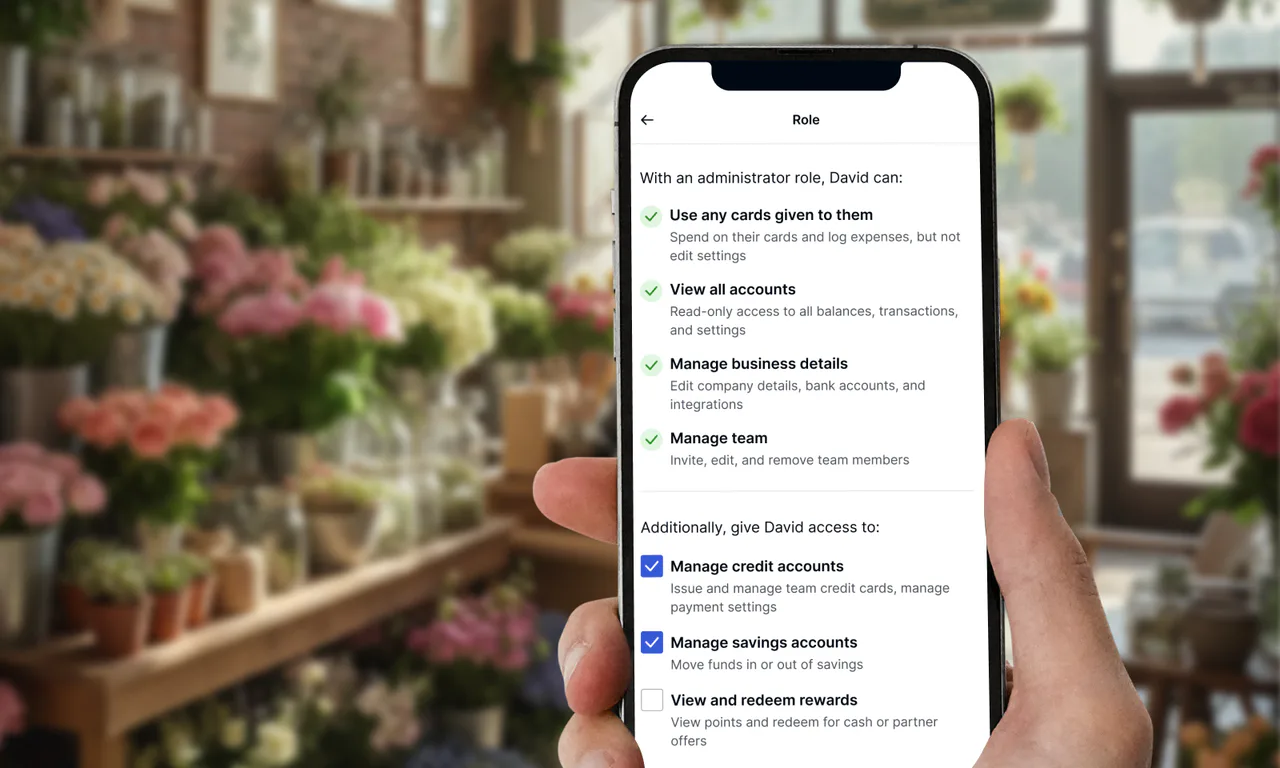
Capital on Tap has added a permission that lets authorised team members redeem business card points for gift cards, cashback or travel rewards. Its product announcement was first published on November 3, 2025 and revised on June 17, 2026; the description below reflects that updated version. [S01]
The change gives rewards administration its own place in the company's system of delegated account access. An employee's ability to spend on a company card does not, by itself, describe who should be able to dispose of the resulting reward balance.
Where rewards access sits
Show data tableHide data table
| Base role | Core scope described by Capital on Tap | Additional rewards permission |
|---|---|---|
| Administrator | Account visibility, business settings and team management | Can be granted separately |
| Accounts | Account visibility and accounting exports or integrations | Can be granted separately |
| Employee | Assigned cards and the individual's own activity | Not listed for this role |
The company lists rewards redemption as an advanced permission for Administrator and Accounts users. Credit-card management and savings-account management are separate permissions. Owners can assign access when inviting someone or edit an existing team member's role. [S01]
From points to a usable reward
Capital on Tap's current rewards information, reviewed in July 2026, describes points becoming available after purchases clear. Customers choose a redemption route in the app or online account, with gift cards among the options. The rewards history displays earnings, bonuses, redemptions and adjustments. These current product details provide context; they are not evidence that every option had identical terms in November 2025. [S02]
For a business, the distinction is practical. Granting someone permission to organise expenses is a different decision from allowing that person to exchange accumulated rewards. The feature gives an owner a way to make those decisions separately.
An access change, not a measured outcome
The announcement does not quantify adoption, administrative time saved or additional gift card redemptions. Those would require separate evidence. Its concrete contribution is a more explicit boundary around who can manage the rewards balance. [S01]
For gift card distributors, that boundary matters because redemption is often the final step in a longer business workflow. Making that step available to an authorised colleague can change who operates the account without changing the nature of the underlying reward.
In this article

Daniel Brooks
Daniel Brooks covers payment networks, financial technology, payment security, gift card fraud and PCI DSS for Gift Card News.