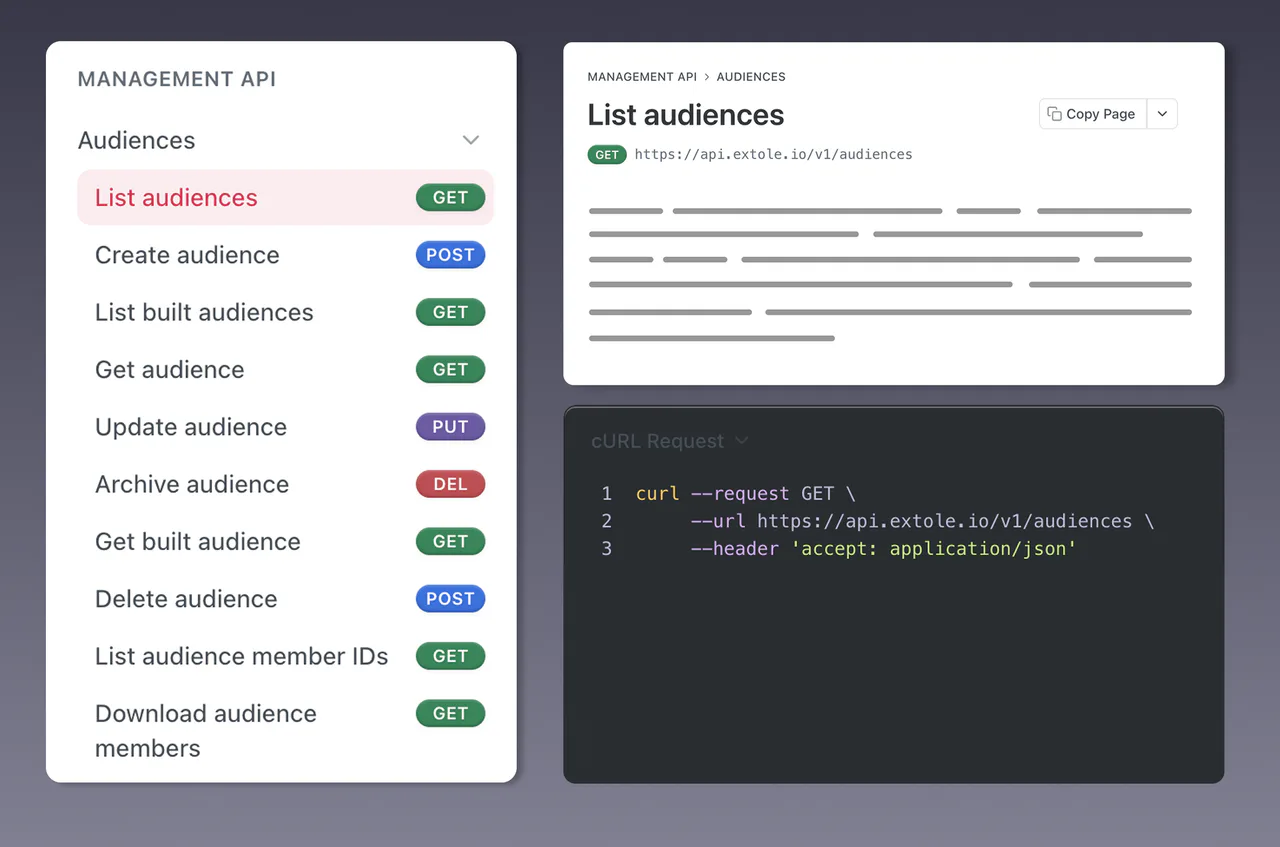
Extole's August 13, 2026 developer overview describes how referral and reward functions can operate inside a company's own website, app and business systems. Gift card delivery is one possible result of that connection, with events and eligibility rules deciding when value is owed. [S01]
The business behind the interface
Extole sells an offer-management platform built around customer referrals and engagement. Its company positioning is to help brands use their existing customer relationships as a source of acquisition, rather than relying only on purchased media. [S02]
An API makes that service less dependent on a separate dashboard. The customer can keep its own interface while sending activity to the provider and receiving reward information back.
That is commercially attractive to a brand with an established app or checkout. It can add a referral mechanism without moving the entire experience elsewhere. For Extole, it means becoming part of the customer's operating systems, potentially supporting more programmes through the same relationship.
The integration is not free operational capacity. The buyer still supplies reliable customer events, maintains its connection and decides which activity deserves a reward. The overview does not disclose implementation charges or ongoing fees.
What the interfaces actually divide
Extole separates backend integration, consumer-facing integration and management functions. The first handles server operations, the second supports participant experiences, and the third configures the platform. [S01]
That division lets different systems perform different jobs. It also makes responsibility important: an event received from a customer's checkout is evidence supplied by that customer, not an independent guarantee that the underlying transaction is valid.
Extole's reward-webhook documentation says messages can arrive out of order or more than once. It requires the receiving system to avoid processing a repeated event as a second action. [S03]
This is a material business detail, not merely developer housekeeping. Where an event leads to value being issued, duplicate handling can become duplicate cost. Reliable automation needs to preserve the distinction between retrying a message and paying again.
Scale has defined operating conditions
The August overview specifies limits of 100 requests per minute per IP address or token and 10 per second per identified person, with a separate asynchronous route for high-volume event ingestion. [S01]
Those details are more useful than a general promise of unlimited scale. They show that real-time and bulk activity may follow different paths, which can affect when a customer sees a reward or an operational team sees a result.
A connected system can remove repeated manual handoffs, but errors can also travel further before someone notices. Accurate reconciliation remains necessary when an order changes, a reward fails or a participant disputes eligibility.
The commercial rationale is to give brands control over their customer experience while outsourcing the offer machinery. Its success depends on lower administrative effort and dependable delivery, not on API access alone.
Extole's documentation supports the mechanism. It does not establish a standard saving, faster customer acquisition or a guaranteed improvement in the profitability of a gift card incentive.
In this article

Oliver Reed
Oliver Reed covers industry acquisitions, investment and market research for Gift Card News.