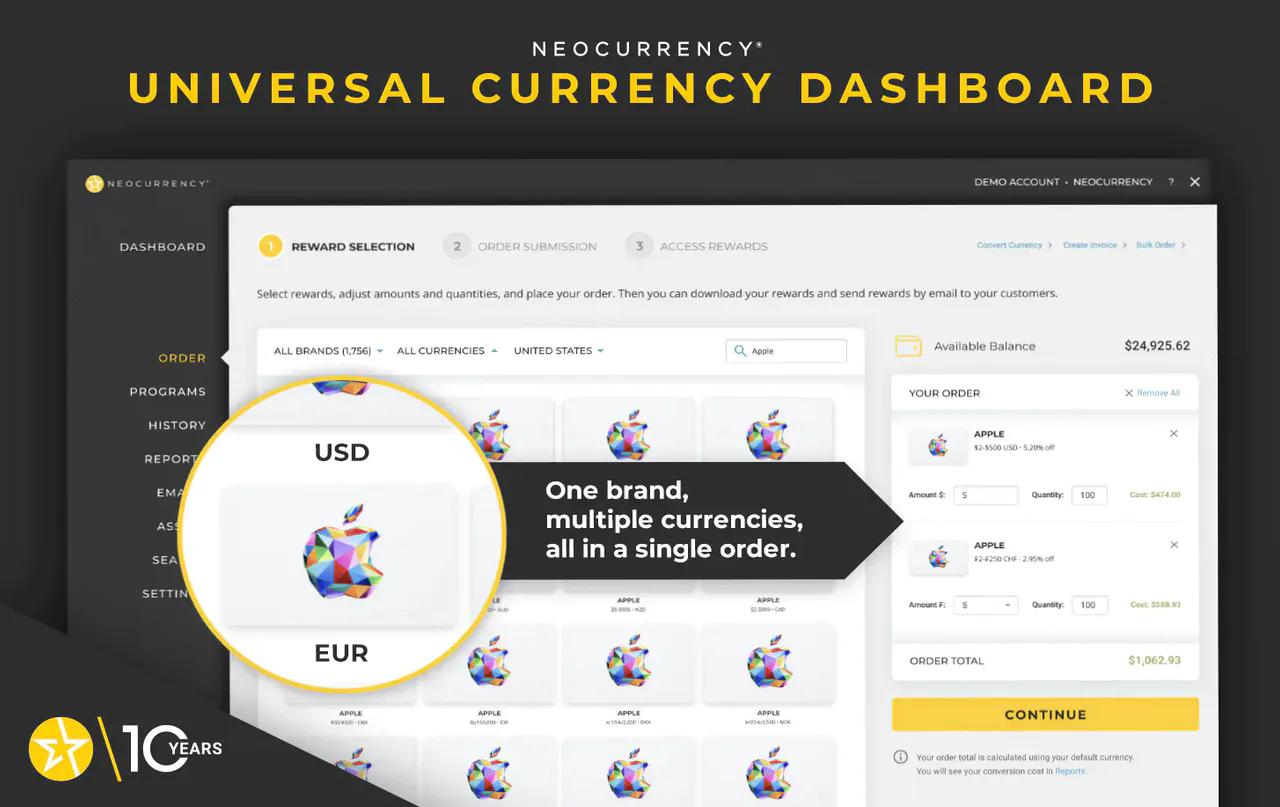
NeoCurrency introduced its Universal Currency Dashboard and API on February 10, 2026, allowing business customers to fund one account and order rewards in other supported currencies. [S01]
The launch identified funding options as US and Canadian dollars, sterling, euros and Australian dollars. Conversion happens during ordering, and bulk files can combine different brands and currencies. [S01]
Why the funding layer matters
Chief executive Geoff Miller pointed to research companies rewarding participants across countries as one use case. Such programs need useful local incentives ready when participants finish. [S01]
Consolidating funding can reduce the number of separate balances a program team monitors. It can also make a single international campaign easier to reconcile. Those are operational advantages; they do not establish that foreign-exchange costs disappear or that the platform gives every recipient identical purchasing power.
NeoCurrency's February release does not specify the exchange-rate benchmark, spread or timing convention used for conversion. Current pricing, checked October 18, adds an important qualification to broad no-fee language: payments using one of its 28 banking currencies have no assessed FX payment fee, but moving funds across currencies with its self-service conversion tool carries a 0.9% cost. These are different funding paths; the current terms do not establish the exact February tariff or the all-in exchange-rate cost. [S03]
The two rates concern the applicable payment amount or converted amount in each named path. They do not compare identical FX transactions and do not quantify savings against a bank or another provider. The public material still leaves the underlying exchange-rate benchmark and spread unspecified.
NeoCurrency published currency-handling charges by funding path
Current public pricing observed October 18, 2026, not verified February launch pricing.
% of applicable funds
Tap or hover for details. All values are also available in the data table.
Source
Different funding paths and applicable amounts. Not a total FX cost, exchange-rate spread, savings estimate or proof of the February 2026 tariff.
Show data tableHide data table
| Category | % of applicable funds |
|---|---|
| Eligible banking-currency payment | 0.0 % of applicable funds |
| Self-service cross-currency conversion | 0.9 % of applicable funds |
The distributor behind the dashboard
The US-based provider, established in 2016, reported coverage of 51 currencies and 140 countries in February. It distributes rewards for business programs. [S01]
A separate product, Reward Choice, shows how the company packages that distribution role. Buyers can configure a selection of reward brands, leaving the recipient to choose. The product page describes wholesale pricing and handling brand creative approvals, placing procurement and marketing administration alongside the delivery itself. [S02]
Dated announcements give a same-product view of the distributor's reach: Reward Choice was offered in 50 countries in April 2023 and listed in 65 in the February 2026 table. These are provider-reported availability counts, not customer adoption, orders or a measured effect of the new dashboard. Undated product pages contain different coverage descriptions and are not treated as a time series. [S01] [S04]
Reported Reward Choice country availability
April 11, 2023 and February 10, 2026 company announcements.
countries
Tap or hover for details. All values are also available in the data table.
Sources
Company-reported countries supported, not customers served, active markets, transaction volume or dashboard-driven growth. Later undated website counts are not used.
Show data tableHide data table
| Category | countries |
|---|---|
| April 11, 2023 | 50 countries |
| February 10, 2026 | 65 countries |
Those services can make a distributor useful even when a buyer could purchase individual cards elsewhere. An employer or research agency is acquiring coordination across brands and markets, not just a code with a balance.
One account does not mean one global gift card
The distinction between funding currency and redemption currency remains important. A centralized order can contain several local products without turning any of those products into a card accepted across every country. A balance denominated in one currency still has to meet the selected reward's conditions.
The launch table illustrates the difference between one funding account and local reward products. It listed the selected brands below in different numbers of reward currencies. That describes catalogue availability; it does not make one card interchangeable across every listed currency or establish equal local purchasing power. [S01]
Reward currencies listed for selected brands at launch
February 10, 2026 original release table.
currencies
Tap or hover for details. All values are also available in the data table.
Source
Provider-reported catalogue availability, not redemption rates or a card usable in every currency. Local product eligibility and terms remain separate.
Show data tableHide data table
| Category | currencies |
|---|---|
| Nike | 5 currencies |
| Airbnb | 9 currencies |
| Apple | 14 currencies |
| Amazon | 16 currencies |
| IKEA | 17 currencies |
Likewise, equal converted amounts are not a complete measure of fairness. Local prices and available merchants affect what the recipient can actually buy. That is a program-design issue alongside the currency mechanics.
For NeoCurrency, reducing the work of international ordering supports a clear commercial objective: make it easier for clients to put more of a multinational reward program through one provider. A convenient funding workflow can become a reason to retain that relationship across campaigns.
The release reports no customer adoption totals, conversion savings or incremental revenue from the dashboard. Its significance lies in removing a funding and reconciliation hurdle from an established gift card distribution business, while leaving product eligibility and foreign-exchange economics as separate considerations.
In this article

Emma Carter
Emma Carter covers retail, e-commerce and the gift card shopping experience for Gift Card News.