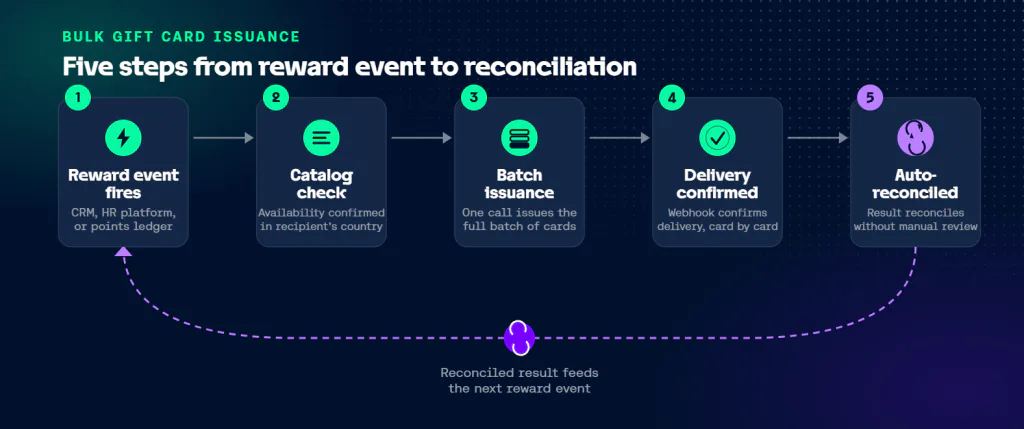
Reloadly has set out the operating requirements it considers necessary for bulk gift card distribution through an API. Its August 19, 2026 guide connects reward events in CRM, HR or points systems to catalog checks, card delivery and financial reconciliation.
The company describes a sequence in which an approved reward first triggers a check of the requested brand, denomination and recipient country. The order is then processed, delivery is reported through a webhook, and the resulting transaction is linked back to the event that authorized the reward.
The guide focuses on the problems that appear when a program moves from individual orders to large batches. Product availability may change between selection and purchase, some orders may complete while others fail, and an uncertain response can prompt an application to submit the same reward again.
Reloadly recommends defining how those exceptions will be handled before distribution begins. If a brand is unavailable, the program can use a comparable option that has already been approved. If only part of a batch fails, the retry should cover the failed portion rather than repeat successful orders. A missing webhook should lead to an order-status query instead of an assumption that nothing was issued.
The article describes idempotency keys as a way to distinguish a repeated request from a new purchase. It points to Stripe's documentation to explain that general engineering pattern; that reference is not an announcement of a Stripe partnership with Reloadly.
For international rewards, the guide says reconciliation records should identify the transaction, card currency, any exchange rate used, recipient country and brand, and the original reward reference. Keeping those details together lets finance match the payout without rebuilding its history from separate exports.
Reloadly says its catalog spans more than 150 countries, over 1,000 brands and more than 14,000 gift card products. It advises partnerships teams to assess the selection in their actual target markets, the reporting of partial failures and the format of finance records, rather than relying only on headline catalog size.
The guide cites Kani Payments' 2025 survey of 250 UK payments and banking businesses, in which 56% reported using spreadsheets for reconciliation. That is wider payments-sector context, not a measurement of Reloadly users or of gift card programs alone. The article's practical focus is reducing those manual reconciliation steps in bulk rewards distribution.
Sources and documents
Collapse
In this article

Oliver Reed
Oliver Reed covers industry acquisitions, investment and market research for Gift Card News.