Reloadly's August 25 argument for changing gift card suppliers begins with a commercial obstacle rather than a technical one: the buyer may already be committed to a catalogue, contract and operating process that cannot be replaced on the date a new API becomes ready. [S01]
That is a competitive sales proposition with a real underlying issue. A new supplier can offer attractive terms, but the customer must still account for the cost of leaving the old arrangement and keeping outstanding rewards usable.
An established distribution model
Reloadly supplies infrastructure intended to operate inside other businesses' products. TheVentureCity's 2019 description of the company already emphasised an interface that could be embedded in websites and mobile applications. [S02]
A successful integration can make that relationship durable. The client may build its own pricing, customer promises and support processes around the supplier's available products. Winning the account then means displacing more than a technical connection.
For Reloadly, explaining migration can help convert interest into an actual transfer of purchasing volume. The source does not name a customer that has moved, quantify a competitor's losses or disclose the value of a contract won through this approach.
The catalogue is part of the customer's promise
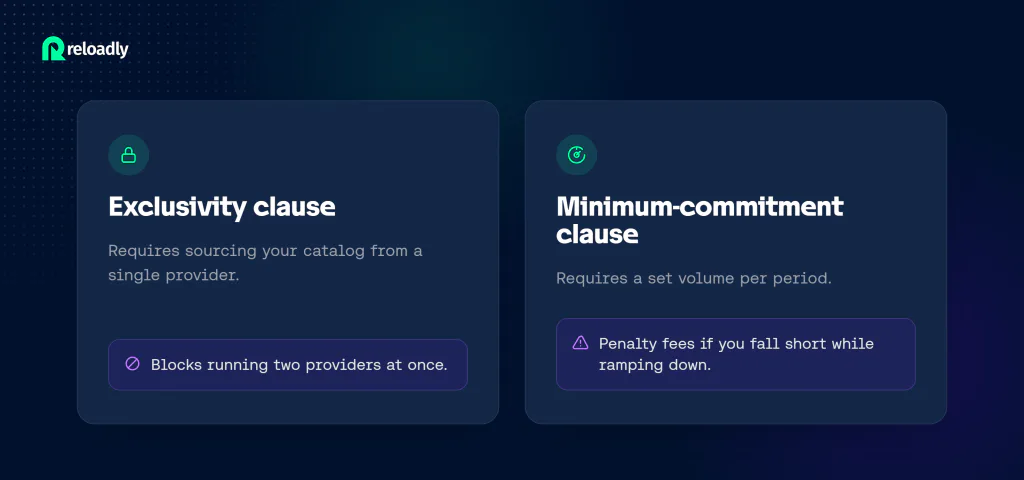
The commentary emphasises matching country, currency, denomination and availability against the rewards a business already sells. It also discusses contract exit provisions, minimum purchasing commitments and circumstances in which exclusivity can affect a transition. [S01]
These are considerations raised by the supplier, not findings about every contract in the industry. The precise effect depends on the agreement involved.
The economic problem is broader than choosing the lower headline price. If a replacement catalogue lacks a frequently purchased product, the distributor may lose sales or have to maintain another supplier for that gap. If both arrangements operate during a transition, temporary duplicated expense can delay the expected saving.
A technical cutover also leaves earlier orders behind it. Customers may ask about a code purchased before the switch, and finance may still need the old transaction record after new volume has moved elsewhere.
Outstanding value does not disappear
Reloadly's own corporate terms distinguish a limited cancellation opportunity from products already redeemed, with restrictions and discretion applying to later refunds. [S03] That illustrates why an issued reward cannot be treated like an unused software setting when a supplier relationship changes.
The buyer's responsibility to recipients continues across the transition. Preserving support information and a usable redemption path is therefore part of the commercial cost of moving, not an optional administrative detail.
For gift card providers, this explains both the attraction and the difficulty of winning an incumbent account. Recurring volume can be valuable precisely because the relationship contains accumulated operational dependencies.
Reloadly's pitch asks buyers to make those dependencies visible before deciding. A switch creates value only if better service or pricing outweighs migration expense and any lost catalogue utility. The August material identifies that calculation; it does not establish a universal saving. This is journalistic analysis of the commercial issues, not legal advice on a particular agreement.
In this article

Emma Carter
Emma Carter covers retail, e-commerce and the gift card shopping experience for Gift Card News.