Reloadly has described its approach to reconciling gift card orders when the currency presented to the customer differs from the currency used for settlement. The company's July 2026 guide focuses on keeping the original sale, exchange rate and settlement record connected throughout the payout process.
The guide distinguishes presentment currency, which the customer sees at purchase, from settlement currency, in which the distributor receives the relevant funds. It uses cross-border gift card transactions to illustrate how a finance team can otherwise end up comparing figures expressed in different currencies.
Reloadly identifies timing differences, limited access to accounts in every currency and the growth of a multi-market operation as sources of reconciliation work. Its examples include arrangements where the settlement occurs after the sale, exposing a difference between exchange rates at the two points. The timing described depends on the commercial arrangement behind the transaction.
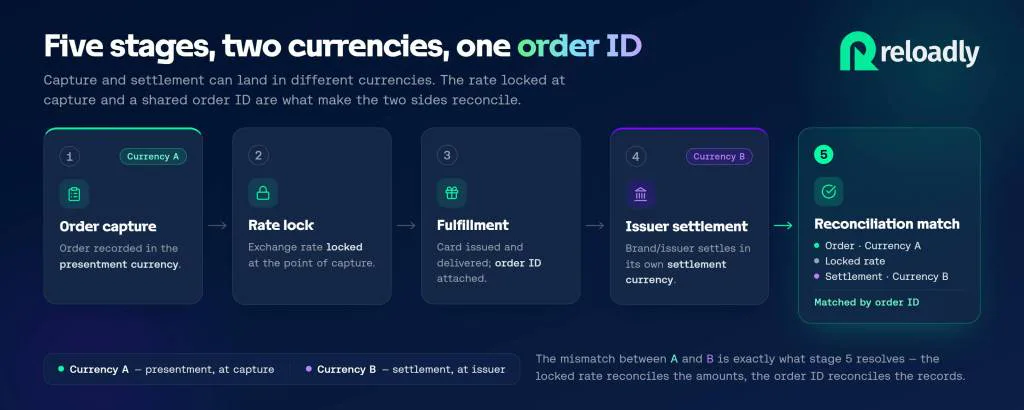
The company sets out five stages in its API workflow. It says the order is captured with its presentment currency and timestamp, an exchange rate is fixed for that order, and the gift card is fulfilled with the order ID retained. The settlement record is then matched to that original order and rate using the same reference.
According to Reloadly, the resulting records distinguish settled transactions, pending transactions and orders showing a rate difference. It also says foreign exchange gains or losses are recorded separately from product revenue at order level. Fixing the rate used for reconciliation does not remove subsequent currency movements; it makes the difference identifiable in reporting.
The provider describes coverage spanning more than 150 countries and settlement across more than 100 currencies. These are the company's stated coverage figures in the guide, which presents the reconciliation process as part of its broader gift card API service.
For businesses comparing suppliers, Reloadly highlights three questions: when the order's exchange rate is fixed, whether foreign exchange reporting is separate from product revenue, and whether one transaction reference survives from sale through settlement. Those details determine how readily a finance team can trace a payout discrepancy back to the original gift card order.
Sources and documents
Collapse
In this article

Maya Bennett
Maya Bennett covers customer loyalty, employee rewards and incentive programmes for Gift Card News.