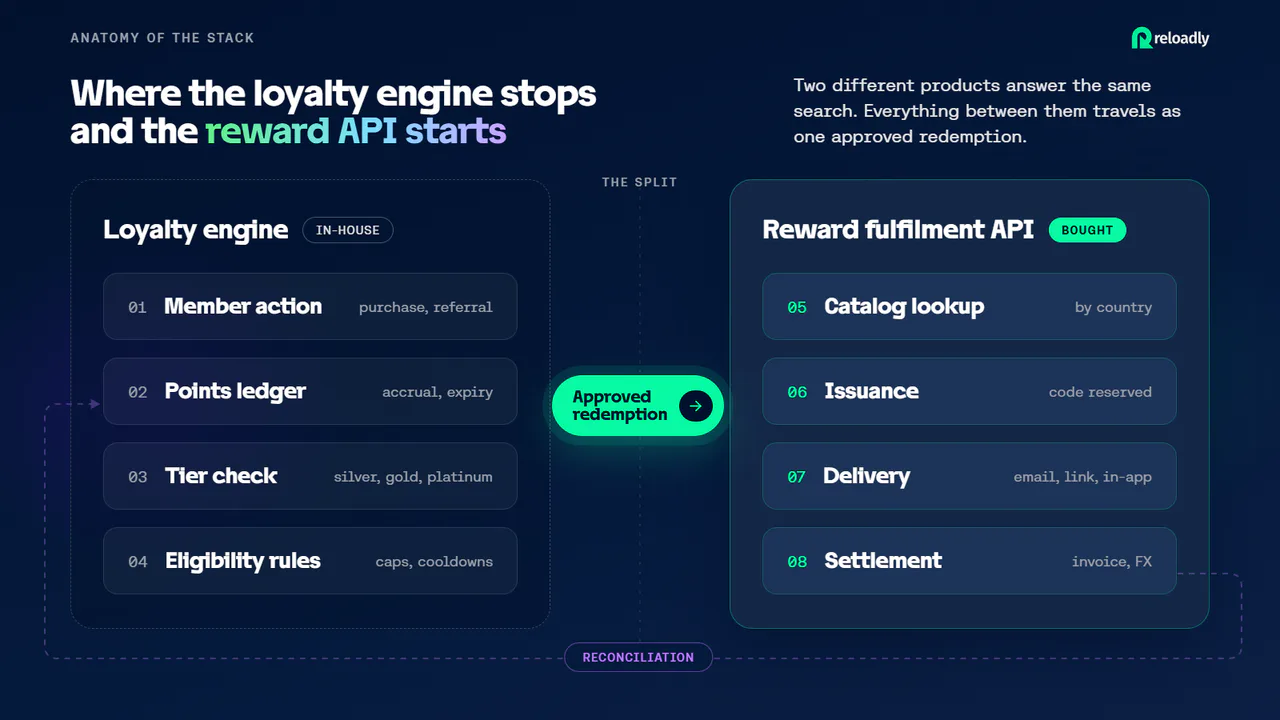
Reloadly has published a guide separating two services often described as a loyalty program API: the engine that manages points and eligibility, and the fulfillment service that delivers a reward after redemption is approved. Its September 2, 2026 article focuses on how businesses should assess the second service.
A loyalty engine maintains member records, balances, tiers and promotion rules. A reward fulfillment API handles the catalog and the delivery and settlement of gift cards, prepaid cards or mobile top-ups. Reloadly argues that businesses can retain their own loyalty logic while connecting an external provider for fulfillment, without making that provider the system of record for members' points.
The guide asks buyers to evaluate catalog availability by brand and recipient country. A provider's total brand count may conceal a much smaller selection in a particular market. Reloadly says its catalog contains more than 1,000 brands and 14,000 gift card products, with delivery into more than 150 countries and support for over 100 currencies; it advises buyers to establish which part of that catalog is actually usable for their members.
Delivery reporting and financial matching are another focus. The article recommends examining how orders report their progress, how a repeated request is recognized, and how refunds, unused rewards and batch orders appear in transaction records. Its discussion of idempotency concerns avoiding a second reward when an application retries the same request.
The company also highlights the gap between a reward's local currency and the currency used for settlement. Finance teams need records that connect those amounts to the original order, rather than trying to reconstruct the relationship at the end of the month.
Reloadly cites the Incentive Research Foundation's Industry Outlook for 2026, published in December 2025, as context. That research covered 400 organizations and reported internally managed programs at 84% in North America and 79% in Europe. The guide separately cites Antavo's 2026 loyalty research on unused points and difficulties analyzing program data; these are external studies, rather than Reloadly's own customer results.
The provider assessment also includes sanctions screening, business verification, data residency and the consequences of switching suppliers. A migration may change the brands members can select, making it a program decision as well as a technical integration. Reloadly's guide recommends assessing the whole order and reconciliation process during procurement.
For programs seeking branded prepaid rewards, the article describes Reloadly's Swype Flex offering as a virtual card program carrying the customer's branding. It specifies single-load cards, funded once rather than topped up later. That product description is distinct from the loyalty rules engine that determines when a member earns a reward.
Sources and documents
Collapse
In this article

Daniel Brooks
Daniel Brooks covers payment networks, financial technology, payment security, gift card fraud and PCI DSS for Gift Card News.