South Korea plans to redesign Onnuri gift-voucher incentives around where balances are spent, directing larger benefits toward traditional markets and regional shopping districts. The Ministry of SMEs and Startups announced the reform on October 1, 2026. Its differentiated digital-voucher rates are a proposal for 2027, not rates confirmed as available today.
The proposed refund depends on where the voucher is used
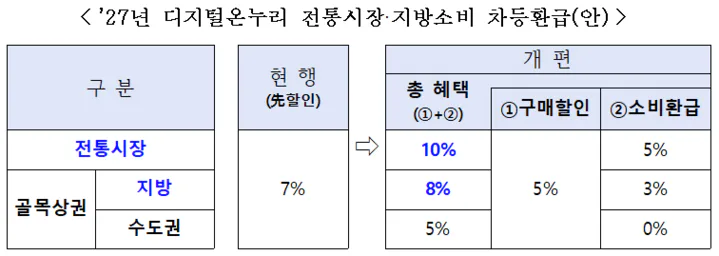
The plan reduces the uniform purchase discount from 7% to 5%, then adds a refund tied to the spending location. Traditional markets would receive a 5% spending refund; neighborhood shopping districts outside the capital region would receive 3%; capital-region neighborhood districts would receive none. The ministry calls the combined benefits 10%, 8% and 5%, respectively.
Proposed 2027 digital Onnuri incentive components
A common purchase discount would be supplemented by different spending refunds according to the acceptance location.
percent
Tap or hover for details. Select a series above to show or hide it.
Source
Announced proposal for 2027, not a live offer. The 0% refund is explicit in the source. The ministry adds the component rates to describe total benefits; this chart does not calculate a compounded return on cash paid or assume unrestricted cash withdrawal.
Show data tableHide data table
| Category | Purchase discount | Refund after spending |
|---|---|---|
| Traditional markets nationwide | 5 percent | 5 percent |
| Regional neighborhood districts | 5 percent | 3 percent |
| Capital-region neighborhood districts | 5 percent | 0 percent |
This makes the destination of spending part of the incentive mechanism. Planned local tourism benefits could include attraction tickets, accommodation vouchers and local-shopping discounts, with local governments designing and funding their own offers. These are proposed links to consumption, not measured increases in merchant revenue.
The reference paper also schedules welfare-point conversion for public-agency employees from January 2027 and proposes reflecting conversion and Onnuri prize distributions in agency cooperation evaluations. Planned Naver and Kakao map cooperation and foreign-visitor QR payments appear in the first-half 2027 schedule. Alipay interoperability is an example in the government paper; that document does not establish a completed new payment-provider agreement.
Merchant-density rules would vary with local fiscal capacity
Neighborhood shopping-district designation determines which clusters can enter the acceptance system. The proposed density requirements are 30 small-business stores for local governments in the top quarter of fiscal self-reliance, 20 for the middle half and 15 for the bottom quarter, within 2,000 square metres. The proposal also applies a 15-store threshold to areas within one kilometre of a traditional market
Continue reading for free.
Create your account or sign in to get unlimited access.
No payment required. Newsletter signup is optional.
Already registered? Sign inIn this article

Emma Carter
Emma Carter covers retail, e-commerce and the gift card shopping experience for Gift Card News.