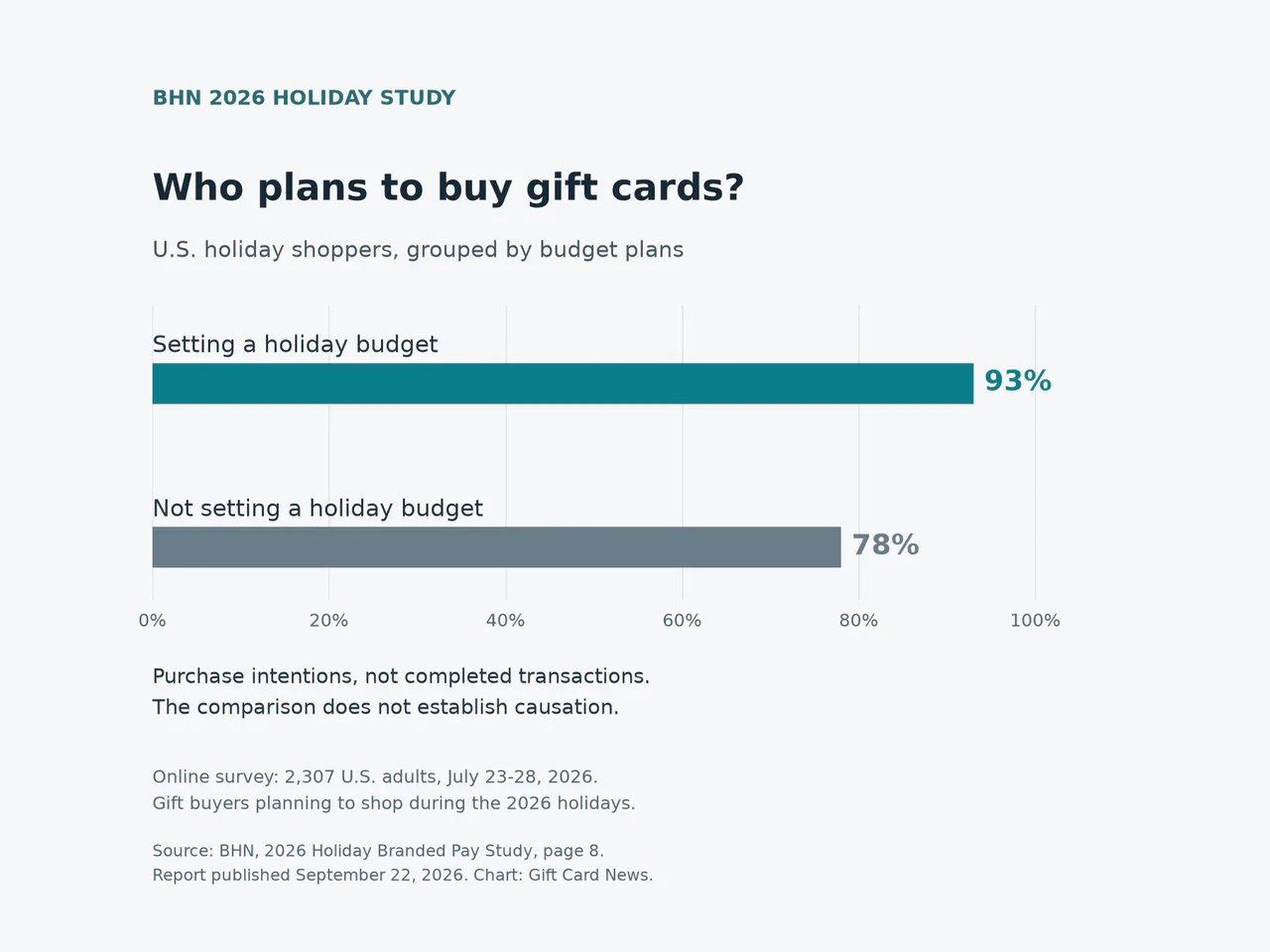
Ninety-three percent of U.S. holiday shoppers who set a budget plan to buy gift cards, compared with 78% of those without a budget, according to Blackhawk Network’s new holiday research. The report, published on September 22 and publicised in an October 5 release, puts gift cards at the centre of a tighter spending plan. [S01][S02][S03]
The company surveyed 2,307 U.S. adults online between July 23 and 28. Respondents had bought gifts during the preceding 12 months and expected to shop during the 2026 holiday season. Eighty-two percent said they were setting a holiday budget. The findings describe those shoppers’ intentions, rather than the general population or completed holiday transactions. [S02]
Smaller budgets, a larger role for cards
Gift-card purchase plans differ with holiday budgeting
Share planning to buy gift cards, among surveyed shoppers with and without a holiday budget. [S01][S02]
%
Tap or hover for details. All values are also available in the data table.
BHN online survey, July 23-28, 2026, of 2,307 U.S. adults 18+ who had purchased gifts in the preceding 12 months and planned to shop during holiday 2026. Recruitment, weighting, item subgroup sizes and margin of error are not disclosed. These are separate budgeting groups, not complementary response categories. Budgeting and card-buying plans are associated; the survey does not establish causation or completed purchases.
Show data tableHide data table
| Category | Plan to buy gift cards |
|---|---|
| Setting a holiday budget | 93% |
| Not setting a holiday budget | 78% |
Average planned spending on holiday gifts was $721, 3% below the previous year’s comparison. Gift cards represented 32% of the overall intended gift budget. Among households earning less than $40,000, planned gift spending was $410, down 13%, with 36% allocated to cards. The corresponding card share was 29% for households earning at least $80,000. [S01][S02]
Lower-income shoppers allocate more of their gift budget to cards
Gift-card share of planned holiday gift spending, by annual household income, from report page 8. [S01]
%
Tap or hover for details. All values are also available in the data table.
Source
BHN online survey, July 23-28, 2026, of 2,307 U.S. adults 18+ who had purchased gifts in the preceding 12 months and planned to shop during holiday 2026. Recruitment, weighting, item subgroup sizes and margin of error are not disclosed. Percentages are allocations within each income group’s intended gift budget, not the groups’ shares of total gift-card sales. Different total budgets mean a higher percentage does not establish higher gift-card dollars. Overall reported allocation is 32%; no respondent-level spend is reconstructed.
Show data tableHide data table
| Category | Planned gift budget allocated to gift cards |
|---|---|
| Under $40,000 | 36% |
| $40,000 to under $80,000 | 34% |
| $80,000 or more | 29% |
A higher allocation to gift cards does not by itself mean higher dollar sales. A larger share of a shrinking gift budget can leave the value spent on cards under pressure. The comparison between budget setters and other shoppers also shows an association, without establishing that setting a budget causes card buying.
Loyalty balances provide another route into gifting
Loyalty balances provide another potential route into the category. Half of respondents planned to redeem most or all of their loyalty points for holiday shopping. BHN reported that 61% of younger shoppers and 55% of older shoppers use loyalty points for gift cards; among those shoppers, 70% intended to give the resulting cards to somebody else. [S02]
Loyalty points fund gift cards in both age groups
Surveyed shoppers using loyalty points for gift cards, reported on page 19 and in the issuer release. [S01][S02]
%
Tap or hover for details. All values are also available in the data table.
BHN online survey, July 23-28, 2026, of 2,307 U.S. adults 18+ who had purchased gifts in the preceding 12 months and planned to shop during holiday 2026. Recruitment, weighting, item subgroup sizes and margin of error are not disclosed. Age definitions are the report’s Gen Z/Millennial and Gen X/Boomer groupings for 2026. The 70% who plan to give resulting cards to others is conditional on point-to-card users and is not an additional population share. The source does not establish an age-group difference is statistically significant.
Show data tableHide data table
| Category | Use loyalty points for gift cards |
|---|---|
| Younger shoppers: ages 18-45 | 61% |
| Older shoppers: ages 46-80 | 55% |
The report defines younger shoppers as ages 18 to 45 and older shoppers as ages 46 to 80. Its global research covered 22,754 consumers in 20 countries, but the figures in this report concern the U.S. sample. It does not disclose recruitment details, weighting or margins of error. [S01]
BHN supplies gift-card issuance, distribution and rewards services, giving it a commercial interest in how holiday value reaches retailers. For programme operators, the findings identify prospective demand from both direct purchases and points redemption. Actual loaded value and completed redemptions will show how much of that interest becomes business. [S02]
The previous holiday peak offers a timing cue
A separate Google Trends check adds historical search context to the operational calendar. In a single U.S. Web Search comparison requested for October 1, 2025 through September 30, 2026, both English terms reached their highest returned weekly score during December 21-27, 2025: 100 for “gift card” and 28 for “gift cards”. These are jointly normalized search-interest indexes, not percentages of holiday shoppers. [S04][S05][S06]
Continue reading for free.
Create your account or sign in to get unlimited access.
No payment required. Newsletter signup is optional.
Already registered? Sign inIn this article

Oliver Reed
Oliver Reed covers industry acquisitions, investment and market research for Gift Card News.