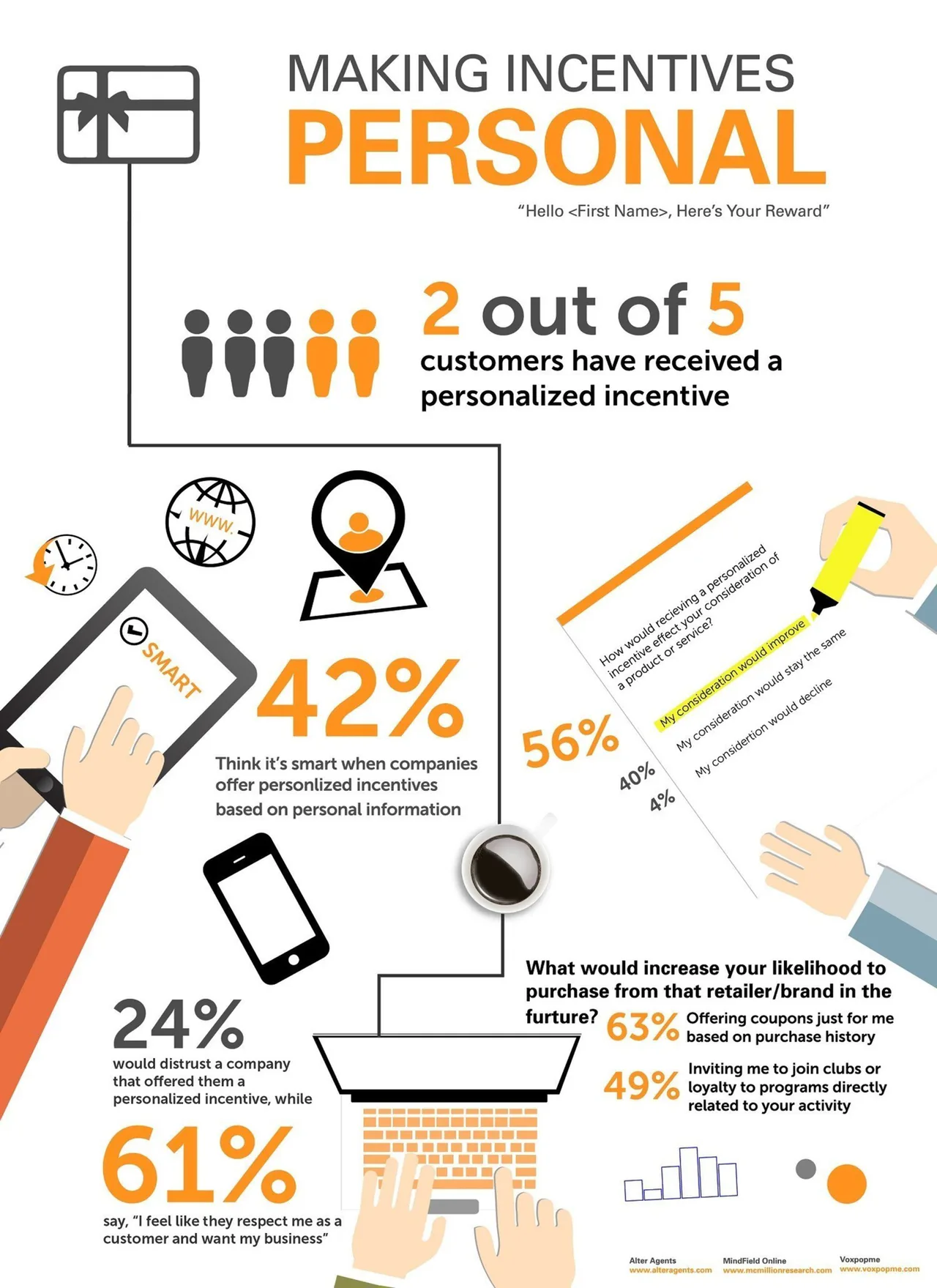
Virtual Incentives released initial research findings on September 19, 2016 suggesting that personalised rewards could improve brand consideration while also creating privacy concerns. The company said 56% of respondents expected a personalised incentive to improve their view of a brand, while one in four considered personalisation a privacy violation. [S01]
Interest does not remove the privacy question
The release also reported that 40% had received a personalised incentive and that one-third preferred a virtual gift card usable across merchants. Alter Agents designed and analysed the study, Voxpopme supplied video-response technology, and MindField Online provided programming and the sample. [S01]
| Finding in the initial release | Reported share |
|---|---|
| Had received a personalised incentive | 40% |
| Expected personalisation to improve brand consideration | 56% |
| Viewed personalisation as a privacy violation | 25% |
These measures describe different questions and should not be added together. They concern reported experience or stated attitudes, not observed changes in spending. A favourable response about a personalised reward does not establish that the respondent bought more or became a more loyal customer.
Two decisions inside one reward
The findings separate the choice of reward from the information used to select or present it. A recipient may value a broadly usable card while still objecting to a message that exposes an unexpected amount of personal knowledge. The commercial attraction of relevance therefore comes with a design question: what makes the recognition feel appropriate to the person receiving it?
For programme operators, the practical issue is how to explain the connection between the customer’s action and the reward. A clear reason for an incentive can make the offer understandable. Additional personal detail does not automatically improve that explanation, and a higher stated preference cannot establish a causal business return.
An initial release with methodological limits
The published announcement did not give a sample size, fieldwork dates, question-level bases or weighting information. It described the findings as the first release from the study and said a fuller paper would follow. [S01] Those omissions prevent calculation of confidence intervals or a reliable assessment of population representativeness.
The figures are therefore best read as reported findings from a 2016 industry study. They identify a tension for reward design, while providing no basis for treating the percentages as current consumer benchmarks. The initial announcement documents that discussion at the time; it does not establish how attitudes subsequently changed.
Sources and documents
Collapse
- [S01] Original research announcement, September 19, 2016 at 09:10 ET — Virtual Incentives via PR Newswire
- [S02] Company republication of the initial findings — Virtual Incentives
In this article

Suzie Elis
Suzie Elis covers gift card products, digital gifting and distribution for Gift Card News.