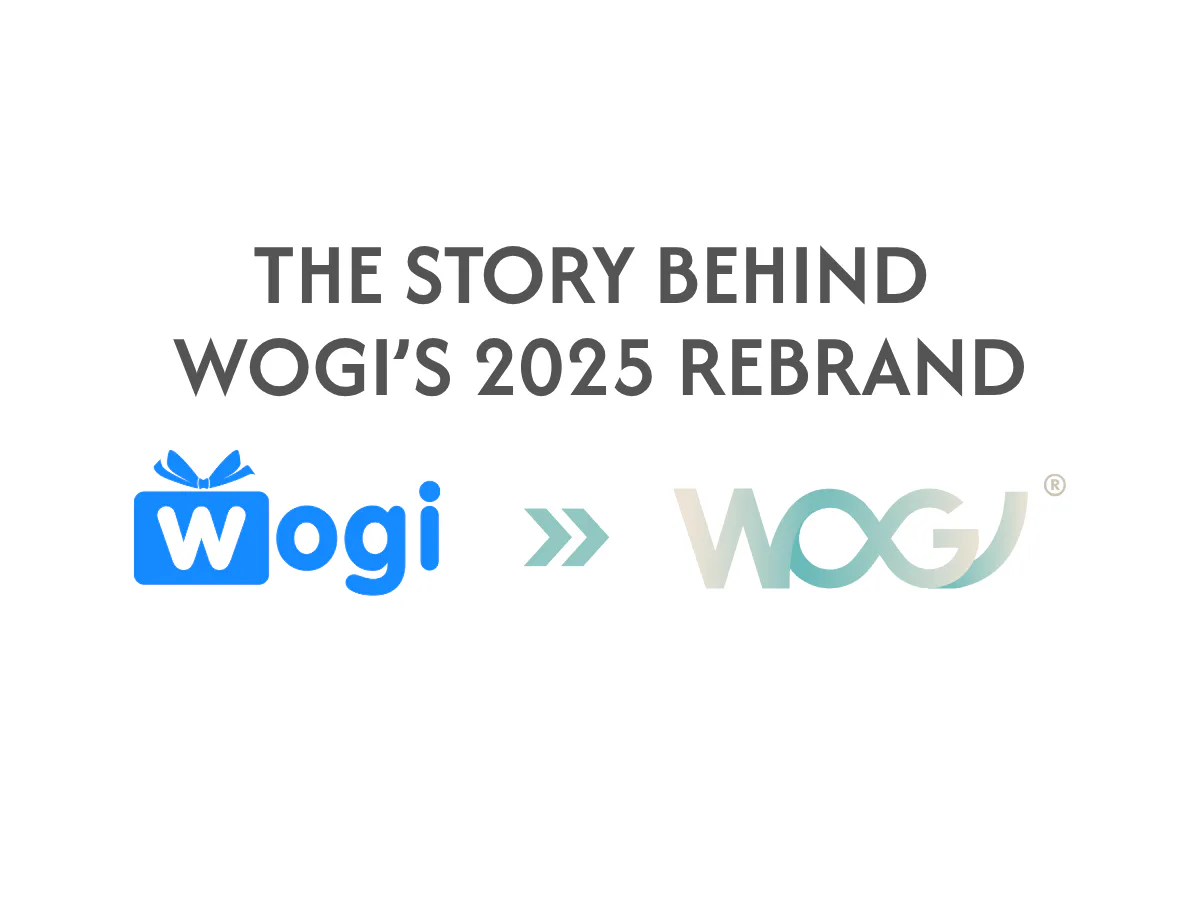
WOGI has published a retrospective explaining the thinking behind its 2025 rebrand, linking the change in visual identity to a broader role in rewards infrastructure. The company says the identity first appeared at an industry event in Singapore in May 2025. Its June 12, 2026 account describes an earlier change and its subsequent rollout, rather than announcing a new rebrand. [S01]
The central idea is a familiar tension in gift-card distribution: recipients see a reward arrive, while the business behind it may also manage catalogs, campaign rules, balances and merchant processing. A gift-box logo represented the visible outcome. WOGI argues that its wider activities had outgrown that image. [S01]
A brand built around connections
The replacement wordmark joins its letters around an infinity motif and uses the tagline “Rewards and Incentives That Resonate.” Founded in Singapore in 2015, WOGI presents localization across Asian markets as a central part of its operating model. The retrospective describes adapting the identity for different languages as the rollout continued during 2025 and 2026. [S01]
Where the platform sits in a rewards program
| Offering | Company-described role |
|---|---|
| CONNECT | Catalog and redemption capability embedded in client systems through an API. |
| DASH | Self-service campaign management and reward tracking. |
| RWRDS | A points bank and milestone automation for loyalty programs. |
| RBS Hub | Voucher processing and management for merchants. |
These are the functions described in the retrospective, not four product launches dated to June 2026. Taken together, they place WOGI at several stages between a company deciding to reward someone and that person using the reward. [S01]
Why the distinction matters for gift-card buyers
A catalog answers one purchasing question: which brands can a recipient choose? A cross-border program raises several more. The organization funding it needs to know how balances are held and reported, while the recipient needs a reward that can actually be spent in the intended market. A campaign manager also needs to distinguish a reward that has been sent from one that has been successfully redeemed.
Those differences provide a more useful way to assess the repositioning than the new logo alone. An API connection can put rewards inside an existing product; a campaign interface serves a different administrative workflow; a points bank introduces an ongoing balance relationship. The commercial significance depends on how those components perform in a particular implementation, not simply on calling the combined offer infrastructure.
The retrospective sets out WOGI’s own rationale. It does not independently establish that the rebrand improved redemption, retention or revenue, and it should not be treated as a performance comparison with competing platforms. Its clearest contribution is to explain the scope WOGI wants customers to associate with its name: a business involved in operating a rewards program as well as supplying its final gift. [S01]
Sources and documents
Collapse
In this article

Maya Bennett
Maya Bennett covers customer loyalty, employee rewards and incentive programmes for Gift Card News.