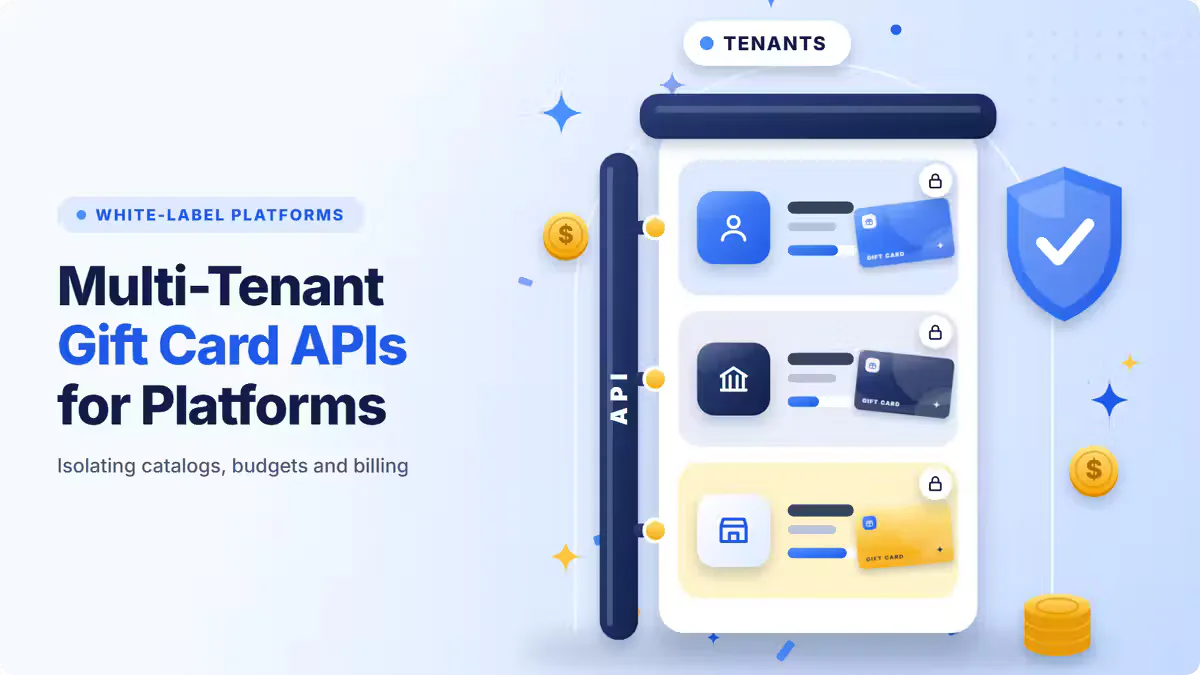
White-label platforms that deliver rewards to dozens of enterprise clients under separate brands face a distinct architectural challenge compared to single-company deployments. The system must maintain strict separation between each client’s catalog, budget, approval rules, reports, and invoices, all while relying on a single shared supply connection. The core design question shifts from merely calling a gift card API to defining where the tenant boundary sits and determining the enforcement mechanisms at every layer. [1]
A robust multi-tenant gift card API treats the tenant as a first-class object, ensuring every request, ledger entry, and report is scoped specifically to the client. By enforcing per-tenant catalogs, budgets, spend limits, and approval rules within the platform layer, above a single upstream supply integration, operators can transform catalog curation, budgeting, and invoicing into configurable settings rather than requiring custom code for each new client. [1]
Standard guidance on gift card APIs typically assumes a single operator model where one company purchases codes for its own employees or customers. In contrast, white-label loyalty, HR-tech, or fintech platforms operate within a three-party chain: the platform integrates with supply once, then resells or embeds reward features for numerous enterprise clients, each managing its own end-users. This shift fundamentally alters the architectural requirements. [1]
The market potential for this model is significant. Industry estimates place the global B2B gift card market at USD 16.4 billion in 2025, projecting growth to USD 32.87 billion by 2035, representing a compound annual growth rate (CAGR) of 7.2% between 2026 and 2035. While these figures serve as rough indications given variations among research publishers, they highlight that multi-tenant design impacts revenue generation as critically as engineering stability for platforms serving enterprise clients. [1]
A significant demand-side gap exists that white-label platforms are positioned to exploit. A 2021 Blackhawk Network survey of 2,000 U.S. employees revealed that while 41% preferred prepaid or gift cards as incentives, only 20% actually received them. Each enterprise client that leverages a platform to close this gap becomes a new tenant with unique policies, necessitating an architecture capable of absorbing additional tenants without introducing new code paths. [1]
Tenant isolation is the non-negotiable foundation of secure multi-tenant systems. As noted by AWS solutions architects in 2022, ensuring that one tenant cannot access another's resources is a primary responsibility for every SaaS provider. In the context of rewards, 'resources' include stored-value codes that function similarly to cash. A data leak between tenants constitutes a severe financial incident rather than merely a privacy breach. [1]
Effective tenant design begins by categorizing five critical domains. Most clients require a curated subset of the upstream catalog, imposing limits on specific countries, excluded categories, or brands approved by their compliance teams. This should be modeled as a tenant-level catalog policy—utilizing allowlists, denylists, country filters, and denomination ranges—applied over a shared master catalog. Copying catalogs per tenant is discouraged, as independent copies quickly drift out of sync when upstream products change prices, become unavailable, or are retired. [1]
Platforms can implement optional tenant overrides for display names, images, or sort orders, allowing for white-label branding customization without contaminating the underlying product data structure. [1]
Budget management is where isolation failures incur the highest costs. Each tenant requires an independent funding source, whether through prepaid balances, extended credit lines, or pass-through arrangements. Every transaction must check and debit the tenant's funds atomically. Common implementation layers include debiting the upstream provider before the call and reconciling results, releasing holds upon failure, or maintaining holds during timeouts until status confirmation is achieved. Idempotency keys must include tenant scope to prevent collision between a tenant's retry and another tenant's distinct order. [1]
Enterprise clients frequently mandate human approval workflows for transactions exceeding specific thresholds or linked to particular programs. These workflows should be declarative, utilizing rules such as requiring one approver from a designated role for orders above a certain value. Orders progress through defined states (pending, approved, submitted, fulfilled, failed), ensuring that codes are not released until the fulfilled state is confirmed. [1]
Reporting must be strictly isolated, with each tenant viewing only their own orders, recipients, and spending, ideally segmented by program and cost center. Internally, operators require a cross-tenant view for financial and operational oversight. This is best achieved through an append-only ledger where every entry records the tenant ID, program ID, product ID, amount, currency, and upstream reference. Audit logs should meticulously track who approved or canceled specific items and when. [1]
Settlement processes are typically per-tenant, meaning each client receives individualized invoices or statements, often denominated in their local currency. The financial ledger must support per-tenant currency views while keeping the upstream cost basis distinct from the amount billed to the tenant. Operating across borders introduces varying rules regarding invoicing, tax treatment of reward spend, and stored-value regulations; operators should consult local legal and tax counsel before finalizing billing models. [1]
Defining tenant ownership is only half the work; the second half involves ensuring no code path can breach the defined boundary. Authentication and context resolution must derive tenant identity from credentials, such as per-tenant API keys or OAuth clients, rather than mutable request parameters. Once resolved, tenant context must be propagated through every service call, queue message, and background job. [1]
Data access controls are critical. Whether utilizing separate databases, separate schemas, or a shared schema with row-level security, the database must enforce tenant scoping independently. A shared schema with tenant ID columns and row-level security policies is a common compromise for platforms hosting many small and mid-sized clients, while very large or highly regulated clients may justify dedicated silos. [1]
Code storage and delivery require rigorous security. Gift card codes should be encrypted at rest, ideally using tenant-scoped keys, with decryption restricted strictly to the delivery path. Codes must never appear in logs, analytics events, or tenant-visible exports. Because codes in transit and at rest are prime targets for fraud, code-handling services must be treated as high-sensitivity systems subject to strict access reviews. [1]
Rate limiting and fairness ensure that one tenant's bulk campaigns, such as year-end distributions to thousands of employees, do not starve other tenants' real-time redemptions. Platforms must apply per-tenant rate limits and queue partitioning, pacing upstream calls so that a single tenant cannot exhaust the shared supply-side quota. [1]
Webhook handling must fan out upstream fulfillment events to per-tenant endpoints, signed with per-tenant secrets. Event payloads from one tenant must never be sent to another tenant's endpoint, even during retries or replays. [1]
In a hypothetical scenario involving an HR-tech platform with two clients, isolation remains paramount. Client A, a manufacturer, might restrict rewards to domestic grocery and fuel cards with fixed amounts and mandatory manager approval. Client B, a distributed software firm, might allow a broad international catalog with no approvals but impose monthly caps per recipient. In a well-designed system, both clients operate on the same codebase and supply integration, differentiated only by their tenant records regarding catalog policy, budget, approval rules, and billing currency. Onboarding a third client requires only creating a new configuration, not launching a new engineering project. [1]
When evaluating upstream supply providers, platforms must assess their reliability. Key criteria include clear documentation of expiry and redemption conditions for each product, enabling platforms to surface this information to tenants and recipients. [1]
Some reward platforms integrate multiple upstream suppliers to broaden coverage. In such cases, a routing layer should map master catalog products to one or more suppliers, ensuring the tenant-facing catalog remains stable even when routing changes occur. [1]
Wincube Global operates as a B2B digital gift card aggregator and rewards infrastructure provider, offering real-time API integration and bulk fulfillment. Having processed over USD 220 million in gift card GMV in 2025, the platform supports a catalog of more than 30,000 gift cards across over 90 countries. For white-label reward platforms, this infrastructure allows a single upstream integration to supply the master catalog behind numerous tenant-specific catalogs, while the platform retains control over tenant isolation, budgets, approvals, and client-facing settlement. [1]
Because every platform's tenant model differs, the optimal split between platform-owned functions and supply-layer responsibilities depends on specific client needs, regions, and compliance requirements. Teams considering these architectures are encouraged to engage with infrastructure providers to explore tailored implementations. [1]
A multi-tenant gift card API serves many separate clients, or tenants, from a single shared system, ensuring that each client's catalog, budget, orders, and reports remain strictly isolated. For white-label reward platforms, the tenant is typically the enterprise client, and every request and ledger entry is scoped to that specific tenant. [1]
Regarding catalog management, tenants generally should not maintain their own copies of the gift card catalog. A single master catalog, synced from the upstream supply API and filtered at read time by per-tenant policies, is easier to maintain accurately. Per-tenant copies tend to drift whenever upstream products change prices, availability, or status. [1]
White-label reward platforms typically invoice each tenant separately from a ledger that records the tenant, program, currency, and upstream cost for every order. Given that invoicing, tax, and stored-value rules vary by jurisdiction, platforms must confirm their billing approaches with local legal and tax counsel. [1]
In this article

Maya Bennett
Maya Bennett covers customer loyalty, employee rewards and incentive programmes for Gift Card News.