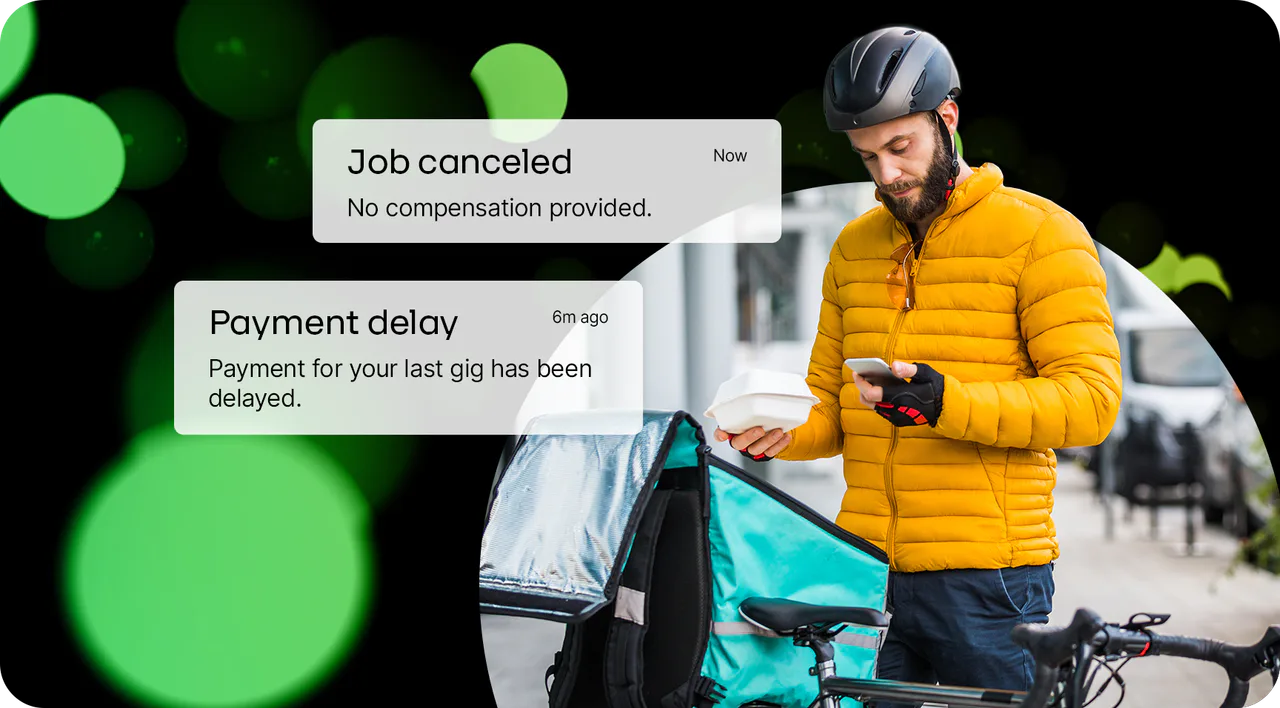
Runa discussed late payouts in a July 7, 2025 article about its Decoding Payouts research. The detailed report records 9% experiencing financial stress frequently and 34% occasionally because of payout delays, a combined 43%;57% answered no. The blog's 40% summary does not match that detailed distribution. Runa surveyed 957 US independent workers in March 2025, including gig/freelance workers, marketplace sellers, content creators and direct sellers. The original report does not disclose recruitment, survey mode, weighting or exact subgroup sizes. Overall results are not restricted to gig workers. [S02]
How often respondents reported financial stress from payout delays
The detailed original report separates frequent, occasional and no financial stress.
% of surveyed respondents
Tap or hover for details. All values are also available in the data table.
Source
Self-reported financial stress, not observed financial loss or demonstrated platform causality. Sample includes several kinds of independent work.
Show data tableHide data table
| Category | Respondents |
|---|---|
| Frequently | 9 % of surveyed respondents |
| Occasionally | 34 % of surveyed respondents |
| No | 57 % of surveyed respondents |
The report also describes overlapping consequences: emotional or mental stress for 29%, trouble paying bills on time for 25%, drawing on savings for 24% and difficulty meeting basic needs for 22%. These are respondents' reported experiences, with no causal experiment or independent measurement of their finances. [S02]
For a poor payout experience, the detailed chart records 23% saying they would quit and 49% saying they would rethink staying. A separate question about improvements records 35% saying they would feel more motivated to stay and 31% more loyal. Those overlapping intentions do not substantiate the blog's claim that nearly 60% would stay for reliable payment, and none measures actual retention. [S02]
The study also records 45% wanting instant payouts and 60% expressing interest in digital wallets such as PayPal, Venmo and Zelle. The 31% switching figure refers to respondents who considered changing companies because of payment issues, not a verified departure rate. [S02]
Runa separately cites a Mastercard discussion published in October 2020, which reported that 85% of surveyed US gig workers would take on more work if paid faster. That is a different study and an intention claim; the accessible Mastercard page does not disclose its sample size or field dates. It does not independently validate Runa's 2025 findings. [S03]
The provider promotes options including bank transfers and digital gift cards within that context. Its recommendation is to consider payment reliability, timing and recipient choice together rather than treating disbursement only as an internal processing task.
In this article

Emma Carter
Emma Carter covers retail, e-commerce and the gift card shopping experience for Gift Card News.