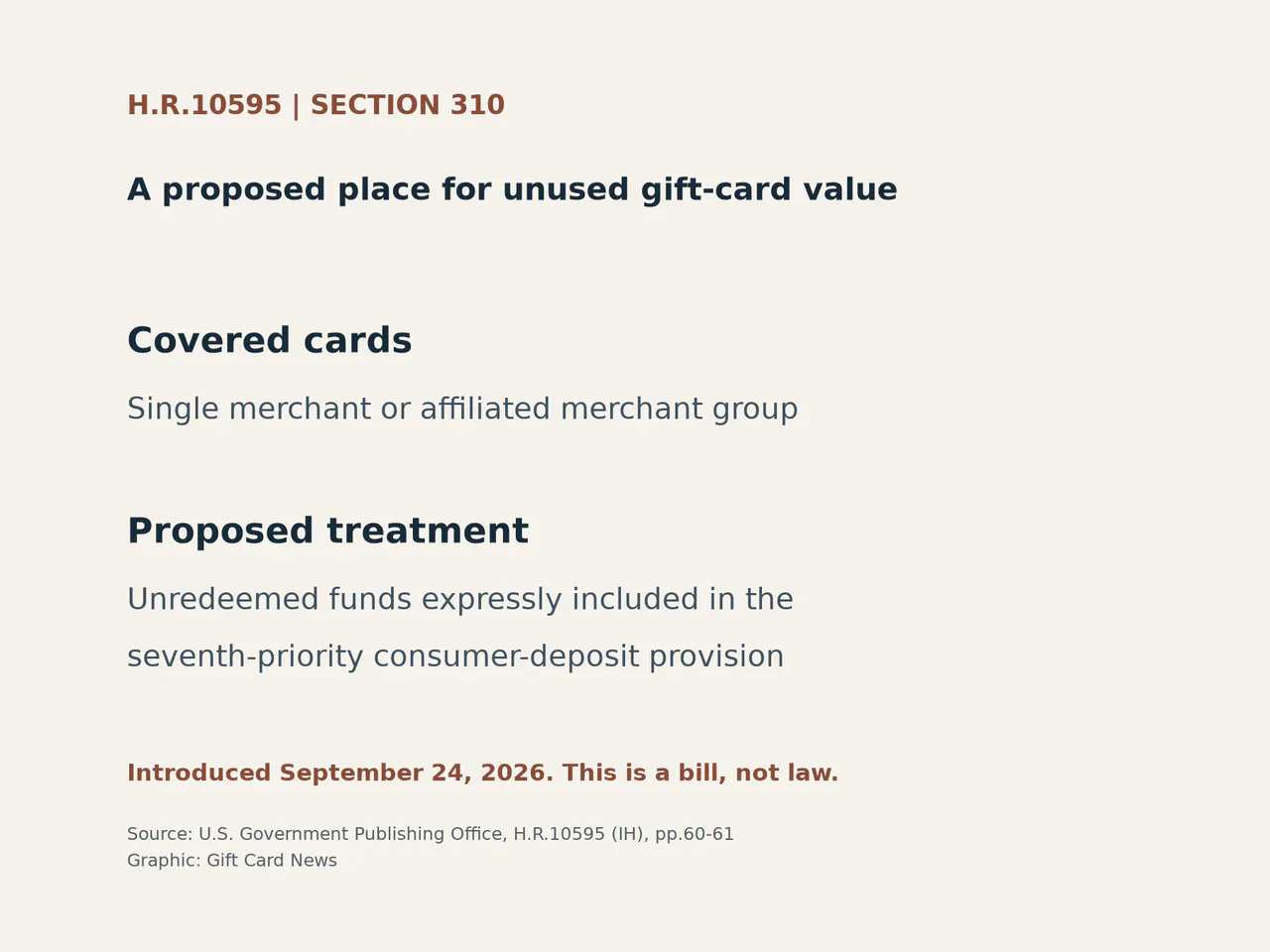
A U.S. House bill introduced on September 24 would expressly include unredeemed merchant gift-card funds in a consumer-deposit bankruptcy priority provision. Section 310 of H.R.10595, the Stop Wall Street Looting Act, sets out the proposed treatment within a broader package addressing private investment funds and the companies they control. [S01]
Express card coverage and the separate adjustment of priority limits
The definition covers paper and electronic promises, plastic cards and other payment codes purchased in advance for goods or services. A qualifying card must be redeemable with one merchant or an affiliated group sharing a name, mark or logo. Reloadable cards can qualify; the definition does not require a plastic format. [S01]
The proposed replacement for section 507(a)(7) of the Bankruptcy Code would list unredeemed gift-card purchases alongside consumer deposits for property and services. It describes seventh-priority allowed unsecured claims of individuals and prints a $1,800 per-person limit. That amount is the wording of this introduced proposal, not a statement of the claim limit applicable under current law. [S01]
Priority amounts also have an inflation-adjustment history that must be kept separate from the proposal. The Judicial Conference’s February 4, 2025 notice changed the amount in section 507(a)(7) from USD 3,350 to USD 3,800 for cases commenced from April 1, 2025. It describes automatic three-year CPI adjustments, rounded to the nearest USD 25. The February 25 correction concerns different table entries under title 28 and does not change this row. [S03] [S04]
The 2025 adjustment raised the qualifying consumer-deposit priority ceiling
Amounts printed for 11 U.S.C. 507(a)(7) in the Judicial Conference notice: the prior amount and the replacement effective April 1, 2025.
USD per individual
Tap or hover for details. All values are also available in the data table.
Source
Historical indexed limits for qualifying consumer-deposit priority claims under that notice, not gift-card reimbursements or evidence every card balance qualifies. The adjustment excludes cases commenced before April 1, 2025. The bill’s separately printed USD 1,800 wording is not plotted as a directly comparable indexed limit or a guaranteed recovery.
Show data tableHide data table
| Category | Consumer-deposit priority ceiling |
|---|---|
| Amount immediately before adjustment | 3,350 USD per individual |
| Adjusted amount from April 1, 2025 | 3,800 USD per individual |
The chart explains the indexed priority framework that the bill proposes to amend. It does not decide whether an existing gift-card holder has an allowed qualifying claim, estimate how much a bankruptcy estate will pay, or resolve how indexing would interact with the proposed replacement text. The bill’s USD 1,800 figure is retained as the introduced wording, rather than presented as the amount currently payable for every unused card. [S01] [S03]
Representative Mark Pocan of Wisconsin introduced the measure. The official record lists referrals to Ways and Means, Financial Services, the Judiciary, and Education and Workforce. The published version is identified as introduced in the House. [S02]
For merchants and card programmes, the relevant development is a proposed express treatment of outstanding card value when a bankruptcy case begins. The filing does not itself create a reimbursement programme, promise full recovery or change redemption arrangements at any retailer. [S01]
In this article

Oliver Reed
Oliver Reed covers industry acquisitions, investment and market research for Gift Card News.