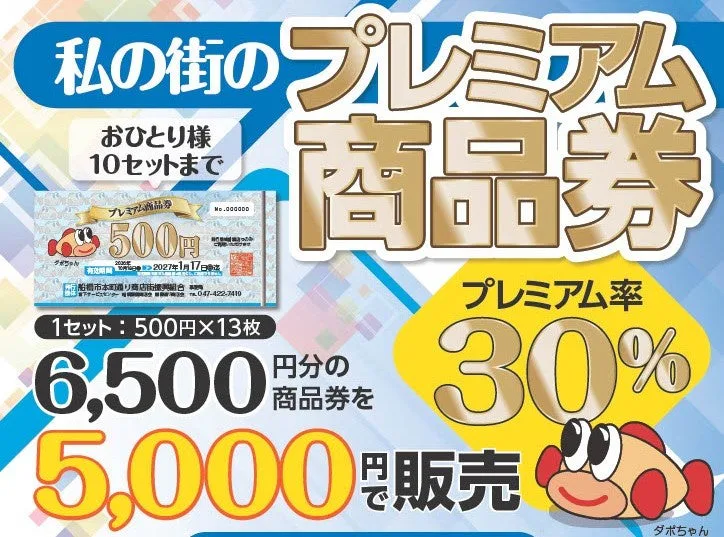
Future Link Network announced on October 6, 2026 that it had taken on administration of the Funabashi Honcho-dori shopping-voucher programme. Its scope spans reservations, customer enquiries, printed vouchers, collection-day staffing and coordination with participating businesses. The supplier described acceptance at more than 50 local shops. [S01]
A 30% premium with a defined purchase ceiling
Buyers pay JPY5,000 for a booklet containing thirteen JPY500 vouchers, worth JPY6,500 in total. The issuer limits purchases to ten booklets per person across the reservation period. That makes the maximum purchase JPY50,000 for JPY65,000 in spending value, including JPY15,000 above the price paid. These are contractual limits, not observed average purchases. [S02][S03][S04]
Funabashi voucher price and value at the published purchase limits
The premium is 30% of the purchase price; the ten-booklet ceiling determines the maximum benefit.
JPY
Tap or hover for details. Select a series above to show or hide it.
Sources
The maximum is calculated from the published ten-booklet cap: 10 × JPY5,000 paid and 10 × JPY6,500 value. It is not a second product, actual purchase volume or issued balance. Price and spending value overlap economically and must not be added together.
Show data tableHide data table
| Category | Cash purchase price | Voucher spending value |
|---|---|---|
| One booklet | 5,000 JPY | 6,500 JPY |
| Ten-booklet limit per person | 50,000 JPY | 65,000 JPY |
The online stage was a reservation for physical collection. The issuer’s teket form says customers present the booking QR code and pay cash at their reserved collection time. Its displayed JPY0 ticket is therefore a reservation, not a free JPY6,500 voucher. Customers who miss their allocated collection time have their reservation cancelled. [S03]
Reservations were scheduled from October 6 at 9 a.m. to October 11 at 5 p.m., first come, first served. The programme page now marks the planned quantity sold out; local outlet Funabashi Tsushin reported that closure on October 7. Collection remains scheduled for October 17-20, with vouchers usable from October 18, 2026 through January 17, 2027. A full reservation allocation does not establish that every booklet was subsequently collected or spent. [S01][S02][S05]
Voucher use is restricted to participating shops and JPY500 units, with no change. The issuer prohibits resale, cash exchange and refunds, and excludes utility bills, payments to public authorities, financial products, other gift certificates, stamps, tobacco and other specified goods. Membership of one of the issuing shopping associations alone does not guarantee acceptance. [S02][S03][S04]
The programme materials name Honcho-dori alongside Miyashita Service Center, the Funabashi Station-front Shopping Association and Goten-dori Shopping Association as issuers, and state that the scheme uses Funabashi City’s fiscal-2026 shopping-street consumption support subsidy. FLN operates the Mypl information service and is based in Funabashi; its contract combines that promotional channel with customer support and four collection days. [S01][S02][S04]
Neither the supplier announcement nor the programme terms reviewed discloses the administration fee, total booklet allocation or measured staff-time savings. FLN’s claims of reduced workload and stronger local consumption describe its intended outcomes. The documented change is who operates the reservation-to-collection process and the terms of the voucher offer, not a demonstrated rise in retail sales. [S01][S02]
In this article

Oliver Reed
Oliver Reed covers industry acquisitions, investment and market research for Gift Card News.