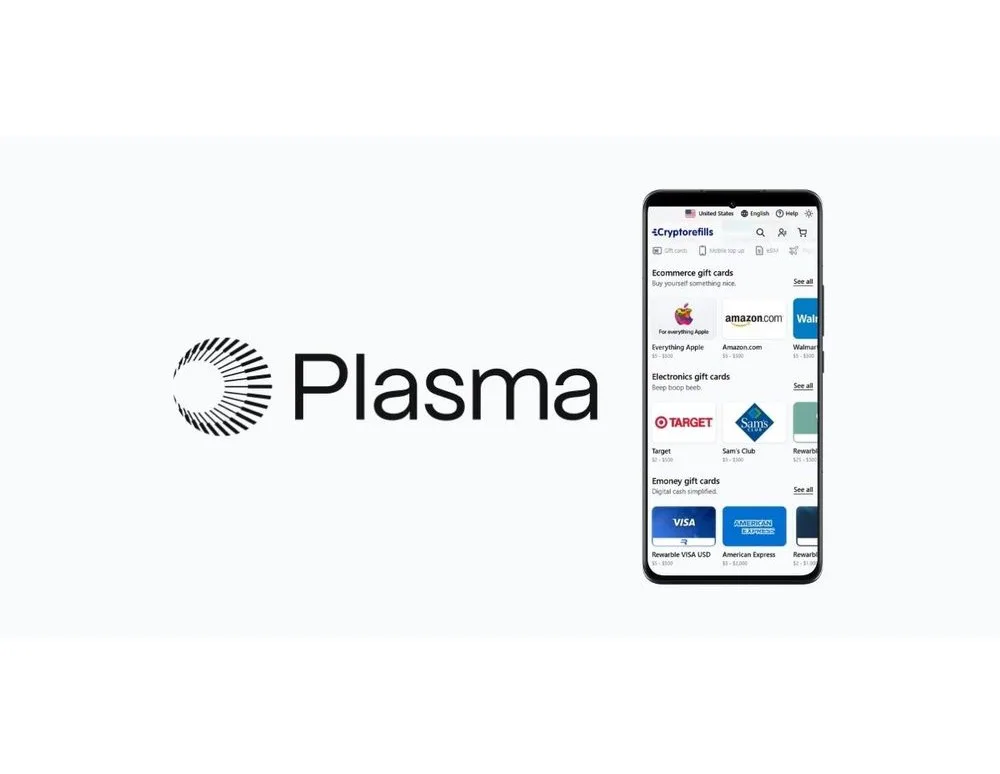
Cryptorefills added Plasma as a route for spending USDT on gift cards on March 18, 2026, connecting another stablecoin network to its existing retail catalogue. Customers can use the same route for mobile credit, eSIMs and travel products. The announcement puts the emphasis on making small purchases economical, rather than introducing a new type of gift card. [S01]
A retailer meets a network built for stablecoins
Cryptorefills has operated since 2018 and is based in Amsterdam. Its business combines digital-asset payments with the delivery of products from other providers. That history matters here: Plasma is joining an established commerce operation, rather than supplying the underlying gift-card catalogue or replacing its retail brands. [S03]
The service’s terms describe a resale business operated by Big Dream Ventures B.V. Customers select a country-specific product and pay the quoted cryptocurrency amount; the resulting card is subject to its issuer’s conditions. The payment network and the retailer’s redemption system therefore perform separate jobs. [S04]
Plasma describes itself as a blockchain designed specifically for stablecoin payments. Its documentation emphasises low-cost transfers, quick settlement and compatibility with software built for the Ethereum Virtual Machine. Those are infrastructure characteristics: they concern how digital dollars move, not where an individual store card can be spent. [S02]
Why small transaction costs matter
Plasma had launched in September 2025, according to the integration announcement. Cryptorefills highlighted its dedicated fee-free USDT transfer route, while chief executive Massimiliano Silenzi linked lower payment costs to the practical use of small-value purchases, particularly in emerging markets. Those are the companies’ stated reasons for connecting the services. [S01]
The commercial logic is straightforward. A fixed network charge consumes a larger share of a small purchase than of a large one. Reducing that charge can make an existing stablecoin balance more useful for routine shopping. It can also remove one reason for a prospective buyer to abandon a low-value order before the gift card is delivered.
Show data tableHide data table
| Part of the transaction | Role |
|---|---|
| USDT | The payment asset |
| Plasma | The network used to transfer it |
| Cryptorefills | The merchant selling the selected product |
| Gift card | The stored-value product delivered after purchase |
For Cryptorefills, another supported network creates an additional route into the same inventory. For Plasma, the connection gives holders a spending destination outside transfers between wallets. Both can benefit from repeated use, but the integration does not establish the number of customers who will use it or the margin earned on their purchases.
The boundary between payment and redemption
Plasma’s documentation treats merchant connections as part of the wider infrastructure needed to turn a transferable token into something people can use. The integration illustrates that distinction: moving USDT successfully is only one part of delivering usable retail value. [S02]
A shopper still needs the right gift card for the country, brand and purchase intended. Nor does a fee-free network route establish that every complete order has no other cost. The announcement adds a funding choice to an existing distribution model; it does not make the participating retailers direct USDT merchants.
In this article

Suzie Elis
Suzie Elis covers gift card products, digital gifting and distribution for Gift Card News.