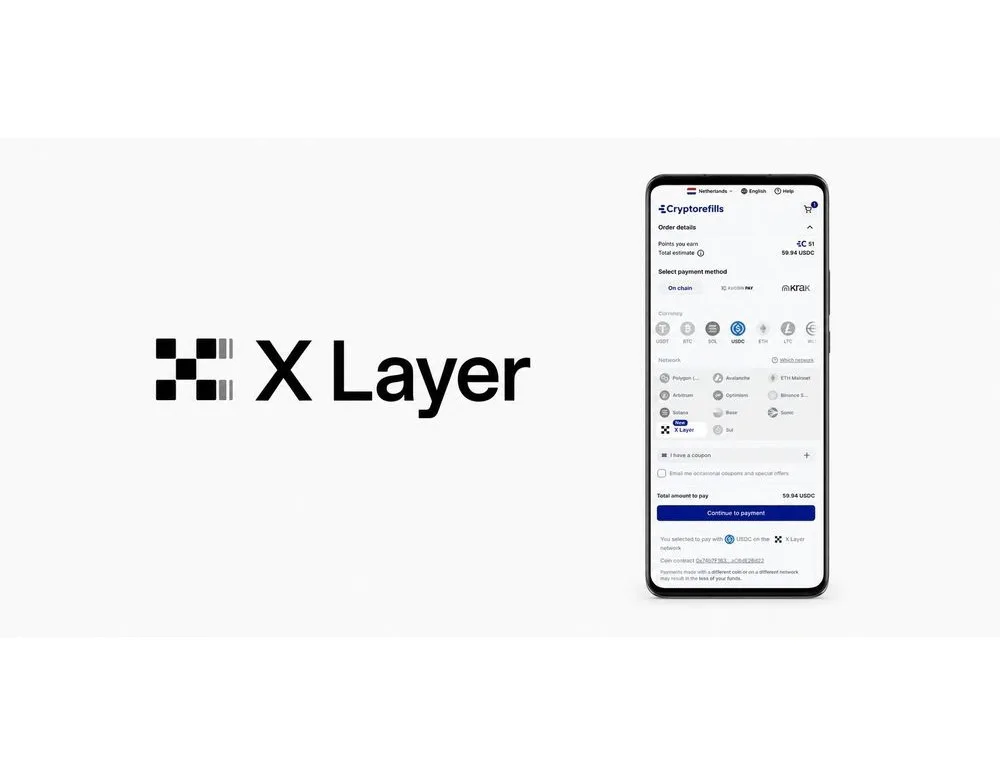
Cryptorefills has added USDT and USDC payments over X Layer, bringing another route from stablecoin balances to gift cards and other purchases. Its announcement dated August 19, 2026 details a staged rollout on the network built by OKX: USDT became available in July, followed by USDC in August. [S01]
Show data tableHide data table
| Milestone | Date reported by Cryptorefills |
|---|---|
| USDT support live | July 21, 2026 |
| USDC support live | August 8, 2026 |
| Combined announcement dated | August 19, 2026 |
Source: Cryptorefills' integration announcement. These are payment-support milestones, rather than the launch dates of the underlying network or gift cards. [S01]
A retail reseller adds another payment route
Cryptorefills dates its operation to 2018 and combines digital-asset checkout with a catalogue spanning gift cards, mobile services and travel. The Amsterdam business has expanded the ways customers can pay for products supplied by other companies. [S03]
Its operator, Big Dream Ventures B.V., describes the model in its terms: it purchases products from suppliers and resells them in its own name. The underlying card issuer still determines redemption conditions. Accepting a token on another network changes how the customer pays Cryptorefills; it does not make each retailer a direct cryptocurrency acceptor. [S04]
That distinction explains the opportunity for gift card suppliers. They can reach customers holding digital assets through a reseller that handles the crypto checkout. Cryptorefills can compete for those purchases without asking every brand in its catalogue to build a separate blockchain payment integration.
What OKX and Cryptorefills stand to gain
OKX operates both exchange and wallet services, and documented wallet support for X Layer in April 2024. The 2026 addition therefore connects an existing network to another spending destination, rather than introducing the network itself. [S06]
Current OKX documentation describes X Layer as an Ethereum Layer 2 built on the OP Stack, with OKB used for network fees. In commercial terms, the network and the shop do different jobs: one processes blockchain activity, while the other supplies products people can buy with the balances they hold. [S05]
Our assessment is that the fit is strongest for customers whose funds are already on X Layer or readily accessible through their existing wallet. Cryptorefills gains another entry point to demand; the OKX ecosystem gains a practical spending use for its network. More purchasing activity would support that rationale, but no transaction volume or revenue-sharing arrangement was disclosed.
Convenience depends on the starting balance
The Cryptorefills checkout guide makes both the selected asset and network part of the payment instructions. It also notes that a self-managed wallet needs OKB for gas: holding USDT or USDC alone may not be enough to submit the payment. [S02]
That operational detail has an economic consequence. Someone already holding the required assets can avoid moving value to another supported network merely to shop. Someone starting elsewhere may incur transfer or conversion costs before reaching the same checkout. A low network fee is therefore only one component of the total cost, not proof that every customer saves money.
The company reports seeing X Layer payments before it promoted the integration, but provides no quantity or comparative sales result. [S02] For the gift card industry, the established change is broader payment access. Whether it produces additional orders will depend on customers finding a useful card, at an acceptable total price, and completing the purchase.
In this article

Suzie Elis
Suzie Elis covers gift card products, digital gifting and distribution for Gift Card News.