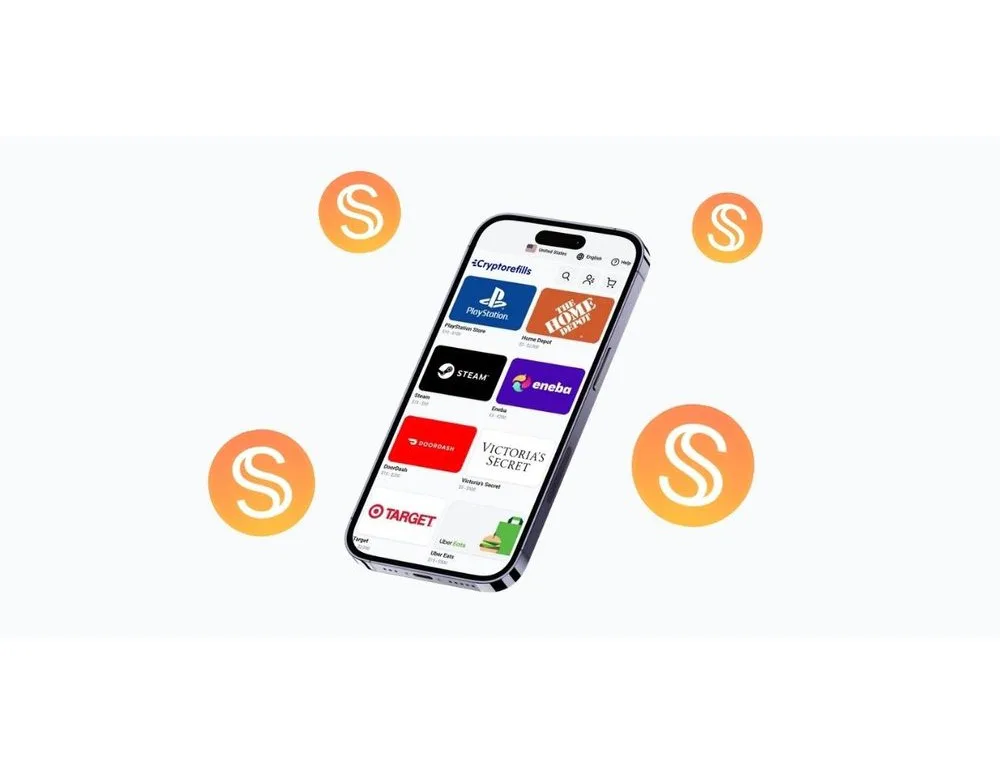
Cryptorefills added USDS payments on April 27, 2026, giving holders of Sky Protocol’s stablecoin another way to buy gift cards and other products. The addition covers the company’s existing catalogue, including mobile credit, eSIMs, flights and hotel bookings. [S01]
The commercial change is at checkout. A customer already holding USDS can choose it as the funding asset instead of first moving into another accepted currency. It does not create a new gift card brand or change the conditions attached to a retailer’s voucher.
Show data tableHide data table
| Element | Position in the announcement |
|---|---|
| New payment asset | USDS |
| Protocol named by the issuer | Sky Protocol |
| Products covered | Gift cards, mobile top-ups, eSIMs, flights and hotels |
| Measured commercial results | No transaction volume or sales uplift disclosed |
Retail distribution meets a stablecoin ecosystem
Amsterdam-based Cryptorefills operates a crypto-funded commerce catalogue, already accepting other stablecoins before this addition. USDS expands its payment choice. [S01]
Sky Protocol has a different business. Formerly MakerDAO, it rebranded in 2024 and introduced USDS alongside the SKY governance token. Sky’s own account distinguishes the stablecoin from the token used for governance and from products through which users supply assets to access variable returns. [S03]
That distinction helps explain the integration’s value to the ecosystem. A token can be held, exchanged or used within financial applications; an accepted payment route gives holders a way to obtain an ordinary retail product. Cryptorefills supplies that commerce connection. It does not turn each participating retailer into a direct operator of Sky’s protocol.
Access to existing balances is the business case
For Cryptorefills, the potential gain is a customer who prefers to spend an existing USDS balance rather than leave the asset to shop. For Sky’s ecosystem, it is a practical use for the stablecoin beyond trading or supplying liquidity. Those incentives follow from the payment design; the announcement does not disclose a marketing payment, revenue-sharing contract or volume commitment between the parties.
The same design creates a measurement problem. An order paid with USDS may be a new sale, or it may replace one the customer would have paid for with another accepted stablecoin. Payment-method adoption alone therefore cannot demonstrate incremental demand. The April release provides no transaction total or sales uplift. [S01]
The accepted asset must remain clear
Sky’s product site distinguishes USDS from sUSDS and stUSDS, which relate to separate savings or lending mechanisms with variable returns. [S02] The Cryptorefills announcement names USDS, not every similarly named product. A displayed yield elsewhere in the ecosystem is not a return attached to buying a gift card.
Sky’s own risk disclosures also say the stablecoin’s dollar peg can come under pressure and identify liquidity and smart-contract risks. [S04] That is relevant to the funding asset, while the gift card carries its own denomination and redemption rules. Keeping those two layers clear is essential to understanding what the new payment option actually offers.
In this article

Suzie Elis
Suzie Elis covers gift card products, digital gifting and distribution for Gift Card News.