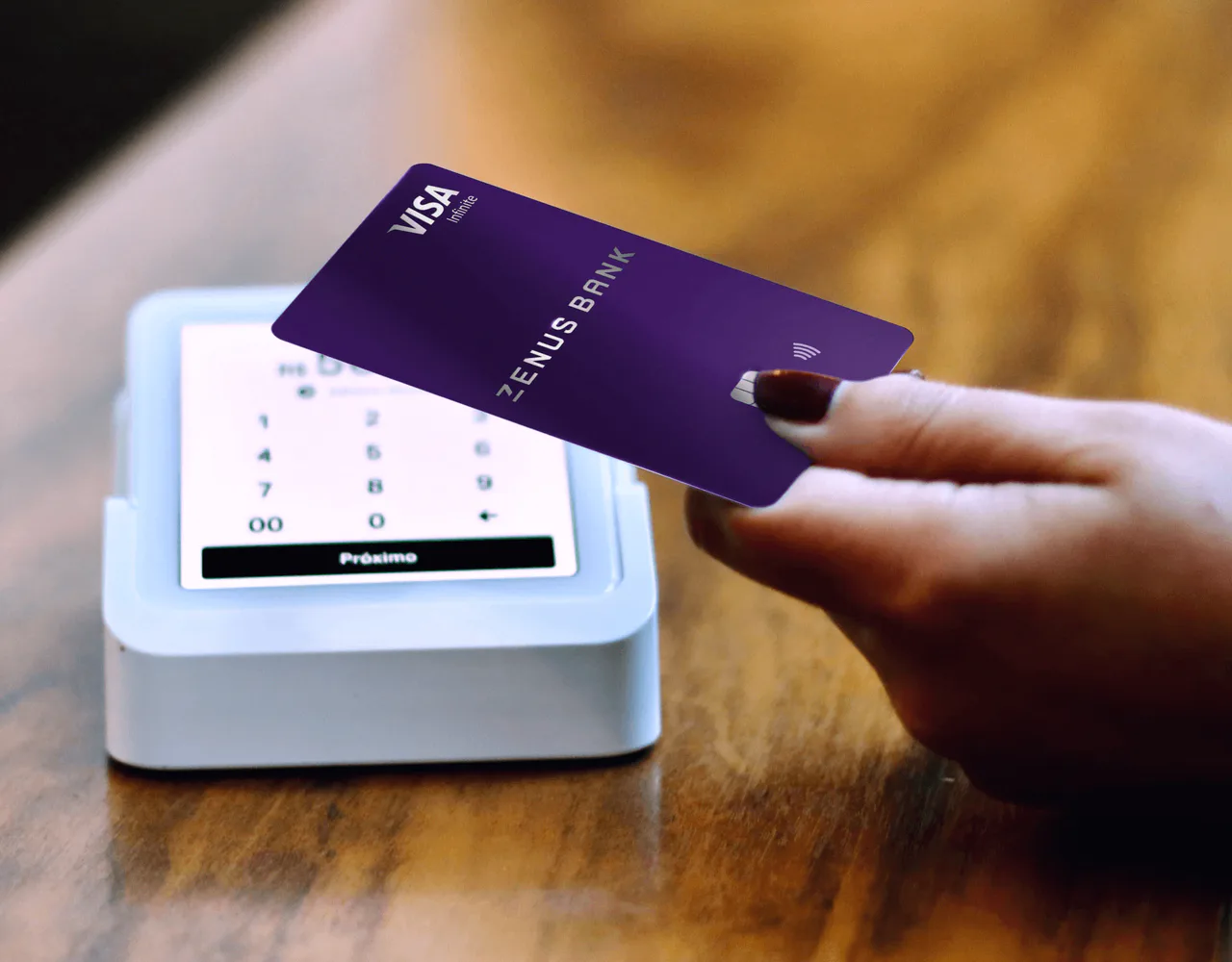
Zenus Bank's first physical payment card combined two different challenges: making a premium metal card work reliably at the terminal and delivering a personalized credential to customers spread across countries. IDEMIA's April 11, 2023 announcement described how its Smart Metal Art technology and Budapest service centre were brought together for the Zenus Visa Infinite debit programme.
The original IDEMIA announcement said the project followed two years of collaboration and four rounds of prototypes. That development history makes the card more interesting than its purple finish: the bank was turning a remotely opened account into a physical object that had to be manufactured, personalized and distributed.
The engineering behind the metal finish
The published design used a vertical dark-purple layout, a metal body with a stainless-steel edge, exposed-metal logo effects and laser-personalized card details following Visa's Quick Read configuration. Zenus's own account of the project confirms the design, prototype process and Budapest hub. As a partner announcement, it supports the product specification rather than providing an independent performance assessment.
IDEMIA's Smart Metal Art technology announcement explains the underlying construction: a decorated non-magnetic metal core protected by layers that can be printed or transparent. The supplier described patented technology originating with X Core and compatibility with both contact and contactless operation. Its broader offering covered design, manufacture, personalization and packaging.
This matters because the material is part of the payment device, not simply decoration added to a plastic card. A successful programme has to preserve terminal functionality while changing the card's weight, appearance and tactile qualities. The supplier's published engineering explanation is the appropriate basis for understanding that tradeoff; there is no need to infer a higher payment-success rate from the premium finish.
The wider installed base helps explain why interoperability mattered more than the finish alone. EMVCo reported 12.0 billion chip cards in circulation at the end of 2021 and 12.8 billion a year later. A new metal card therefore had to work within a large, established chip-payment environment while adding its own materials and design.
The installed base behind chip-card interoperability
Global EMV chip cards in circulation at the end of 2021 and 2022.
billion cards
Tap or hover for details. All values are also available in the data table.
Sources
Global EMVCo figures. They measure chip-card deployment across the industry, not Zenus cards or IDEMIA production.
Show data tableHide data table
| Category | EMV chip cards |
|---|---|
| End 2021 | 12.0 billion cards |
| End 2022 | 12.8 billion cards |
From an account application to an individual card
Show data tableHide data table
| Stage | What the project described | Operational significance |
|---|---|---|
| Design | Two years of collaboration; four prototype rounds | A defined development process before fulfillment |
| Personalization | Laser-personalized card details; Budapest service centre | Converts a card body into a customer-specific credential |
| Delivery | Physical card advertised in under ten days | Connects digital onboarding with cross-border fulfillment |
The companies described immediate issuance of a virtual card after the online application process and physical delivery in under ten days. That was the advertised service proposition. The announcement did not publish delivery-time distributions, fulfillment volumes or the proportion of shipments meeting the promise, so it cannot establish a measured global delivery service level.
Centralizing personalization in Budapest gave the programme a named operational hub. For a bank serving users beyond its home market, that detail is significant: the digital customer journey still depends on securely linking a credential to the correct customer and getting it to the destination. The arrangement illustrates how a digital bank can coordinate physical distribution without a local branch network in every country.
Deployment has two sides: how much of the issued card base supports EMV, and how often card-present transactions use it. EMVCo reported both measures in its June 2022 and August 2023 releases. For a physical-card programme, the distinction connects the credential supplied to the customer with the payment environment in which it will be used.
EMV deployment in issued cards and card-present payments
The annual releases report both the installed card base and use at the point of sale.
%
Tap or hover for details. Select a series above to show or hide it.
Sources
The two series have different denominators: issued cards and card-present transactions. Release dates identify the published snapshots; neither series measures the Zenus programme.
Show data tableHide data table
| Category | Share of all issued cards that are EMV-enabled | Share of card-present transactions using EMV |
|---|---|---|
| June 2022 release | 68% | 90% |
| August 2023 release | 69% | 93% |
Three geographic numbers that should not be confused
In its April 11, 2023 release, IDEMIA described a single-U.S.-BIN programme reaching more than 133 countries; Zenus's version specified Visa-eligible destinations. That is the programme's stated eligible-market scope. Visa's glossary identifies BIN as an issuer-identification term, not an unconditional right for any applicant in any country to obtain a card.
The earlier March 2023 Zenus and Visa rollout account, covered contemporaneously on March 2, described actual issuance in more than 46 countries and acceptance at more than 80 million merchant locations in 200 countries. The dated snapshots measure different things: reported issuance footprint, the later stated eligible-market scope and network acceptance. The figures do not demonstrate that actual issuance expanded from 46 to 133 countries between the announcements.
The same release gave the card a weight of 13.5 grams. That is a tangible product specification. Its references to travel, purchase protection and premium services described the Visa Infinite proposition then being marketed; the details of a benefit depend on the applicable programme and terms.
Visa Infinite described the tier; debit described the product
The card was presented as a Visa Infinite debit product, bringing a premium card proposition to an account-funded relationship. Its metal body did not make it a credit facility, and international acceptance did not make it a prepaid gift card. For the card industry, the project is therefore a case in bank issuance, material engineering and fulfillment rather than stored-value distribution.
That distinction also explains the partnership structure. Visa supplied the network relationship and programme context, Zenus supplied the banking and issuing proposition, and IDEMIA supplied the physical-card capabilities described in its release. Our coverage of Zenus's Visa principal membership follows the earlier network milestone.
The retail programme belongs to its period
In its July 2025 strategy announcement, Zenus scheduled the end of its dedicated retail platform for October 22, 2025 and shifted its emphasis toward fintech and institutional infrastructure. The 2023 application and delivery proposition therefore belongs to that earlier retail programme, rather than serving as instructions for prospective customers today.
The industrial lesson survives that change: cross-border card issuance involves the full chain from a regulated account and network credential to personalization, shipment and customer support. IDEMIA's project with Zenus documented that chain unusually clearly. The later strategic pivot changes the distribution model through which Zenus serves end-users, while the historical announcement remains evidence of how its first physical card was built.
In this article

Daniel Brooks
Daniel Brooks covers payment networks, financial technology, payment security, gift card fraud and PCI DSS for Gift Card News.