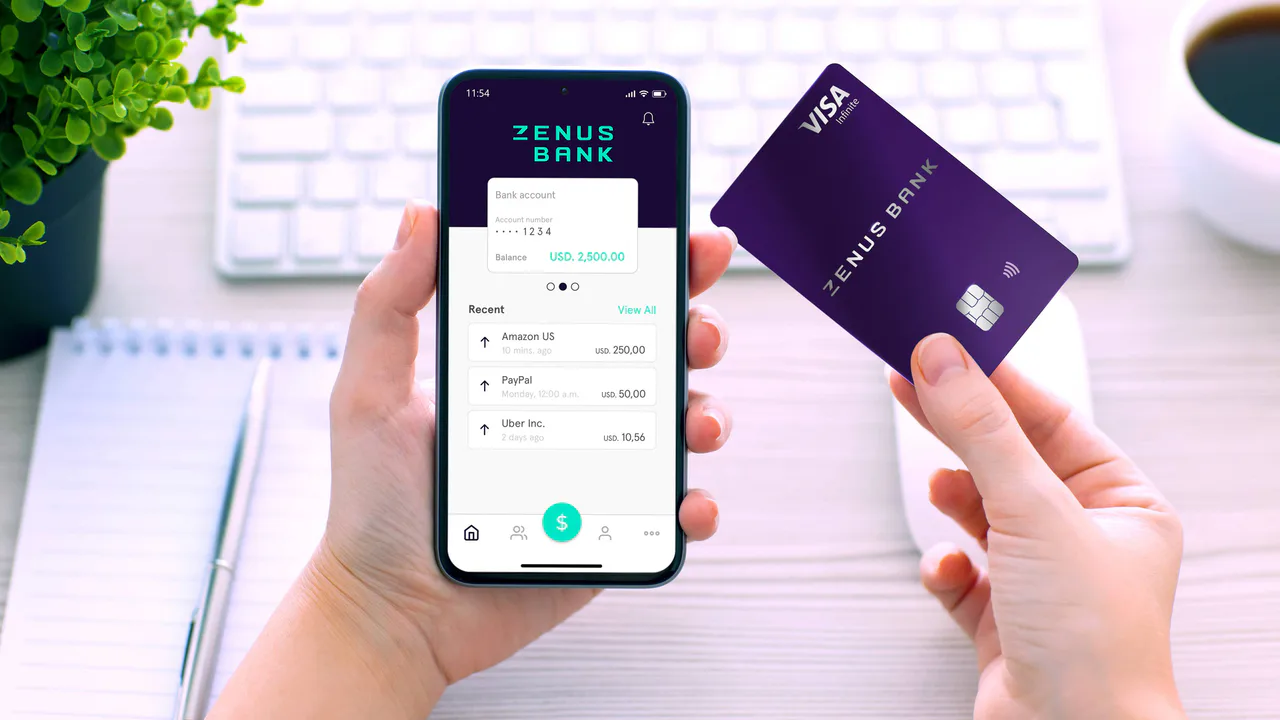
Zenus Bank announced Visa principal membership on June 30, 2020, securing a card-network relationship while the digital bank was still preparing to launch. Its contemporary release committed the bank to issuing Visa-branded debit cards exclusively and presented the agreement as a way to make remotely accessed U.S. banking useful to customers abroad.
In the company-issued announcement, Zenus described itself as the first International Financial Entity to obtain Visa principal membership. It said it expected to open later in 2020 and would operate a full-reserve model without lending or credit activities. Debit access fitted that stated model: the card would let a customer use account funds while the bank was proposing to keep lending outside its business.
The bank licence and the network relationship answered different questions
Puerto Rico's financial regulator, OCIF, lists Zenus Bank International, Inc. as an International Financial Entity under licence IFE-061, with an approval date of August 9, 2019. That regulatory identity is distinct from becoming a member of Visa. One concerns the financial institution; the other concerns participation in a payment network.
For a prospective partner, those are complementary foundations. The institution provides the account relationship and banking services; the network relationship connects the issuing proposition to card payments. A customer-facing programme brings them together through its issuing terms, processing arrangements and a supported route to the cardholder.
The network scale around the membership announcement
Visa's later 2020 annual report provides a consistent view of the network Zenus joined. It separates purchase value from cash volume and reports three fiscal years on the same basis. Rounded purchase volume was unchanged between fiscal 2019 and 2020, the year in which pandemic restrictions disrupted travel and commerce.
Visa payments volume around the 2020 membership announcement
Purchase value carried by Visa-branded cards and payment products, excluding cash volume.
USD trillion
Tap or hover for details. All values are also available in the data table.
Source
Fiscal years are the 12 months ended September 30. Rounded global network figures; FY 2020 extends beyond the June membership announcement. This is not Zenus transaction volume.
Show data tableHide data table
| Category | Payments volume |
|---|---|
| FY 2018 | 8.3 USD trillion |
| FY 2019 | 8.8 USD trillion |
| FY 2020 | 8.8 USD trillion |
Principal membership carries responsibility for the issuing identifiers
Visa's public rules provide a useful later explanation of the network mechanics. In the April 2026 edition, the rules say a principal-type member is responsible and liable for activities associated with the BINs or acquiring identifiers it licenses. A BIN is the bank identification number used within card issuance. The rules also set out responsibilities where a member sponsors another participant.
This is current network context, rather than a reconstruction of Zenus's confidential 2020 contract. It explains why principal status matters beyond brand acceptance: the institution has responsibilities associated with its licensed issuing identifiers. A programme can use a processor or other service providers while those network responsibilities remain defined by the membership and sponsorship arrangements.
Show data tableHide data table
| Milestone | What the public evidence establishes | What requires separate evidence |
|---|---|---|
| Bank authorisation | OCIF identifies the institution and IFE licence. | The precise terms applicable to a particular product or customer. |
| Visa principal membership | Zenus announced the network relationship in June 2020. | A completed launch in every intended market or a particular programme's availability. |
| Physical-card launch | IDEMIA announced the first physical Zenus card in April 2023. | Cards actually delivered, active cardholders or transaction volume. |
| BIN sponsorship | A later infrastructure service offered by Zenus. | Approval, scope and obligations of each sponsored programme. |
Global acceptance did not mean every resident could open an account
The 2020 release cited Visa/PLUS cash access in more than 200 countries. That figure described an ATM-network footprint, rather than a list of countries whose residents were eligible for a Zenus account. Acceptance, customer eligibility and a bank's ability to distribute a particular product are separate dimensions of cross-border banking.
The distinction matters for businesses evaluating a card proposition. A cardholder may travel to a place where the network is accepted, while the issuer applies a different set of rules to onboarding residents there. Merchant acceptance also says nothing by itself about application approval, cash-withdrawal limits, fees or exchange rates. Those are product and account terms.
Network reach is also different from processing activity. Visa's annual report counts transactions processed on its networks separately from the monetary value of purchases. That series continued to increase in fiscal 2020, even though rounded payments volume was flat, showing why a network relationship should be understood through both access and the work performed by its infrastructure.
Transactions processed on Visa networks, 2018 to 2020
Processing activity continued to rise while rounded payments volume was flat in fiscal 2020.
billion transactions
Tap or hover for details. All values are also available in the data table.
Source
Fiscal years are the 12 months ended September 30. Transactions processed on Visa networks are distinct from all Visa-branded transactions and from transactions of any single issuer.
Show data tableHide data table
| Category | Transactions processed |
|---|---|
| FY 2018 | 124.3 billion transactions |
| FY 2019 | 138.3 billion transactions |
| FY 2020 | 140.8 billion transactions |
The 2023 card project made physical delivery concrete
A later milestone arrived on April 11, 2023, when IDEMIA announced Zenus's first physical payment card. The Visa Infinite debit project used a metal design and a personalization and distribution operation in Budapest. IDEMIA described a single U.S. BIN supporting intended issuance in more than 133 countries, an immediate virtual credential and a physical-card delivery proposition of under ten days.
The launch proposition brought manufacture, personalization and fulfillment into the same international service. A customer could begin with a digital credential while the production and delivery operation supplied a physical card. The premium card design made an online banking relationship tangible, with the issuing arrangement and the logistics working behind it.
The later infrastructure strategy changed the customer relationship
On July 22, 2025, Zenus announced a shift away from its dedicated retail platform, with closure scheduled for October 22. The retained business included embedded banking, BIN sponsorship and cross-border payments for fintechs and institutions. That strategy moved more of the end-customer relationship to partner businesses while the bank supplied banking and payment capabilities underneath.
This makes the earlier Visa relationship relevant to an infrastructure story as well as a retail-bank launch. Yet principal membership, a physical debit-card programme and a sponsored partner programme remain different arrangements. Their requirements, customers and commercial economics should be assessed separately.
The membership announcement, physical-card launch and subsequent infrastructure strategy are documented milestones. The original first-IFE assertion remains a bank claim, the country figures describe different network and programme footprints, and the public sources do not disclose active-card totals or the terms of each sponsored programme. For an institutional partner, the useful thread is the bank's development from access to a network toward operating card services for other businesses.
In this article

Daniel Brooks
Daniel Brooks covers payment networks, financial technology, payment security, gift card fraud and PCI DSS for Gift Card News.