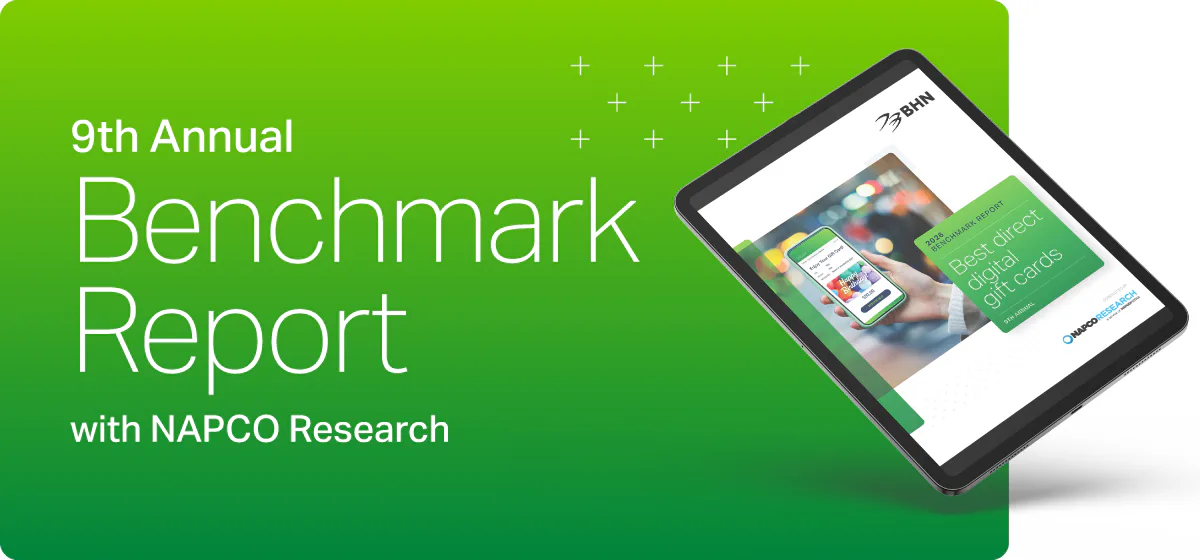
Blackhawk Network and NAPCO Research's 2026 benchmark identifies uneven coverage of digital gift card features across 120 brands. Released on July 15, the ninth annual study assessed 147 criteria across the purchaser and recipient experience. [S01]
The sample comprised 110 U.S. brands and ten Canadian brands. It examined gift cards sold directly through a brand's own website or app, rather than the full third-party distribution market. [S02]
Where the feature gaps appeared
Features reported across the 120 assessed brands
Percentages reported by Blackhawk Network. Hover over bars for values or use the data table and CSV download.
%
Tap or hover for details. All values are also available in the data table.
BHN and NAPCO Research 2026 benchmark. Each bar is a separate reported measure, not a share of transactions or a conversion rate. Criteria are not interchangeable and the percentages must not be added.
Explore the data table
| Category | Brands assessed |
|---|---|
| Met AI-search criteria | 61% |
| Offered AI gifting recommendations | 5% |
| Offered text delivery | 66% |
| Offered scheduled delivery | 48% |
The release reports 61% meeting its AI-search criteria and 5% offering AI-powered gifting recommendations. Text delivery appeared at 66% of brands, while scheduled delivery appeared at 48%. [S01]
A benchmark of the journey, not sales
The assessment spans discovery, purchase, delivery and redemption. Its updated framework also considers group gifting, animation, delivery notifications and purchase-flow integrity. The scope includes desktop, mobile web and mobile apps across 19 retail and service verticals. [S01]
That structure is useful because a gift card purchase has at least two users: the person buying it and the person receiving it. A smooth payment screen cannot compensate for unclear delivery, and an attractive gift message cannot resolve a recipient's difficulty finding how to redeem the balance.
For retailers, a lower score should prompt inspection of a particular step. Discovery, personalisation and delivery each call for different operational work. Treating the benchmark as one broad technology score would obscure those distinctions.
AI visibility is only one part of the picture
BHN reported an average marketing-assessment score of 34%. That is a score under the report's framework, not the percentage of retailers that market gift cards. [S01]
Similarly, meeting an AI-search criterion does not demonstrate that an assistant can complete a gift card purchase or redeem an existing balance. Visibility and transaction support are separate capabilities. A retailer can make information easier to find while still requiring a customer to finish the purchase in its own checkout.
The benchmark provides a structured comparison for the participating market. It is not a representative survey of all retailers, an audit of sales results or evidence that adding a particular feature will increase conversion by a stated amount.
Download the chart and table data (CSV). A free sign-in is required.
Sources and documents
Collapse
- [S01] BHN retailer AI discovery benchmark — Blackhawk Network
- [S02] 2026 benchmark scope and North American sample — Blackhawk Network
In this article

Oliver Reed
Oliver Reed covers industry acquisitions, investment and market research for Gift Card News.