Can you turn a gift card into cash?
Sometimes, but the route depends on what you own. A retailer gift card may attract a buyback offer or a marketplace buyer. An eligible network prepaid card may qualify for a specialist service that deducts fees and sends money to a bank. Some small retailer balances qualify for cash redemption under state law. None of those possibilities means that every Visa, Mastercard or Apple gift card can be transferred into a mobile cash account.
This guide compares the documents behind those routes: issuer agreements, platform eligibility, payout methods, fees and the event that starts the payment clock. It covers US products first, then separates UK, Nigerian and Ghanaian services. Conditions were checked on September 19, 2026. No cards were submitted, sold or redeemed for the research, and no personalized quotes were obtained. Published acceptance is therefore conditional, not a promise that a particular card will pass review.
The most consequential distinction is between a payment method and a withdrawable balance. Adding a card to a wallet may enable spending without enabling bank transfers. Apple explicitly excludes gift cards from Apple Cash funding. A separate resale company paying proceeds into PayPal is a different transaction from transferring a gift-card balance directly into PayPal. [S10], [S11]
The five routes and what each one delivers
| Route | What changes hands | Potential destination | Main condition | What the route does not establish |
|---|---|---|---|---|
| Issuer cash redemption | An eligible remaining balance is redeemed under law or the product agreement | Cash or the issuer's supported refund method | Product, jurisdiction, amount and other statutory or contractual conditions | A universal right to withdraw the entire face value |
| Buyback service | The buyer purchases an accepted card or balance | The order's supported bank, check or wallet payout | Accepted brand, valid ownership, verification and a confirmed offer | A guaranteed offer or payout speed for every card |
| Resale marketplace | A seller lists a card and waits for a buyer | Withdrawable sale proceeds after applicable holds and fees | An actual sale, valid balance and seller eligibility | Immediate liquidity merely because listing is available |
| Eligible prepaid conversion | A specialist accepts a qualifying network prepaid product | A supported bank payout after fees and approval | Exact card programme, issuer restrictions and service eligibility | Cash access for every Visa or Mastercard gift product |
| Reward choice before issuance | A recipient selects an available sponsor-funded reward method | A gift card, prepaid product or monetary payout, depending on the programme | Sponsor configuration, recipient location and method availability | Conversion of an unrelated card that has already been issued |
The product and provider profiles below document the first four routes. The section on reward programmes explains the fifth. Our separate state-by-state gift card cash-out guide covers statutory small-balance rights in detail. The search-interest map here answers a different question: where the phrase “gift card to cash” accounted for a larger share of Google searches during the selected period.
For a practical comparison, record the exact card and issuer, remaining balance, country of issue and whether the code has already been redeemed. Then compare the net amount reaching the destination and the time from starting the process to receiving it. A quoted recovery percentage, a marketplace commission and an ACH fee describe different parts of that calculation. They should not be placed in one ranking without explaining those differences.
US search-interest map: where people look for gift card to cash
The interactive map covers all 50 states and the District of Columbia. It uses the unquoted English search term “gift card to cash”, US Web Search, all categories, over 52 complete weeks from September 14, 2025 to September 12, 2026. The table was retrieved on September 19, 2026. The wording and period are fixed so that every jurisdiction belongs to the same comparison. [S08]
Wyoming has the highest relative score, 100. Alabama follows at 67, Georgia at 66, Mississippi at 65 and Oklahoma at 63. These scores compare the term's proportional search interest within each jurisdiction. They do not say that Wyoming produced more searches than California or that a Wyoming resident can recover more money. Google normalizes Trends data, so a high score in a small state can coexist with fewer absolute searches than a lower score in a large one. [S09]
The four colored bands are editorial display choices: below 40, 40–49, 50–59, and 60 or above. They are not legal categories, confidence intervals or measures of platform coverage. Gray is reserved for insufficient data; all 51 jurisdictions had a numeric score in this extraction. Hover previews an area, while click or the selector keeps its details open. The analysis link leads to the shared state table and interpretation below.
State-by-state search data and interpretation
The table preserves the displayed Google Trends ordering; tied scores do not imply a meaningful rank difference. A score of 50 indicates half the highest normalized proportional interest in this comparison, not half as many searches. 51 areas have values.
| Display order | Jurisdiction | Relative interest (0–100) |
|---|---|---|
| 1 | Wyoming | 100 |
| 2 | Alabama | 67 |
| 3 | Georgia | 66 |
| 4 | Mississippi | 65 |
| 5 | Oklahoma | 63 |
| 6 | Louisiana | 61 |
| 7 | Maryland | 61 |
| 8 | West Virginia | 61 |
| 9 | South Carolina | 60 |
| 10 | Nevada | 60 |
| 11 | Pennsylvania | 60 |
| 12 | Connecticut | 57 |
| 13 | Ohio | 57 |
| 14 | California | 57 |
| 15 | District of Columbia | 57 |
| 16 | North Carolina | 57 |
| 17 | Tennessee | 57 |
| 18 | Massachusetts | 55 |
| 19 | Kentucky | 55 |
| 20 | Virginia | 55 |
| 21 | Florida | 54 |
| 22 | New Jersey | 54 |
| 23 | Arkansas | 54 |
| 24 | New Mexico | 54 |
| 25 | Illinois | 52 |
| 26 | Arizona | 52 |
| 27 | Texas | 51 |
| 28 | Michigan | 51 |
| 29 | Oregon | 50 |
| 30 | Delaware | 50 |
| 31 | Indiana | 50 |
| 32 | New York | 50 |
| 33 | Washington | 48 |
| 34 | Kansas | 48 |
| 35 | Missouri | 48 |
| 36 | Hawaii | 48 |
| 37 | Rhode Island | 47 |
| 38 | Vermont | 45 |
| 39 | Alaska | 45 |
| 40 | Colorado | 45 |
| 41 | Nebraska | 45 |
| 42 | Utah | 42 |
| 43 | Minnesota | 42 |
| 44 | Maine | 41 |
| 45 | New Hampshire | 41 |
| 46 | Wisconsin | 41 |
| 47 | North Dakota | 40 |
| 48 | Iowa | 38 |
| 49 | Idaho | 33 |
| 50 | South Dakota | 25 |
| 51 | Montana | 23 |
Source: Google Trends, fixed term, period and geography [S08]. Field: interest by subregion; unit: normalized index. Extracted September 19, 2026. No population weighting or estimates of monthly search counts have been added. The same source rows feed the map and this downloadable table.
The unused-value problem: what Statista actually measures
Unused gift value explains why the conversion question attracts attention, but an unused balance is not the same thing as saleable inventory. A consumer may intend to spend the card later, have a balance too small for a marketplace, hold a restricted promotional instrument, or have already moved the code into a nontransferable merchant account. The following four Statista series describe possession, value and friction. None measures the amount a reseller will pay today.
The Bankrate and YouGov survey behind the first series was conducted online on August 19–21, 2024 among 2,373 US adults. Bankrate reports that 43% had unused gift cards, vouchers or store credit. Among the 1,010 respondents holding that unused value, the mean was $244 and the median was $100. The $244 figure must therefore be read as an average among holders, not an average across all adults. The survey used a non-probability sample with quotas and weighting. [S02]
Statista's generational table places Millennials at $332, Gen X at $255, baby boomers at $227 and Gen Z at $142, with $244 overall. These are 2024 survey values, even though the Statista page carries a later publication date. The table does not report the cash value recoverable from those cards, the number eligible for resale, or a 2026 market total. The original Bankrate findings also report that 7% of adults had resold a gift card, a separate behavior measure that cannot be multiplied by the unused-balance average to size a resale market. [S01], [S02]
Accenture's Holiday Shopping 2024 research, reproduced by Statista, gives a more operational view. Among 483 US respondents with unused balances, limited brands or stores and forgetting the card each received 34%. A balance too small to use received 25%. These were multiple-response questions: one person could have several reasons. Adding the percentages would count overlapping answers, not distinct people. The inspected source did not supply exact fieldwork dates or the complete questionnaire wording. [S03]
A separate Accenture sample of 1,501 US respondents identified experience improvements. Simpler balance checks attracted 36%, unused-balance reminders 35%, and both easier online/in-store redemption and more versatile uses 32%. Those findings support an editorial focus on balance visibility and redemption flexibility. They do not establish that 32% want cash conversion: the published category is broader than that. The sample is also different from the 483 people in the unused-balance question. [S05]
The fourth series, sourced to CivicScience, divides respondents among many unused cards, a few unused cards, unused cards they plan to spend soon, and no unused cards. Statista labels the columns 2024 and 2025 and gives a fieldwork window of January 25, 2024 to January 6, 2025, with 1,865 respondents age 18 and older shown in its metadata. The original publisher identifies the population as people who typically buy or receive gift cards. That is narrower than all US adults. [S06], [S07]
For the 2025-labeled column, 11% reported many unused cards, 29% a few and 21% cards they planned to use soon; 39% had none. The first three categories sum to 61% within that surveyed gift-card-user population. It would be incorrect to compare that number directly with Bankrate's 43% of adults and announce an increase. The surveys use different populations and periods, and separate annual CivicScience sample counts are not supplied in the inspected metadata. The original narrative also uses different holiday-year wording, so this guide retains the Statista series labels and displays the reported fieldwork window.
For readers, the useful implication is concrete: determine why the balance remains unused before accepting a discount. A reminder or an ordinary planned purchase might resolve one problem; a product restriction or an unsuitable merchant might require a different decision. For programme operators, balance checks and redemption instructions deserve attention alongside cash-choice features. This interpretation follows the survey categories without converting them into an unsupported estimate of recoverable money. Our research on gift card balance-check searches examines the related information need.
F02. Mean unused gift value by generation, US, 2024
Bankrate / YouGov: mean USD among holders of unused gift cards, vouchers or store credit.
USD per unused-value holder
Tap or hover for details. All values are also available in the data table.
Fieldwork August 19–21, 2024. Overall US adult sample 2,373; unused-balance subsample 1,010. Non-probability online sample with quotas and weighting. Not the average across all adults, a 2026 measure or recoverable resale cash. Generation-cell counts and exact questionnaire not supplied.
Explore the data table
| Category | Mean unused value |
|---|---|
| Gen Z | 142 USD per unused-value holder |
| Millennials | 332 USD per unused-value holder |
| Gen X | 255 USD per unused-value holder |
| Baby boomers | 227 USD per unused-value holder |
| Overall | 244 USD per unused-value holder |
T02. Mean unused gift value by generation, US, 2024
| Generation | Mean unused value (USD) |
|---|---|
| Gen Z | 142 |
| Millennials | 332 |
| Gen X | 255 |
| Baby boomers | 227 |
| Overall | 244 |
Bankrate / YouGov: mean USD among holders of unused gift cards, vouchers or store credit. Fieldwork August 19–21, 2024. Overall US adult sample 2,373; unused-balance subsample 1,010. Non-probability online sample with quotas and weighting. Not the average across all adults, a 2026 measure or recoverable resale cash. Generation-cell counts and exact questionnaire not supplied. [S01]
F03. Why gift-card balances remained unused, US, 2024
Accenture Holiday Shopping 2024: multiple-response online survey of 483 people with unused balances.
% of respondents
Tap or hover for details. All values are also available in the data table.
Not all US adults. Exact fieldwork dates and complete questionnaire wording not provided. Multiple selections overlap and should not sum to 100%. Responses are not legal determinations or cash-conversion demand.
Explore the data table
| Category | Respondents |
|---|---|
| Limited brands or stores | 34 % of respondents |
| Forgot the card | 34 % of respondents |
| No items to buy | 28 % of respondents |
| No time to use it | 28 % of respondents |
| Uninteresting options | 28 % of respondents |
| Balance too small to use | 25 % of respondents |
| Single redemption channel | 23 % of respondents |
| Technical redemption problems | 23 % of respondents |
| Expired before use | 22 % of respondents |
| Insufficient flexibility | 20 % of respondents |
| Required registration | 18 % of respondents |
| Lost the card | 17 % of respondents |
T03. Why gift-card balances remained unused, US, 2024
| Response | Respondents (%) |
|---|---|
| Limited brands or stores | 34 |
| Forgot the card | 34 |
| No items to buy | 28 |
| No time to use it | 28 |
| Uninteresting options | 28 |
| Balance too small to use | 25 |
| Single redemption channel | 23 |
| Technical redemption problems | 23 |
| Expired before use | 22 |
| Insufficient flexibility | 20 |
| Required registration | 18 |
| Lost the card | 17 |
Accenture Holiday Shopping 2024: multiple-response online survey of 483 people with unused balances. Not all US adults. Exact fieldwork dates and complete questionnaire wording not provided. Multiple selections overlap and should not sum to 100%. Responses are not legal determinations or cash-conversion demand. [S03]
F04. Requested gift-card experience improvements, US, 2024
Accenture Holiday Shopping 2024: separate multiple-response online sample of 1,501 US respondents.
% of respondents
Tap or hover for details. All values are also available in the data table.
This is not the 483-person unused-balance subsample. Exact dates and complete questionnaire not provided. Versatility is broader than cash conversion. Multiple selections should not sum to 100%.
Explore the data table
| Category | Respondents |
|---|---|
| Simpler balance checks | 36 % of respondents |
| Regular unused-balance reminders | 35 % of respondents |
| Easier online and in-store redemption | 32 % of respondents |
| More versatile uses | 32 % of respondents |
| Personalization options | 30 % of respondents |
| Upgrade to premium offerings | 26 % of respondents |
| Clearer instructions | 23 % of respondents |
| Better technical support | 23 % of respondents |
T04. Requested gift-card experience improvements, US, 2024
| Response | Respondents (%) |
|---|---|
| Simpler balance checks | 36 |
| Regular unused-balance reminders | 35 |
| Easier online and in-store redemption | 32 |
| More versatile uses | 32 |
| Personalization options | 30 |
| Upgrade to premium offerings | 26 |
| Clearer instructions | 23 |
| Better technical support | 23 |
Accenture Holiday Shopping 2024: separate multiple-response online sample of 1,501 US respondents. This is not the 483-person unused-balance subsample. Exact dates and complete questionnaire not provided. Versatility is broader than cash conversion. Multiple selections should not sum to 100%. [S05]
F05. Possession of unused gift cards, US gift-card users, 2024–2025
CivicScience: people who typically buy or receive gift cards; retain Statista series labels.
% of respondents
Tap or hover for details. Select a series above to show or hide it.
Statista metadata: 1,865 respondents age 18+, January 25, 2024 to January 6, 2025; annual sample counts not supplied. Original publisher defines gift-card users, not all US adults, and uses different holiday-year wording. Do not compare these proportions directly with Bankrate adult prevalence.
Explore the data table
| Category | 2024 | 2025 |
|---|---|---|
| Many unused cards | 12 % of respondents | 11 % of respondents |
| A few unused cards | 32 % of respondents | 29 % of respondents |
| Unused cards, planning to spend soon | 21 % of respondents | 21 % of respondents |
| No unused cards | 35 % of respondents | 39 % of respondents |
T05. Possession of unused gift cards, US gift-card users, 2024–2025
| Response | 2024 (%) | 2025 (%) |
|---|---|---|
| Many unused cards | 12 | 11 |
| A few unused cards | 32 | 29 |
| Unused cards, planning to spend soon | 21 | 21 |
| No unused cards | 35 | 39 |
CivicScience: people who typically buy or receive gift cards; retain Statista series labels. Statista metadata: 1,865 respondents age 18+, January 25, 2024 to January 6, 2025; annual sample counts not supplied. Original publisher defines gift-card users, not all US adults, and uses different holiday-year wording. Do not compare these proportions directly with Bankrate adult prevalence. [S06]
Identify the card before looking for a cash-out route
A useful gift-card-to-cash comparison begins with the legal product and the transaction being proposed. A Visa or Mastercard logo identifies a payment network. It does not identify the issuer, establish that the product is a bank debit card, or promise access to an ATM. A merchant gift card, a nonreloadable network gift card, a reloadable prepaid account and a cash-account debit card can appear in the same mobile wallet while retaining very different rights. Mastercard itself tells consumers that conditions vary by issuer. [S12]
Before comparing apps, record the programme name, issuer, physical or virtual format, issuing country and the agreement supplied with the card. Also establish whether the value remains on an unredeemed code, sits in a merchant account after redemption, or is available through a network card number. Those details determine which agreement and support process to use. A product page for a different issuer or an older programme cannot settle the question simply because its branding looks familiar.
Four operations deserve separate labels throughout the comparison. Storage displays a card or barcode in an app. Spending charges eligible purchases against that card. Funding moves value into a separate account balance. Resale exchanges a card or its rights with a buyer, who pays an agreed amount. A fifth operation, statutory cash redemption, depends on the applicable law and the particular product. None should be inferred from evidence that establishes only one of the others.
For example, adding a card to Apple Wallet may make an eligible purchase more convenient, but Apple expressly excludes gift cards from Apple Cash top-ups. PayPal separately documents an unwanted-gift-card offer through CardCash. The first concerns payment credentials; the second concerns a resale transaction with an offer. Both involve familiar mobile services, but they have different counterparties, restrictions and financial outcomes. [S10], [S11]
The practical decision is therefore narrower than asking which app accepts gift cards. Ask whether the issuer permits the proposed operation, whether the destination service supports that exact product for that exact operation, and what value remains after any discount or charges. A positive answer at the card-linking stage does not answer the other questions. Where the published documents stop short of confirming a specific route, the comparison below preserves that uncertainty instead of supplying an assumed cash-out method.
Cards and apps: what the official terms support
Vanilla Visa: a spending product with conditional wallet support
Vanilla Visa gift cards illustrate why broad merchant acceptance is easily mistaken for cash access. The current US FAQ describes a product for purchases and supports adding eligible eGift cards to Apple Pay, Samsung Pay and Google Pay. It also rules out ATM use. These are compatible features: a card can pay a merchant through a phone while providing no ability to withdraw its balance. The documented wallet function is a way to present the payment card at checkout. [S13]
The FAQ covers use in the United States and District of Columbia, excludes recurring billing, and distinguishes the card's validity date from the underlying funds, which it describes as nonexpiring. It states that no additional fees apply after the purchase fee. That fee statement belongs to the Vanilla product described by the page. It is not a claim that any outside resale service would buy the card without a discount or charge. [S13]
For an owner who wants to turn an unused balance into cash, the first fork is whether cash is actually necessary. Using an eligible card for an ordinary purchase already included in a household budget may preserve cash that would otherwise have been spent. That is a budgeting effect, not a withdrawal, and it does not create cash in a bank account. It should be described honestly when comparing it with an actual payout offer.
If a third party advertises acceptance of Vanilla cards, the next step is to match the exact card programme with that service's current eligibility and the issuer agreement. This article has not submitted a card or obtained a personalized acceptance decision. Its conclusion is limited to what the product documentation supports: merchant spending, conditional wallet use and no ATM route. A separate buyer's advertised interest cannot by itself establish that the issuer permits every form of monetization.
MastercardGiftCard.com and Sutton Bank: identify the agreement, not just Mastercard
The agreement examined on MastercardGiftCard.com describes a specific nonreloadable gift card or virtual account issued by Sutton Bank. Its published effective date is December 2023. It prohibits obtaining cash through the card, including ATM transactions, while providing for conditional virtual-card use at physical merchants through a supported digital wallet. The distinction is important for readers who see a Mastercard credential accepted by an app and assume that bank-transfer features must follow. [S14]
The website's FAQ independently says that these gift cards do not provide ATM withdrawals or purchase cashback. It ties digital-wallet functionality to an available Add to Wallet option and merchant acceptance. It also describes most approved eGift orders as arriving within five minutes, with some taking up to 24 hours. Delivery speed says when the recipient may receive the product; it does not change the product into a cash account. [S15]
The Sutton agreement states that there are no fees after purchase, although an activation fee may be charged when the card is purchased. Those terms should not be attached to all Mastercard gift products. The site also references another issuer in its broader disclosures. A recipient needs the agreement associated with their own card, not a conclusion drawn from the storefront's network branding or the first agreement found in search results. [S14]
A useful support request therefore includes the programme name and asks whether a proposed transfer is permitted under that programme. Asking only whether Mastercard works with an app invites an answer about the network, not the gift product. Until both issuer permission and the destination service's eligibility are established, the appropriate comparison entry is conditional or unverified. The prohibition on cash in the examined Sutton agreement remains a substantive restriction, rather than a technical problem to solve through another payment screen.
Giftcards.com and Pathward: product labels and agreement versions matter
Giftcards.com's legal pages show why an apparently precise web link can still leave a product-identification problem. The URL labelled as a Visa eGift card agreement rendered a page titled Visa Gift Virtual Account Cardholder Agreement when reviewed. That document names Pathward and describes online, mail and telephone purchases. The legal index separately lists different virtual, eGift, physical and reward products, as well as programme-closure notices. These documents cannot safely be compressed into one rule for everything sold by Giftcards.com. [S16], [S17]
The examined virtual-account agreement excludes physical-store use and prohibits cash and quasi-cash transactions, including deposits, money orders and wire transfers. It also lists a $4.95 monthly maintenance fee after 12 consecutive inactive months and a $5 lost-or-stolen replacement charge. These figures document that particular agreement. They are not a verified schedule for every current Giftcards.com eGift product, nor a fee quotation for a third-party cash-conversion service. [S17]
Elsewhere, the site's product disclosures describe contactless retail use for eGift cards. The editorial response to this difference is to preserve the product boundary. It would be misleading either to declare every product online-only or to ignore the restrictive agreement because another page describes a wallet feature. A recipient should match their actual card, issuer and supplied terms before relying on either description.
This case also shows why a cash-out guide needs an evidence-status field. The source can be authentic while its applicability to a particular reader's card remains unresolved. Programme closures make that match even more important. Until the identity is reconciled, neither the quoted maintenance fee nor a claimed wallet route should be used to calculate the reader's expected proceeds. The unknown is the applicable product contract, not the arithmetic.
Apple Gift Card, Apple Account and Apple Cash: three distinct concepts
An Apple Gift Card, the Apple Account balance created through redemption, and Apple Cash should be treated separately. Apple's US gift-card terms describe eligible purchases within the Apple ecosystem. They restrict cash redemption and refunds except where required by law, prohibit resale or exchange, and make unused associated balances nontransferable. An Apple Account virtual card displayed in Wallet remains a way to use that associated balance; its presence alongside payment cards does not turn it into Apple Cash. [S18]
Apple's separate Apple Cash support page directly addresses the potential confusion: gift cards cannot be used to add money to Apple Cash, including gift cards already stored in Wallet. It also notes that some prepaid cards may not work. The relevant distinction is therefore the source of the money and the permitted funding product, rather than the fact that both balances appear on the same phone. [S10]
That creates two practical checkpoints. Before redeeming a gift code, identify the purchases for which the resulting balance is intended. After redemption, do not assume that an account balance can be exported using instructions written for an unredeemed card. Redemption changes the form in which the value is held, and the associated-balance terms remain relevant. Separately, a resale site's willingness to quote for an Apple-branded product does not remove Apple's restrictions. The listing and the issuer terms answer different questions.
For readers searching for Apple gift card to Apple Cash, the documented answer is that Apple does not support that funding route. A legally required cash-redemption exception must be assessed under its own conditions; it is not the same as routine Apple Cash functionality. Nor should an advertised bank payout from an unrelated buyer be labelled an Apple withdrawal. Keeping these distinctions explicit prevents a seemingly simple comparison table from promising a conversion that the platform's own documentation excludes.
Amazon.com gift cards: distinguish Amazon shopping from Amazon Pay
Amazon Pay creates an understandable source of confusion because shoppers encounter the Amazon name at third-party checkouts. Its official US help page states that Amazon.com gift cards cannot pay for orders made through Amazon Pay. A gift balance intended for eligible Amazon purchases does not therefore become a general third-party checkout balance simply because the checkout offers Amazon Pay. The merchant's payment button and the customer's Amazon gift balance belong to different payment arrangements. [S19]
For the Amazon.com gift cards distributed through the examined CashStar channel, the published distribution terms prohibit resale, transfer for value and cash redemption, subject to legally required exceptions. They also prohibit using the gift card to buy other gift cards and describe a received card as nonreturnable and noncancelable. That is a channel-specific contractual example. The page points readers to Amazon.com for additional redemption conditions, and the complete current US account-balance agreement was not independently retrievable for this review. [S20]
The missing document limits the breadth of the conclusion, but it does not leave the Amazon Pay question unanswered. That restriction is directly documented. It also would be inappropriate to replace the unavailable US agreement with Amazon's UK, Indian or Japanese rules. A common brand name does not make country-specific balances interchangeable, and a foreign refund or transfer feature would not establish a US entitlement.
For a US holder, the evidence supports checking the applicable Amazon.com agreement before redemption or any proposed transfer, and rejecting Amazon Pay as an assumed cash bridge. A reseller's brand listing is not proof of contractual permission. If the practical objective is simply to use the gift, the relevant comparison is eligible spending. If the objective is a legally required refund, the issue is the applicable rule and support procedure. Neither can be answered by showing that Amazon Pay appears on another retailer's website.
Google Play: content credit does not become a transferable payment balance
Google Play balance is intended for eligible digital content and services, with country and currency restrictions. Google's permitted-use guidance expressly separates it from other payment methods: the balance cannot be used to add money to GPay or another payment method. The presence of Google branding across Play, Wallet and payment services should therefore not be interpreted as a shared pool of withdrawable money. Each product's rules determine what the balance can purchase or fund. [S21]
The refund policy generally describes Play balance as nonrefundable and nontransferable, subject to applicable law. Its US provision says gift cards ordinarily cannot be redeemed for cash except when state or federal law requires it. The policy also addresses specific gift-card problems and regional exceptions. A remedy for a defective or undelivered product is conceptually different from a standing ability to exchange a valid, redeemed balance for a bank transfer. [S22]
Consider the decision before redeeming a Play code. If the recipient wants cash rather than eligible content, completing redemption should not be treated as a necessary first step toward conversion. The documented product is designed for spending within its permitted uses. Any potential refund, support remedy or resale proposal needs assessment in its own form, with the issuing country and whether the code has already been redeemed clearly stated.
Google Wallet provides an additional boundary: its gift-card storage instructions say that Google Play gift cards are not supported. A generic suggestion to add every Google-branded gift product to Wallet is therefore not even a reliable storage instruction, much less a transfer method. The appropriate entry in a cash-route table is that Play does not document ordinary balance funding into another payment account, with legal refund exceptions evaluated separately. [S23]
Cash App: its own account features do not extend to unrelated gift cards
Cash App's US terms provide a direct answer to a common search: unaffiliated prepaid cards and gift cards cannot be used to fund transactions on Cash App. The restriction concerns the funding source. It is more specific than a generic claim that an app supports a major payment network, and it is not resolved by giving a nonreloadable gift card the same label as a bank debit card. [S24]
PayPal: card acceptance, balance funding and resale proceeds are separate
PayPal's help lists supported payment-card networks and includes prepaid cards. That establishes a general category of supported cards for the described service; it does not confirm that every nonreloadable gift card can fund a PayPal balance or be withdrawn to a bank. The separate add-money instructions refer to Visa or Mastercard debit cards and confirmed bank accounts. Product eligibility must be checked at the operation being attempted, rather than inferred from a broader card list. [S26], [S27]
PayPal does, however, document another route for unwanted gift cards: obtaining an offer through CardCash and accepting an available PayPal payout. That is useful evidence because it identifies a counterparty and an offer process. It is resale, with the amount determined by the available offer, rather than an instruction to transfer every dollar of a gift balance at face value. The help page does not establish acceptance of every merchant or network gift product. [S11]
The resulting decision tree has distinct branches. Paying an eligible merchant using a linked card is spending. Adding money through a supported funding source is account funding. Accepting a buyer's quoted payment is resale. A reader comparing net proceeds needs the third branch's current quote and conditions, not the card-linking branch's general acceptance language.
The issuer's contract remains relevant to resale, including any restriction on transfer or cash conversion. An available buyer offer is evidence of that buyer's willingness to transact, not a ruling on the issuer agreement. For this reason, the PayPal route should display offer availability, product eligibility and issuer conditions alongside the payment destination. No universal percentage or guaranteed instant payout can be extracted from the general PayPal instructions alone.
Venmo: registered prepaid-card support is not universal gift-card funding
Venmo's card FAQ permits supported cards registered in the user's name, including prepaid cards. It also describes issuer or Venmo declines and the relevance of card details such as the ZIP code. This is a conditional card-acceptance statement. It does not establish that an anonymous or nonreloadable gift card is eligible for every payment, add-money or withdrawal feature available to a Venmo customer. [S28]
The separate balance-funding instructions describe adding money from a bank or debit card. Debit funding is generally described as instant, while bank funding can take three to five business days; transfers may be reviewed or declined. These timing descriptions start from an eligible funding method. They cannot be used to claim that a specific Visa or Mastercard gift card can become a transferable Venmo balance instantly. [S29]
The distinction is especially important for a recipient who has already added a card successfully. A saved card record answers whether the service accepted those details for that stage. It does not independently establish the issuer's permission for a later transaction or the destination feature's eligibility. The right question for support is whether the exact nonreloadable product is supported for the proposed operation, not whether Venmo accepts prepaid cards in general.
This review therefore leaves direct gift-card-to-Venmo balance funding unconfirmed for unspecified gift products. It does not convert the absence of product-specific confirmation into a claim that every prepaid card is prohibited. That preserves both sides of the evidence: Venmo documents some prepaid-card support, while the documents examined do not validate a universal gift-card cash-out procedure. Any third-party service offering a Venmo payout should be evaluated as a separate transaction with its own eligibility, price and payment conditions.
Google Wallet: a container for supported credentials, not a cash-conversion service
Google Wallet's gift-card instructions describe adding and displaying supported merchant gift cards. They separately direct cards bearing Visa or Mastercard branding through the payment-method setup flow. These are different ways of storing credentials for later use. Neither instruction establishes that the underlying gift value can be withdrawn, transferred to a bank or combined into a general-purpose cash balance. The merchant or card issuer still defines the spending rights attached to the credential. [S23]
For a merchant gift card, the practical benefit may be easier retrieval at checkout. For an eligible network product, the benefit may be supported contactless spending. A recipient comparing apps should record these functions separately from bank payout. Describing every supported card as convertible would erase the distinction between presenting a barcode or payment token and transferring the economic claim represented by the balance.
The same help page explicitly excludes Google Play gift cards from its gift-card support. That is a useful reminder that ownership by the same corporate group does not create interoperability. A Play balance has content-purchase rules; a merchant pass represents a retailer's programme; a supported network payment card has an issuer agreement. Google Play's own documentation also prevents using that balance to add money to other payment methods. [S23], [S21]
The comparison entry for Google Wallet should consequently describe supported storage and payment presentation, with merchant, issuer and country limitations. It should not quote a cash-out fee because no general gift-card cash-out service is established by these sources. For someone whose objective is using an otherwise forgotten balance, storage can still be valuable. For someone who needs money in a bank account, storage alone does not satisfy the objective. The next decision must concern a separately documented redemption, refund or resale route for the actual product.
Comparing US cash-conversion and resale services
The services below solve different problems. A buyer can purchase a retailer gift card at a discount, a marketplace can wait for another customer to purchase it, and a prepaid-card service can process an eligible network card and send the proceeds to a bank. These routes have different acceptance rules, payment clocks and economics. Their public documentation was checked on September 19, 2026; this comparison records published conditions rather than completed transactions or personalized offers.
A useful comparison begins with the amount that will actually reach the chosen destination. The card's remaining balance, the selling price, a platform wallet credit and the eventual bank deposit are separate amounts. A headline percentage may exclude withdrawal costs, while a headline delivery time may start only after identity checks, sale or approval. Treating every service as an instant exchange obscures precisely the conditions that matter to someone trying to recover a small balance.
| Service | Conditional acceptance and geography | Cost or recovery basis | When the payment clock starts | Identity and payout requirements |
|---|---|---|---|---|
| CardCash | US-focused retailer-card service; acceptance and physical-card delivery depend on the order. General Visa/Mastercard input eligibility not established. | Individual buyback quote; an alternative listing route preserves the agreed payout. | Older help: 1–2 business days after approval. Listing route: onward sale, then seven issue-free days. | Older help requires a credit card and verification authorization; lists ACH, check and PayPal. Confirm the methods offered on the order. |
| US transactions, USD cards, supported brands and seller-tier limits. | New Seller tier: 15% commission, $0.30 listing fee; conditional refund fees may apply. | A buyer must purchase the listing; New Seller payout term is 14 days, followed by payment processing and ACH delivery. | State ID/license, selfie, credit card and ACH in seller's name. Current payout guidance specifies ACH only. | |
| Retailer-card quotes; Visa/Mastercard restricted to selected sellers. Older help covers US/Canada; current Canadian onboarding needs confirmation. | Verified balance multiplied by the offered recovery rate, with applicable payout costs. | Published processing guidance conflicts: marketing says 1–5 business days; dated help says 5–10, with some retailers taking up to 30. | Identity verification before payout. US ACH documented; older Canadian and crypto options require current confirmation. | |
| Eligible USD network prepaid cards for US residents aged 18+; not every card is accepted. | Current ACH support: 10% plus $1.50. | Approval is necessary; next-business-day target depends on the 2pm Pacific cutoff. Review can add time. | Identity/account checks and a matching-name bank account. Instant processing is currently marked unavailable. |
Sources and qualifications for each row appear in the corresponding profile. This is a comparison of documented processes, not a ranking of reliability or guaranteed recovery. A card accepted by a marketplace must also be assessed against its issuer's transfer and resale restrictions. In particular, the appearance of Apple in a buyer's brand list does not override Apple's gift-card terms [S18].
CardCash: distinguish an upfront offer from a sale-first listing
CardCash is relevant to holders of eligible retailer gift cards who want a quoted payout. Its documentation also describes orders that cannot be purchased upfront and instead enter a listing process. That distinction changes the time to money: accepting a quote does not establish that every order will be paid on the same schedule.
The company's seller-help page [S30], dated January 2021, lists ACH, mailed check and PayPal. It describes payment being sent shortly after order approval, with additional time possible for physical-card delivery and new-member checks. It also describes verification using an actual credit card, with a $1 authorization, rather than a debit card. Because this page is older than the current research date, a seller should confirm the payout method and verification conditions presented on the actual order.
The alternative listing agreement [S31] supplies the important exception. Inventory or system constraints can prevent an upfront purchase. With the seller's agreement, CardCash lists the card, normally within one or two days. Payment follows an onward sale and seven days without issues. The seller retains the previously agreed payout even if the platform's resale price differs, and the page describes no additional listing-route fee. A physical card must arrive before listing; cancellation is unavailable after a buyer purchases it.
For a consumer comparison, these are two payment processes under one brand. The practical question is whether CardCash is buying the balance now or finding an onward buyer first. A quoted amount can remain fixed while the waiting time remains dependent on demand. Someone who needs a bank deposit by a particular date should therefore read the selected route before transferring control of the card.
CardCash also provides an exchange for a virtual prepaid Mastercard [S32]. This exchanges an eligible retailer card for another spending instrument, with identity and product conditions. The page identifies a US-use prepaid output and a claim deadline. It does not establish that the resulting Mastercard balance can be withdrawn to a bank. The exchange may broaden where value can be spent, but it belongs in a different column from an ACH cash payout.
For readers comparing a retailer-card exchange with cash recovery, the relevant decision is what they need next. A more widely accepted prepaid product can be useful when the aim is a planned purchase. It does not answer a need for rent money, a bank deposit or an unrestricted transfer merely because Mastercard branding appears on the replacement instrument.
GCX: selling price, seller tier and ACH timing all matter
GCX operates a marketplace for accepted retailer gift cards and store credit. The seller proposes a price and waits for a purchase; a successful listing is not an immediate buyback. For a first-time seller, the current tier schedule and withdrawal rules matter more than an older summary advertising free listings or multiple payment methods.
GCX states that it supports US transactions and USD-denominated cards [S33]. Its September 2026 card-eligibility guidance [S34] includes new and partially used cards from supported brands, with a $5 eGift minimum. The general upper balance ceiling is not necessarily the limit for a particular seller: the tier schedule gives New Sellers a lower $500 card limit.
The August 2026 seller-tier table [S35] assigns New Sellers a 15% commission, a $0.30 listing fee and a 14-day payout term. Higher-volume sellers have different terms. A refund fee can apply when a refund creates a seller debit; it is not an inevitable charge on every sale. These details supersede the picture in the older general fee page, which still describes free listing. The listing and earnings screen should be checked before submission.
Commission is calculated on the selling price, which can already be below the card's remaining balance. Thus a seller who discounts a card to attract a buyer and then pays commission has two reductions to consider. A platform's commission percentage alone is not the percentage of the original gift value the seller will lose. No live listing price or completed trade was obtained for this study, so there is no observed GCX recovery rate to generalize across brands.
The August 2026 payout guidance [S36] says ACH Direct Deposit is the only payout method and that PayPal is no longer supported. Funds must clear the seller-tier delay after sale before withdrawal eligibility. After GCX processes payment, ACH can take up to three business days, excluding weekends and holidays, with possible additional bank posting time. A statement that a marketplace pays in a few banking days therefore omits the earlier sale and holding stages.
GCX's identity guidance [S37] calls for a selfie, state identification, a credit card and ACH details in the seller's name. Its selling instructions [S38] also make acceptance dependent on the current brand selector and, for some brands, seller approval. A general website description cannot establish eligibility for a particular Visa, Mastercard or restricted retailer product.
GiftCash: a quoted buyback with unresolved timing differences
GiftCash offers a quoted purchase route for eligible retailer cards. Its documentation distinguishes ordinary retailer-card transactions from Visa and Mastercard transactions available only to selected sellers. It also contains inconsistent payout-speed statements, so a comparison should disclose the difference instead of selecting the fastest published number.
The company's payout-calculation page [S39] explains the basic model: multiply a card's verified remaining balance by its offer rate, then combine the offers for a multi-card order. That rate is the central economic input. An advertised maximum recovery percentage is a ceiling for some circumstances, not the expected price for an arbitrary card. Brand demand, card form and the specific offer need to be known before a consumer can compare the net amount with another service.
GiftCash's verification policy [S40] requires identity verification before payouts and expressly restricts Visa/Mastercard transactions to selected sellers. A landing page with a Visa-related URL is therefore insufficient evidence that every visitor can sell every network-branded gift card. Approval concerns both the card and the seller. Readers should establish that eligibility before considering headline rates or sending sensitive card details.
The December 2024 timing guidance [S41] gives a typical processing range of five to ten business days, with some retailers taking up to 30. In contrast, current indexed marketing [S42] advertises US direct deposits in one to five business days. The available evidence does not reconcile these statements. This article therefore reports the conflict rather than treating the marketing range as a verified service level.
The older payment-method guidance [S43] lists ACH for US users, Interac for Canada and cryptocurrency options. It makes availability dependent on country, retailer, card form, amount and verification. Current marketing emphasizes the US, so the older Canadian instructions should not be read as a fresh confirmation that Canadian onboarding or every historical payout method remains open.
The useful question for a seller is consequently specific: for this card, account and destination, what amount is payable, when does processing begin, and what can delay it? A written order confirmation is more decision-relevant than a generic landing-page promise. This comparison identifies GiftCash as a documented option to investigate, without treating uncertain eligibility or conflicting timing as resolved.
Prepaid2Cash: eligible network cards, a percentage charge and a fixed charge
Prepaid2Cash addresses eligible network prepaid cards rather than functioning as a universal buyer of retailer gift cards. Its current support material describes an ACH route, while marking Instant temporarily unavailable. The percentage-plus-fixed-fee structure makes the cost proportionally heavier on small balances.
The terms [S44] describe a service for adults in the United States using USD and eligible cards on networks including Visa, Mastercard, American Express and Discover. They exclude reloadable prepaid cards and cards associated with government, insurance or transit agencies, and leave acceptance subject to review. These exclusions are significant: a payment-network logo does not erase differences between a gift product, a benefits card and a reloadable account.
The current pricing page [S45] lists ACH at 10% plus $1.50, with a 2pm Pacific submission cutoff for its next-business-day target. Its Instant option is explicitly unavailable. For illustration only, applying that published ACH formula to an accepted $100 balance yields $88.50 before any separate costs not included in the formula. Applying it to $20 yields $16.50. These are arithmetic illustrations, not quotes or evidence that either hypothetical card would be accepted.
Approval is another separate step. The timing guidance [S46] says review can take up to 24 hours and payment processing begins only after approval. The account's transaction estimate, banking calendar and cutoff therefore matter. The homepage's continued reference to receipt in as little as 15 minutes should not be used as the operative promise while the current support page marks Instant unavailable.
The transaction support collection [S47] describes virtual prepaid-card submissions, a published $20 minimum and a $1,000 per-user limit over 24 hours, subject to change. It also calls for matching account and bank names and makes clear that acceptance is not universal. A virtual format does not itself disqualify a card, but neither does it secure approval.
This route should be evaluated against a straightforward alternative: using the card for an eligible purchase the holder already intends to make. A bank deposit offers flexibility, but the processing charge is an economic cost of obtaining that flexibility. The decision turns on the actual accepted balance, the final fee, timing and the holder's needs, not on an assumption that cash conversion preserves face value.
International services and payout geography
International gift-card resale requires four separate geographic checks: where the seller may hold an account, where the card was issued, where its balance can be redeemed, and where the proceeds can be withdrawn. A US-dollar card can be traded for a Naira balance, and an app available in a US app store can still require a Nigerian or Ghanaian payout destination. A wallet labelled USD may offer cryptocurrency withdrawal rather than a transfer to a US bank.
The following services broaden the comparison beyond US domestic resale. They are not presented as equivalent substitutes for a US resident seeking an ACH deposit. Their published workflows establish particular combinations of account eligibility, card categories, currencies and payout rails. Where a complete supported-country list or a current identity threshold was not established, that limitation remains explicit.
| Service | Geography and conditional acceptance | Cost or recovery basis | Approval and payout clock | Identity and destination |
|---|---|---|---|---|
| UK-resident sellers; supported retailer physical and digital products. | Quoted purchase value; cash and Cardyard credit are distinct outputs. | Two weeks after onward sale, or after the final card sells in a multi-card order. | Published ID triggers: £150+ card or £1,000 monthly selling. Bank transfer, PayPal or platform credit. | |
| Nigerian/Ghanaian users with corresponding account and ID; exact brand, origin and format category required. | Live trade quote; review precedes wallet credit. | Review, wallet credit and withdrawal are separate; contact support for trades pending beyond 30 minutes. | NGN/GHS accounts, local bank rails and Ghana mobile money; published withdrawal and KYC conditions apply. | |
| Broad app access; documented fiat rails are Nigerian banks and Ghana MTN MoMo. | In-app quote; Naira withdrawal fee of ₦50. | Trade review precedes wallet availability and separate withdrawal. | Wallet minima published as ₦2,000, GH₵30 and $50. USD withdrawal is to crypto; exact selling KYC tier needs confirmation. | |
| Documented Nigeria/Ghana fiat routes; non-Nigerian verification exists but does not establish every country's eligibility. | Rate at review; ₦50 Naira withdrawal fee; GHS mobile-money withdrawal described as free, with other fees conditional. | Submission enters review; wallet credit and withdrawal are distinct. | Certain features/limits require KYC; USD wallet withdrawal uses a stablecoin destination, not a demonstrated US-bank route. |
Cardyard: UK resale with payment after the onward buyer
Cardyard accepts supported retailer gift cards from UK residents and quotes an agreed purchase amount. Its payment process depends on selling the card onward and then waiting through a quarantine period. This structure is relevant to someone who can wait for resale, rather than someone who needs immediate liquidity.
The selling instructions [S48] cover physical cards, eGift cards, eVouchers and digital cards, subject to retailer support. Sellers confirm UK residence, provide their details and choose bank transfer, PayPal or Cardyard credit. The confirmation process displays the agreed amount and an estimated payment date. Platform credit should be classified as additional spending value, not as cash already delivered outside the platform.
The payment-timing page [S49] states that payment is two weeks after Cardyard sells the card to a buyer. When an order contains several cards, that clock starts after the last card is sold. The distinction matters because a multi-card order combines the waiting risk: a slower-selling card can affect when the order is paid. Describing this simply as a two-week payout would omit the time needed to find the final buyer.
Cardyard's identity guidance [S50] identifies checks for cards worth at least £150 or monthly selling reaching £1,000. Photo identification, address verification and a private bank account can form part of the process. These are the provider's documented thresholds; this study does not present them as universal UK rules for every gift-card exchange.
The seller-obligations page [S51] is also important. Sellers guarantee balance and expiry information and must not use the card or permit another person to use it after transfer. Obligations can continue until the buyer has spent the full value, with repayment exposure if the supplied information is wrong. Receiving payment therefore does not necessarily end the contractual relationship.
The comparison did not establish general Visa/Mastercard acceptance or a verified native Cardyard app. Its documented retailer-card workflow should stand on its own terms. Neither a mobile-friendly site nor a digital-card category is sufficient evidence of a native app or network-card cash-conversion service.
Cardtonic: card categories and Nigerian or Ghanaian payout access
Cardtonic publishes a gift-card trading workflow for Nigerian and Ghanaian users. It lists retailer brands and certain network-branded products, but actual acceptance depends on the precise card category. Its documented account geography prevents a broad accepted-brand list from becoming a promise of worldwide bank cashout.
The official selling page [S52] says users need Nigerian or Ghanaian bank and identity credentials even where the service is accessed from abroad. It names brands including Apple, Amazon and Steam, alongside Visa, Mastercard, Vanilla and American Express products. These listings describe the buyer's inventory categories. They do not override issuer terms or prove eligibility for every issuer, country, denomination and seller associated with a named network.
The July 2026 sale instructions [S53] require selection of physical card or code, brand and country/value subcategory. Amazon submissions also distinguish receipt types. After approval, the payout credits a Naira or Cedis wallet. The instruction to contact support when a trade remains pending beyond 30 minutes is an escalation point, not a guarantee of bank receipt within that time.
Cardtonic's withdrawal guidance [S54] publishes a Nigerian minimum of ₦2,000 and separate limits linked to verification. It describes withdrawals normally processing within minutes, while acknowledging tracing and waiting periods when a payment is marked paid but has not reached the bank. Bitcoin is not listed as an available withdrawal method. A completed trade and a completed bank withdrawal consequently require separate confirmation.
The Ghana account guidance [S55] says the signup country determines currency and services. Ghana withdrawals are in Cedis, with mobile-money support; moving between Nigerian and Ghanaian arrangements is not merely a currency toggle. The company's separate virtual-dollar-card offering should not be interpreted as proof of US-dollar bank withdrawals from gift-card sales.
Official-linked iOS [S56] and Android [S57] listings were documented. Their existence establishes a distribution route, not successful payout, all-country eligibility or an independent reliability rating. For the reader, the decisive comparison remains the accepted card subcategory and the accessible payout destination.
NOSH: worldwide access does not mean worldwide fiat withdrawal
NOSH illustrates why mobile availability and cashout geography need separate labels. Its help material describes broad international app access, while its documented fiat withdrawal routes center on Nigerian bank accounts and Ghanaian mobile money. A user should identify the destination rail before interpreting a quoted wallet amount as usable local cash.
The country-access guidance [S58] says some services are country restricted. For example, the Nigerian virtual-bank-account feature requires Nigerian banking and verification information. This qualifies the general claim that the app can be accessed from any country: the ability to open an app or submit a card does not demonstrate withdrawal to an arbitrary foreign bank.
NOSH's sale instructions [S59] require a card type, country and physical-or-code subcategory, amount and payout currency. The distinction between a US physical Steam card and a US Steam code is one documented example. A displayed rate belongs to that product category. The research did not establish universal Visa or Mastercard acceptance, so these network names should not be added to a compatibility matrix without product-specific support.
The wallet guidance [S60] lists Nigerian-bank withdrawals for NGN, MTN MoMo withdrawals for GHS and cryptocurrency withdrawal for USD. Published minima are ₦2,000, GH₵30 and $50 respectively. A small sale can therefore produce a wallet credit that does not yet meet the relevant withdrawal minimum. USD denomination, in particular, should not be described as an established US-bank transfer capability.
Documentation dates matter for costs. An older wallet page describes Naira withdrawal without a charge, but the January 2026 fee notice [S61] introduces ₦50 per withdrawal, added to the wallet debit while the requested amount reaches the bank. This study reports that as the provider's fee. It does not adopt the provider's explanation as an independently verified statement of universal tax law.
The Android listing [S62] identifies Topnosh Global Services Limited, and an iOS listing [S63] also exists. Their availability does not resolve the exact current KYC requirement for every selling tier. That remaining condition belongs alongside withdrawal minimums and destination support when assessing a particular account.
Prestmit: the review-time rate and the eventual withdrawal rail
Prestmit provides a reviewed gift-card trade with wallet and cryptocurrency payout options. Two distinctions are especially important: a previewed rate may change before review, and credit to a USD wallet does not establish that the proceeds can be sent to a US bank. The final route depends on the account and selected payout method.
Its June 2026 sale instructions [S64] require brand, issuing country, physical-card or code format and value category. Amazon, iTunes and Steam appear as examples, rather than an exhaustive or unconditional acceptance catalog. A displayed expected amount precedes review. A seller needs the correct product category before the displayed figure has practical meaning.
The rate guidance [S65] says the applicable rate is the one current when the transaction is reviewed. A screenshot of an earlier calculator output is consequently not evidence of a locked offer. This is a different comparison problem from a provider that agrees a fixed purchase amount at submission: both the amount and the process for establishing that amount matter.
Prestmit's payout-method guidance [S66] describes Naira, Cedis and USD wallet options, as well as external cryptocurrency destinations. The Cedis wallet is identified as Ghana-only. The more specific withdrawal-fee page [S67] says a USD wallet requires a stablecoin destination. It gives a ₦50 Naira withdrawal fee, describes GHS mobile-money withdrawal as free and allows for merchant-bank or network charges in relevant routes.
A cryptocurrency receipt is an asset transfer, not the same end state as bank cash. If the user's aim is money in a domestic bank account, any further conversion has separate availability, timing and cost questions. This article does not count an external crypto payout as verified bank recovery or imply that the user can complete the next step in every jurisdiction.
The August 2026 verification instructions [S68] distinguish basic use from features and higher limits requiring KYC. Nigerian users verify through BVN; non-Nigerian verification involves government identification and a selfie. This establishes a non-Nigerian verification process, not a complete worldwide eligibility list. An official-linked Android app [S69] was documented, but no transaction was performed. Country eligibility, issuer resale restrictions, the review-time rate and the withdrawal destination remain the necessary checks for an individual card.
Reward platforms: choose the payout before a card is issued
Some searches for gift card to cash arise after a recipient has selected a reward they cannot use. The programme-design question comes earlier: can the sponsor offer a suitable payment method before a gift card is issued? Public material from Blackhawk Network, InComm Payments, Tremendous and Giftbit describes several kinds of recipient choice. Those descriptions need to be read at product level. Choosing from gift-card brands, choosing a network prepaid card and choosing a monetary payout are different capabilities.
For employers, research teams and promotional sponsors, the timing of that choice matters. A reward invitation may still allow selection among configured options, while a redeemed code or issued card is governed by the chosen product's conditions. A broad catalogue should not be advertised as a promise that recipients can reverse any selection later. The sources below establish particular pre-issuance options; they do not document a general service for buying unrelated consumer gift cards.
Blackhawk Network: distinguish Reward Link from Payouts Link
Blackhawk Network presents Reward Link and Payouts Link as distinct offerings. Reward Link centers on selecting rewards from a catalogue. Payouts Link describes a wider choice of payout methods that can include gift or prepaid cards, PayPal, push-to-card and ACH. That makes the latter relevant to a sponsor deciding how recipients should receive value. It does not mean that every Reward Link invitation contains a bank-transfer option. [S70]
The operative questions are which product the sponsor uses, which choices the programme enables and which methods are available for the recipient. The overview does not establish a universal country list or a single fee schedule for every method. A comparison should therefore record “programme-dependent payout choice” rather than “converts all gift cards to cash”. The money originates in the sponsor's programme, not in a third-party card the recipient happens to own.
For a merchant or finance team, the procurement question is also more precise than whether BHN offers cash. Ask which configured choices appear to each eligible recipient, when selection becomes final, what costs attach to each option and how unclaimed invitations are handled. Those are programme-specific questions, not properties of the Visa, Mastercard or retailer logos in the catalogue.
InComm Payments: a choice of gift-card brands is still a gift-card reward
InComm's employee-rewards material describes Choice Rewards as a certificate recipients can exchange for one of the offered gift-card brands. The page describes reward amounts beginning at $10 in $5 increments. This is a useful form of recipient choice, but the documented selection is among gift cards. The use of monetary language in a reward description does not by itself establish a bank payout. [S71]
The practical distinction is between increasing merchant choice and changing the payment instrument. A recipient who dislikes one retailer may benefit from a catalogue even when no cash option exists. Someone who needs money in a bank account has a different requirement. The inspected overview does not document third-party card buyback or a general entitlement to convert a selected InComm reward to cash, and this guide does not infer either capability.
Sponsors should describe the delivered choice accurately. “Select a gift-card brand” gives a recipient a clearer expectation than an undefined promise of flexible money. If the programme has additional monetary options under a separate agreement, those should be documented separately with their eligible countries and fees. The public Choice Rewards description alone is not evidence for them.
Tremendous: monetary options depend on campaign configuration
Tremendous separates gift cards, prepaid cards, monetary payouts and charitable donations in its programme guidance. It lists monetary methods including bank and PayPal options internationally, with additional US options such as Venmo, instant debit and Cash App. Availability depends on the recipient's country and the options enabled for the campaign. Monetary payouts carry fees that may be paid by the sender or recipient; the overview examined here does not establish a single rate. [S72]
This is relevant to someone holding an unclaimed reward invitation because the available monetary option may be visible before a gift card is selected. It is not evidence that a previously selected gift card can be reversed, nor that Tremendous will convert an unrelated Apple or Visa gift card. The campaign invitation, recipient eligibility and current option screen are the documents that connect the general product description to an actual reward.
For comparison purposes, the key values are the reward amount and the amount the recipient receives after any recipient-paid charge. A sponsor paying the fee creates different economics from a recipient paying it. That allocation should be made explicit when communicating the reward, particularly if a gift-card choice and a bank-payout choice do not deliver the same net value.
Giftbit: an easy claim flow does not establish recipient cash access
Giftbit describes a business reward platform through which recipients claim configured gift or prepaid rewards by email or link without having to download an app. Its FAQ and product disclosures also restrict cash access for named prepaid products. An accessible claiming flow and a broad catalogue can make reward delivery simpler while leaving the selected card's cash restrictions intact. [S73]
The public material reviewed does not establish general conversion of third-party gift cards. It also does not justify treating every campaign as if it offered a bank-transfer alternative. A recipient should inspect the choices in their own invitation and the terms of the selected product. A business should distinguish its platform-funding costs from the recipient's redemption conditions.
Another important separation concerns unclaimed rewards. A programme's treatment of unused promotional funding concerns the sponsor's contract and the recipient's rights. It is not a consumer cash-out fee or a resale price. Our research on Giftbit research incentives and unclaimed rewards examines that programme context separately. It should not be used to promise that a recipient can demand a sponsor's unused-funding refund.
Questions to ask before configuring a reward programme
| Programme decision | What should be specified | Why it affects the recipient |
|---|---|---|
| Reward choice | Gift brands, prepaid products and monetary methods shown separately | Prevents a gift-card catalogue being mistaken for a cash menu |
| Country coverage | Recipient residence, supported currencies and destination requirements | A globally accessible invitation does not establish every local payout rail |
| Fees | Sender-paid versus recipient-paid costs, and when they are disclosed | The face value can differ from the net amount delivered |
| Selection finality | When a choice becomes final and the documented correction process | A later wish for cash may arise after issuance is complete |
| Delivery and use | Invitation expiry, card validity and any surviving rights distinguished | An email deadline is not necessarily the expiry of the underlying funds |
| Support ownership | Sponsor, platform and card issuer responsibilities identified | Helps direct an unclaimed invitation, declined card or missing payout correctly |
These are diligence questions, not a statement that all four platforms apply the same rules. The commercial overview pages establish the products described above. A sponsor needs the actual programme agreement and recipient disclosures to answer the remaining questions for a live campaign.
Compare the money received, the waiting period and the remaining obligations
The economically meaningful figure is the amount available at the destination the holder actually needs. A $100 card, a $90 marketplace selling price, a platform wallet credit and a bank deposit are different stages. The comparison should start with the verified remaining card balance and end with net proceeds, showing the deductions and conditions between them. Published fee schedules checked on September 19, 2026 support arithmetic examples, but they do not establish an executable offer for an unidentified card.
For an accepted $100 prepaid balance, Prepaid2Cash's published ACH pricing of 10% plus $1.50 produces this illustration: $100 − $10 − $1.50 = $88.50. The difference from the starting balance is $11.50, or 11.5%. At an accepted $20 balance, the same formula produces $16.50, a 17.5% reduction. The fixed charge explains the higher proportional cost for the smaller transaction. These examples assume the quoted schedule applies, approval is obtained and no separate cost applies. [S45]
GCX requires a different calculation. Assume an eligible $100 retailer card actually sells for $90, and the August 2026 New Seller schedule applies: 15% commission on the selling price and a $0.30 listing fee. The calculation is $90 − $13.50 − $0.30 = $76.20. The seller's reduction from the $100 starting balance is $23.80, comprising the $10 buyer discount, the $13.50 commission and the listing charge. A qualifying listing-fee waiver or another seller tier would change the result. [S35]
These examples are not a head-to-head quote comparison: the services may accept different cards, and a hypothetical $90 listing price does not establish that a buyer will purchase it. They demonstrate why comparing only headline percentages fails. A commission based on selling price and a processing charge based on balance have different denominators. An actual comparison must hold the card, time of quote, seller eligibility and desired payout destination constant.
Time also has multiple starting points. Record submission, approval, onward sale, release from any holding period, payment processing and bank receipt separately. The GCX New Seller term includes a post-sale wait; Prepaid2Cash approval and its banking cutoff affect the ACH target. Neither should be represented by an unconditional instant-payment label. [S36], [S46]
Finally, ask when the seller's obligations end. Cardyard's published conditions, for example, make balance and expiry representations relevant after payment. A completed bank deposit does not necessarily eliminate contractual responsibility for an inaccurate balance or subsequent card use. Net cash, time to receipt and continuing liability belong in the same decision, even though only the first fits neatly into a percentage. [S51]
Small-balance cash rights are a separate route
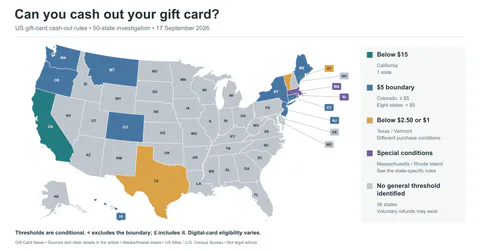
Before paying a resale discount on a small retailer balance, check whether a statutory redemption right applies. This question concerns the covered product, applicable jurisdiction and exact conditions of the law. It is separate from an app's willingness to accept a card. GiftCard.News's state-by-state cash-out guide provides the existing jurisdictional atlas; the examples here explain why its conditions matter rather than reproducing another 51-profile study.
California's current threshold is strictly below $15. The operative version of Civil Code section 1749.5 took effect for these purposes on April 1, 2026. A covered gift certificate with a cash value of $14.99 meets the numerical condition; one worth exactly $15 does not. The small-balance paragraph does not state a purchase-first requirement. Cash can include currency or a check, while an electronic transfer requires both parties' acceptance. Exceptions and product coverage must still be checked. [S74]
California's definition includes electronic gift cards, but excludes certain multiple-seller cards subject to the stated expiration-date condition; that exclusion does not cover cards usable only with affiliated sellers. Consequently, the digital format alone does not remove protection, and the presence of a Visa or Mastercard logo alone does not establish coverage. [S75]
Washington uses a different condition: after a purchase leaves a covered gift-certificate balance strictly below $5, the remaining value must be redeemable in cash on demand. Exactly $5 is outside that small-balance provision. The chapter separately excludes qualifying financial-institution certificates usable with multiple unaffiliated sellers. A retailer balance and a bank-issued network gift product therefore cannot be assumed to receive the same treatment. [S76], [S77]
These provisions were checked against primary legislation on September 19, 2026. They do not establish ATM access, mobile-wallet funding or a universal right to redeem every unused card at face value. When a right does apply, pursue the covered issuer's redemption process. A private buyer's discounted offer and a statutory claim against the issuer have different legal and economic foundations.
Frequently asked questions
Can I turn a Visa gift card into cash?
Sometimes a separately documented service may accept an eligible product, but Visa branding alone does not establish permission or acceptance. Identify the issuer and programme first. Vanilla's documentation excludes ATM use, while Prepaid2Cash describes conditional processing of eligible network prepaid cards. Review both sets of restrictions, the actual fee and the payout destination. This research did not submit cards or obtain approval for an individual balance. [S13], [S44]
Do Mastercard gift cards allow ATM withdrawals or purchase cashback?
The MastercardGiftCard.com product examined here does not: its FAQ excludes both ATM withdrawals and purchase cashback. Its Sutton Bank agreement also prohibits obtaining cash through the card. Those findings apply to the documented programme, rather than every product carrying Mastercard branding. A bank debit card, a reloadable prepaid account and a nonreloadable gift card can have different features even when they share a network. [S15], [S14]
Can an Apple Gift Card be transferred to Apple Cash?
Apple does not support adding money to Apple Cash from a gift card, including one already in Wallet. Apple Account balance is also distinct from Apple Cash. The US gift-card terms restrict transfer, resale and cash redemption, subject to legally required exceptions. A marketplace offering to buy an Apple-branded card does not override those conditions or turn the transaction into a transfer supported by Apple. [S10], [S18]
Can PayPal pay me for an unwanted gift card?
PayPal documents a CardCash offer process in which an available gift-card resale offer can be paid to a PayPal balance. Availability and the quoted amount depend on the card and transaction. This is distinct from linking a prepaid payment card or adding money through a debit card. Check issuer transfer restrictions separately, and do not assume the offered amount equals the remaining gift balance. [S11]
Does Venmo's prepaid-card support mean any gift card can become Venmo cash?
No universal gift-card funding route is established by that statement. Venmo describes supported cards registered in the user's name and separately describes bank/debit-card balance funding. The exact nonreloadable product, issuer conditions and proposed operation still matter. A successful card-linking step would not prove that subsequent balance funding or withdrawal is permitted. This review leaves unspecified gift-card funding eligibility unconfirmed rather than assuming either universal acceptance or universal rejection. [S28]
Can Google Play balance be moved to Google Wallet or a bank account?
Google's published permitted uses do not establish an ordinary bank-transfer route. Play balance cannot top up GPay or other payment methods, and Google Wallet's gift-card instructions exclude Google Play gift cards. Applicable-law refund exceptions remain a separate question. The shared Google name does not make Play credit interchangeable with a supported payment card or a withdrawable account balance. [S21], [S23]
Can Amazon Pay spend my Amazon.com gift balance outside Amazon?
Amazon Pay's US help explicitly excludes Amazon.com gift cards as a payment method for Amazon Pay orders. Seeing its button on another merchant's checkout does not create a way to spend or withdraw an Amazon gift balance there. The separate Amazon.com product terms govern eligible gift-card use. This review did not substitute another country's Amazon rules for the complete current US account-balance agreement that was unavailable during retrieval. [S19]
Which gift-card-to-cash app is best?
There is no supported universal winner in this evidence. A useful shortlist depends on the exact card, issuer restrictions, seller residence, verification requirements and destination. Compare a current net offer with its approval and payout conditions. A marketplace waiting for a buyer, a direct buyback service and a prepaid processor are different models. The profiles document those distinctions; they do not establish transaction success rates or rank providers' reliability through completed trades.
How much cash would I receive from a $100 card?
It depends on the accepted product and actual offer. The Prepaid2Cash ACH fee illustration yields $88.50 under its published 10% plus $1.50 schedule. Separately, a hypothetical $90 GCX sale under the stated New Seller commission and listing fee yields $76.20. These are conditional arithmetic examples, not offers for the same card. Neither demonstrates acceptance, a completed sale or additional charges outside the assumed schedule. [S45], [S35]
Should I sell a very small remaining balance?
First establish whether a covered cash-redemption rule applies. California's current numerical threshold is below $15; Washington's below-$5 provision also requires a preceding purchase. Product definitions and exclusions matter in both cases. If there is no applicable right, compare the realistic net offer with using the balance for an eligible planned purchase. A fixed processing charge or withdrawal minimum can make small balances economically different from larger ones. State-by-state guide
Can I use an international trading app to receive money in a US bank?
Do not infer that capability from app availability, US gift-card categories or a USD wallet label. The reviewed international services document specific residency, identity and payout arrangements. Some USD wallet exits use cryptocurrency rather than US bank transfer. Confirm the final destination before submitting a card, including any subsequent conversion and its costs. A successful wallet credit would not by itself demonstrate that the money can reach the bank account you need. [S67]
Methodology and evidence limits
The documentary cutoff for this study is September 19, 2026. Provider conditions were drawn from official agreements, help pages and official-linked app listings. The research distinguishes the document's publication or update date from the date it was inspected. Where current specific guidance conflicts with older general help or marketing, the profiles identify the difference instead of blending the figures into a single promise. App-store distribution establishes a distribution channel, not successful transactions or worldwide account eligibility.
Statista tables supply survey context with their original source, fieldwork period and respondent population identified. Their unused-balance measures are nominal consumer balances, not verified cash-recovery opportunities. Survey results are not used to estimate provider acceptance, resale prices or fraud rates. Historical survey dates remain visible even though the product-document review took place in 2026.
The geographic map uses Google's unquoted English search term gift card to cash, US Web Search, all categories, for September 14, 2025 through September 12, 2026. Its index reflects each area's proportional search interest, normalized to the highest area in the selected comparison. It is not monthly search volume, the number of cardholders, a payout estimate or a legal-eligibility score. Google's sampled data can change on refresh, and a high-index state need not contain the largest absolute audience. [S09]
No gift-card credentials were submitted, accounts opened, transactions completed or personalized offers accepted for this study. The worked amounts are explicitly conditional calculations. The legal bridge rechecks selected California and Washington provisions and links the existing atlas; it is not a fresh audit of every jurisdiction. Product-specific permission, contractual applicability and actual payout remain unresolved wherever the documentation does not establish them.
Sources and documents
Collapse
- [S01] Statista: Bankrate / YouGov: Amount of money on unused gift cards, gift vouchers, and/or store credits in the United States in 2024, by generation — Statista
- [S02] Bankrate / YouGov original research — Bankrate
- [S03] Statista: Accenture, Holiday Shopping 2024: Leading reasons why consumers did not use their gift card balance in 2024 — Statista
- [S04] Accenture, Holiday Shopping 2024 original research — Accenture
- [S05] Statista: Accenture, Holiday Shopping 2024: Areas that need improvement to enhance the gift card experience according to consumers in the United States in 2024 — Statista
- [S06] Statista: CivicScience: Share of people who have an unused gift card in the United States from 2024 to 2025 — Statista
- [S07] CivicScience original research — CivicScience
- [S08] Google Trends: fixed-period state comparison — Google
- [S09] Google Trends: normalization and data methodology — Google
- [S10] Apple Cash funding rules — Apple
- [S11] PayPal's CardCash exchange guidance — PayPal
- [S12] Mastercard gift-card information — Mastercard
- [S13] Vanilla Gift help — Vanilla Gift
- [S14] MastercardGiftCard.com: Sutton Bank cardholder agreement — MastercardGiftCard.com
- [S15] MastercardGiftCard.com help — MastercardGiftCard.com
- [S16] Giftcards.com legal index — Giftcards.com
- [S17] Giftcards.com: examined Pathward agreement — Giftcards.com
- [S18] Apple gift-card terms — Apple
- [S19] Amazon Pay payment methods — Amazon
- [S20] Amazon.com gift cards distributed through CashStar — CashStar
- [S21] Google Play permitted uses — Google
- [S22] Google Play gift-card refund policy — Google
- [S23] Google Wallet gift-card help — Google
- [S24] Cash App US terms — Cash App
- [S25] Cash App card agreement — Cash App
- [S26] PayPal supported cards — PayPal
- [S27] PayPal balance funding — PayPal
- [S28] Venmo bank accounts and cards FAQ — Venmo
- [S29] Venmo balance funding — Venmo
- [S30] CardCash: seller-help page — CardCash
- [S31] CardCash: alternative listing agreement — CardCash
- [S32] CardCash: exchange for a virtual prepaid Mastercard — CardCash
- [S33] GCX: US transactions and USD-denominated cards — GCX
- [S34] GCX: card-eligibility guidance — GCX
- [S35] GCX: seller-tier table — GCX
- [S36] GCX: payout guidance — GCX
- [S37] GCX: identity guidance — GCX
- [S38] GCX: selling instructions — GCX
- [S39] GiftCash: payout-calculation page — GiftCash
- [S40] GiftCash: verification policy — GiftCash
- [S41] GiftCash: December 2024 timing guidance — GiftCash
- [S42] GiftCash: current indexed marketing — GiftCash
- [S43] GiftCash: payment-method guidance — GiftCash
- [S44] Prepaid2Cash: terms — Prepaid2Cash
- [S45] Prepaid2Cash: pricing page — Prepaid2Cash
- [S46] Prepaid2Cash: timing guidance — Prepaid2Cash
- [S47] Prepaid2Cash: transaction support collection — Prepaid2Cash
- [S48] Cardyard: selling instructions — Cardyard
- [S49] Cardyard: payment-timing page — Cardyard
- [S50] Cardyard: identity guidance — Cardyard
- [S51] Cardyard: seller-obligations page — Cardyard
- [S52] Cardtonic: official selling page — Cardtonic
- [S53] Cardtonic: sale instructions — Cardtonic
- [S54] Cardtonic: withdrawal guidance — Cardtonic
- [S55] Cardtonic: Ghana account guidance — Cardtonic
- [S56] Apple: iOS — Apple
- [S57] Google: Android — Google
- [S58] NOSH: country-access guidance — NOSH
- [S59] NOSH: sale instructions — NOSH
- [S60] NOSH: wallet guidance — NOSH
- [S61] NOSH: fee notice — NOSH
- [S62] Google: Android listing — Google
- [S63] Apple: iOS listing — Apple
- [S64] Prestmit: sale instructions — Prestmit
- [S65] Prestmit: rate guidance — Prestmit
- [S66] Prestmit: payout-method guidance — Prestmit
- [S67] Prestmit: withdrawal-fee page — Prestmit
- [S68] Prestmit: verification instructions — Prestmit
- [S69] Google: Android app — Google
- [S70] Blackhawk Network's BHN Originals overview — Blackhawk Network
- [S71] InComm Payments: InComm employee rewards and Choice Rewards — InComm Payments
- [S72] Tremendous reward-option guidance — Tremendous
- [S73] Giftbit FAQ and product disclosures — Giftbit
- [S74] California Legislature: California Civil Code 1749.5 — California Legislature
- [S75] California Legislature: Enacted California SB 22, including section 1749.45 — California Legislature
- [S76] Washington State Legislature: Washington RCW 19.240.020 — Washington State Legislature
- [S77] Washington State Legislature: RCW 19.240.100 — Washington State Legislature
In this article

Oliver Reed
Oliver Reed covers industry acquisitions, investment and market research for Gift Card News.