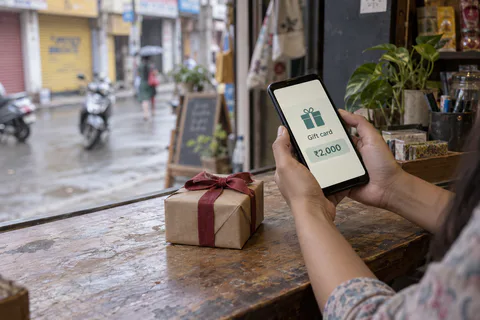
Digital gift cards are already a practical product across much of the Middle East and North Africa. The harder questions are where the evidence supports a market-size claim, what a recipient can redeem, and which rules apply to the organisation holding the value. This study addresses those questions separately across 22 markets, with two interactive maps, country profiles, comparable tables, Statista consumer data and primary regulatory sources.
The strongest observable regional pattern is a shared distribution layer over distinct local products. A platform can advertise several countries while the gift itself remains denominated in one currency, restricted to one country and subject to a particular merchant's expiry and refund terms. Electronic delivery does not make value borderless. A GCC-wide corporate programme may therefore require six local catalogues, several contractual issuers and different regulatory analyses.
The market estimates also need careful interpretation. Public commercial reports use different geographic boundaries and product definitions. Some country figures cannot be reconciled with a regional report from the same research publisher. This study preserves the published figures and identifies those conflicts. It does not turn them into a synthetic MENA total or invent numbers for countries with no comparable public series.
Research date: 18 September 2026. Market numbers are attributed commercial estimates or forecasts, rather than audited national sales. Product terms establish documented availability, not adoption. Legal sections identify relevant rules and classification questions, not a determination that a particular provider holds every required permission.
How to read this research atlas
MENA has no single universal membership list. This editorial atlas covers Algeria, Bahrain, Djibouti, Egypt, Iran, Iraq, Israel, Jordan, Kuwait, Lebanon, Libya, Mauritania, Morocco, Oman, Palestine, Qatar, Saudi Arabia, Sudan, Syria, Tunisia, the United Arab Emirates and Yemen. Turkey, Pakistan and Malta are outside this study. A commercial report that includes Turkey or covers only the six GCC countries consequently measures a different geography.
Western Sahara appears separately as geographic context and receives no market value in the dataset. Boundaries and labels are for navigation and do not express a position on sovereignty. Natural Earth supplies the geographic outlines; the research team supplies the evidence categories. Every country remains selectable, including those with missing quantitative observations. [S01]
T01. What each measure means
| Measure | Meaning in this study | What it cannot establish |
|---|---|---|
| Total gift-card market estimate | A research publisher's estimate covering its defined gift-card universe | Virtual-only sales, provider revenue or independently audited national turnover |
| Digital-only market estimate | A publisher's explicitly electronic-gift-card series | A share of another publisher's total without compatible definitions |
| Intended gift purchase | A respondent's stated plan within a particular occasion and survey population | Completed purchase, annual adoption or transaction value |
| Prepaid-card and voucher usage | Statista's broader payment-method category | Gift-card-only penetration or share of payment spending |
| Documented digital programme | Primary product material supports electronic issuance, delivery or use in a named market | National demand, regulatory approval or exhaustive provider coverage |
| Imported-code distribution | A local seller offers a foreign-market merchant or entertainment code | Domestic issuance, local-currency liability or universal local redemption |
| No verified observation | The reviewed sources did not establish the requested fact | A zero market or absence of lawful activity |
Map 1 groups the available 2025 country estimates into transparent value bands. It is an atlas of attributed figures, not a ranking of independently measured demand. Map 2 classifies the type of programme evidence. Its colours say what was documented, not how mature or attractive a country is. Country panels link directly to supporting sources and the relevant section of the article.
Additional country numbers: markets, recipients and programme terms
The following tables expand the country evidence with commercial forecasts, original survey results, issuer disclosures and product parameters. Each answers a different question. A denomination is an amount offered on a card; a balance cap is a contractual ceiling; a respondent percentage is an opinion or reported experience; an issuer count describes one business. None substitutes for national sales. Missing country totals remain unfilled.
T02. Additional market estimates and growth indicators
| Country | Metric | Figure | Observation or forecast period | Source and scope |
|---|---|---|---|---|
| Oman | Total gift-card market | USD1.38bn | 2025 estimate | IMARC Group [S96], commercial estimate |
| Oman | Total gift-card market | USD4.32bn | 2034 forecast | IMARC, separate publisher series |
| Oman | Forecast CAGR | 12.99% | 2026-2034 | IMARC reported rate |
| Oman | E-gift-card share | 65% | 2025 | IMARC format segmentation |
| Oman | Closed-loop share | 58% | 2025 | IMARC card-type segmentation |
| Oman | Food-and-beverage share | 22% | 2025 | IMARC application segmentation |
| Oman | Retail end-user share | 70% | 2025 | IMARC customer segmentation |
| Oman | Muscat regional share | 45% | 2025 | IMARC region, not city-proper sales |
| Qatar | Forecast gift-card CAGR | More than 16.60% | 2024-2029 | Bonafide Research [S97]; older forecast, no absolute size disclosed |
| Saudi Arabia | Share of publisher's regional market | 43.87% | 2025 | Mordor Intelligence [S03]; gift and incentive cards, six GCC countries |
| Saudi Arabia | Country-segment forecast CAGR | 15% | 2026-2031 | Same Mordor universe |
| United Arab Emirates | Estimated historical CAGR | 11.3% | 2021-2025 | |
| United Arab Emirates | Forecast annual growth | 10.5% | 2026 | Same PayNXT360 vintage |
| United Arab Emirates | Forecast CAGR | 9.9% | 2026-2030 | Same PayNXT360 vintage |
| Iran | Digital-only market estimate | USD271.74m | 2024 | Mordor Intelligence [S33], digital/e-gift cards |
IMARC's public methodology is limited, and its stated forecast rate is not reconciled to its endpoints. No intervening years are calculated. Its five segment percentages concern different denominators and must not be added. The Saudi percentage belongs to Mordor's GCC coverage, not this atlas's MENA definition. Qatar's figure describes a forecast published for an earlier period, not observed 2026 growth. Iran's extra observation extends its digital-only series without dividing it by another publisher's total.
T03. More usable numbers for Kuwait, Qatar, Bahrain and Oman
| Country | Programme | Numeric parameter | What the number describes |
|---|---|---|---|
| Kuwait | KWD10-KWD100 | Email gift-card denominations; online domestic redemption with retained balance; expiry not verified. [S16] | |
| Kuwait | Blue | KWD5-KWD1,000; 12 months | Programme load range and validity, not a national limit. [S30] |
| Qatar | Blue | QAR50-QAR10,000; 12 months | Country-specific programme range and validity |
| Bahrain | Blue | BHD5-BHD1,000; 12 months | Country-specific programme range and validity |
| Oman | Blue | OMR5-OMR1,000; 12 months | Country-specific programme range and validity |
| Bahrain | Seef Properties eGift | BHD1,000 | Maximum outstanding card balance; the same amount caps a single Benefit gateway transaction. [S99] |
| Bahrain | Seef Properties eGift | BHD200 per transfer per day | User-to-user transfer provision, not a nationwide payment ceiling |
| UAE | Blue | 2%, capped at AED500 per wallet per year | Eligible direct-issued card top-up bonus; corporate orders and third-party distributor cards are excluded |
These numbers provide concrete purchasing parameters even where national volumes are unavailable. Blue's common conditions permit partial spending and restrict redemption to the issuing country. Seef's figures describe its virtual-card application. They do not apply automatically to other Bahraini issuers. Currency ranges are retained in their original units and are not ranked by purchasing power.
T04. Quantitative programme evidence across North Africa
| Country | Programme | Figures | Interpretation and limitation |
|---|---|---|---|
| Egypt | noon electronic vouchers | EGP50-EGP5,000; maximum 20 cards per purchase; one-year redemption period | Operational terms, not measured demand. [S65] |
| Morocco | iris.ma gift cards | MAD300-MAD2,000; 12 months | Retail range; email or physical delivery; corporate digital values can be customised. [S100] |
| Morocco | Decathlon gift cards | MAD50-MAD5,000; 24 months | Physical collection is described; not evidence of virtual issuance. [S71] |
| Tunisia | Pluxee Chèque Cadeau | More than 4,000 points of sale; 12 months | Provider-reported gift-cheque acceptance and validity, not unique brands or digital-card users. [S74] |
| Libya | BeautyExpress digital gift card | LYD1,000 | Merchant face value; recipient-email delivery and use across multiple orders advertised. [S101] |
| Libya | Nuran Bank Rikaz Gift Card | LYD20 issue price; six months | Issue fee and validity, not funded face value; local POS and online use. [S102] |
| Libya | Nuran Bank VISA Net Gift Card | USD20 issue price; no annual fee; one-year validity | Separate bank product; format not established as virtual-only. [S103] |
| Libya | Same VISA Net product | USD1-USD750 monthly cash deposits; USD1 purchase fee | Product loading range and fee, not national spending or gift-card sales |
| Algeria | Kiabi announced cards | DZD3,000 / DZD6,000 / DZD10,000 | Still labelled coming soon and store-only; excluded from verified active digital programmes. [S78] |
The new Libyan merchant evidence changes the programme map: Libya now has documented local digital gift delivery, alongside foreign-code distribution. This is a change in the evidence classification, not a market-size estimate. Morocco's iris.ma evidence likewise establishes an explicit emailed format alongside the previously documented Decathlon offer. No additional defensible national gift-card series was established for Djibouti, Mauritania or Sudan.
T05. Israel: issuer-reported gift behaviour and values
| Provider observation | Figure | Year | Meaning |
|---|---|---|---|
| BUYME employee gifts sent | 2,057,174 | 2024 | Programme gifts, not unique employees |
| Mean employee gift, law firms | ILS441.5 | 2024 | Employer-sector average within BUYME |
| Mean employee gift, startups | ILS386.4 | 2024 | Same programme universe |
| Mean employee gift, MedTech | ILS343.7 | 2024 | Same programme universe |
| Selected redemption categories | Fashion 53.02%; home 19.44%; food 11.65%; birth 4.70% | 2024 | Non-exhaustive; monetary denominator not specified |
| Birthdays, births and major holidays | About 55% | 2025 | Share of BUYME gifts |
| Other occasions | About 45% | 2025 | Complementary occasion category |
| Senders including a greeting | More than 70% | 2025 | Sender behaviour |
| Senders including photo or video | About 40% | 2025 | Sender behaviour |
Sources: BUYME's 2024 employee-gift review [S104] and 2025 platform review [S105]. These self-reported operational figures add a different perspective from national commercial estimates. Sector means do not reveal the distribution of gift values or market-wide averages.
T06. Other Levant markets: amounts, fees and restrictions
| Country | Instrument | Numeric evidence | Boundary |
|---|---|---|---|
| Iraq | Locally issued prepaid gift cards | IQD150,000 maximum per card | |
| Iraq | Same regulated product | IQD1,000,000 per phone number per month | Activation-value ceiling; not foreign entertainment-code resale |
| Jordan | Dumyah voucher | JOD100; no fee; no expiry | Retained balance; merchant-only spending; delivery format not established. [S106] |
| Lebanon | Feel22 Premium | USD25 / 50 / 75 / 100 / 150; one year; one use | Value cannot be split across orders. [S48] |
| Palestine | USD5 / 10 / 20 / 50 face values | Foreign-issuer codes; local resale is not local issuance. [S52] | |
| Palestine | Same listed codes | ILS26 / 52 / 101 / 243.5 respectively | Advertised retail prices, not an exchange-rate series or completed transactions |
Syria's mixed digital-product catalogue count and Yemen's app-download threshold were excluded from these gift-card figures because they cannot establish gift-only transactions or local users. This keeps measurable programme terms separate from misleading substitutes for market demand. The source register records those exclusions.
T07. Original YouGov and YOUGotaGift consumer comparisons
| Survey measure | UAE | Saudi Arabia |
|---|---|---|
| Prefer gift card over traditional gift | 62% | 67% |
| Same preference among nationals | 77% | 68% |
| Same preference among expatriates | 60% | 65% |
| Prefer gift card over traditional corporate gift | 68% | 78% |
| Same corporate preference among nationals | 77% | 77% |
| Same corporate preference among expatriates | 67% | 78% |
| Corporate preference, higher-income group | 76% above AED10,000 | 82% above SAR5,000 |
| Have bought or received a gift card | 66% | 61% |
| Prefer digital over physical gift cards | 54% | Not shown |
| Digital preference among UAE nationals / expatriates | 63% / 53% | Not shown |
| Digital preference, UAE age 18-44 / 45+ | 54% / 49% | Not shown |
| Gift-card versus traditional-gift preference, Saudi age 25-44 / 45+ | Not shown | 72% / 61% |
| Full online survey sample | 1,004 respondents | 1,006 respondents |
The original UAE infographic [S107] and Saudi infographic [S108] were visually read. Fieldwork ran from 20 to 27 February 2024; publication was 3 April 2024. Subgroup bases and uncertainty intervals are not supplied in the infographics. The age rows ask different questions and must not be compared as digital adoption. Preferences and reported experience are not sales, and these observations do not update the historical Statista series.
T08. Cross-border digital gifting observed by one platform
| Destination | Sending countries recorded | Observation window | Interpretation |
|---|---|---|---|
| United Arab Emirates | 140 | Twelve months covered by the July 2023 publication | YOUGotaGift internal transactions |
| Saudi Arabia | 76 | Same publication window | YOUGotaGift internal transactions |
The platform's cross-border analysis [S109] describes geographic sender reach. It does not disclose the number or value of gifts in this table, represent every issuer, or establish permission to redeem a gift across borders. The observation is historical, not a 2026 count.
Why the regional forecasts do not produce one MENA total
T09. Regional report definitions and published values
| Publisher and vintage | Published report coverage | 2025 estimate | 2026 forecast | Later forecast | Comparability limit |
|---|---|---|---|---|---|
| PayNXT360, January 2026 bundle | Middle East report plus Iran, Israel, Saudi Arabia, Turkey and UAE country reports | USD8.7bn | USD9.6bn | USD13.6bn in 2030 | Country estimates do not reconcile with the regional figure; bundle includes a Turkey report |
| Mordor Intelligence, updated 11 September 2026 | Explicit segmentation lists the six GCC countries | USD24.94bn | USD27.14bn | USD41.39bn in 2031 | Gift and incentive cards; geography differs from this 22-market atlas |
Sources: PayNXT360 regional report listing [S02]; Mordor Intelligence regional report [S03].
The disagreement is too large to present as a normal confidence interval. More fundamentally, the products and country sets differ. An average of the two would have no defensible denominator. Nor is it reasonable to apply one publisher's digital share to another publisher's country total.
There is also an unresolved reconciliation problem. The selected PayNXT360 country estimates for Israel, Saudi Arabia and the UAE alone exceed that publisher's USD8.7 billion regional 2025 figure. The Israeli country listing reports USD7,359.6 million, while the dated Saudi and UAE releases report USD1.85 billion and USD2.20 billion respectively. This is an arithmetic conflict requiring publisher clarification, not evidence that the missing countries have negative value. The country map labels these as attributed estimates and does not calculate regional shares. [S04]
Editorial analysis: the useful commercial conclusion is that vendor forecasts support investigating a sizeable category, while primary product and legal evidence is more dependable for deciding how a specific programme can operate. The country profiles therefore spend as much attention on acceptance, issuance and restrictions as on headline size. A purchaser evaluating a large investment should obtain the full definitions and a reconciled country workbook before using these numbers in a financial model.
Consumer evidence: gift intent and payment behaviour measure different things
Two kinds of consumer research help explain the opportunity without pretending to measure the same phenomenon. Occasion surveys ask what people intend to give or would like to receive. Payment-method surveys ask which instruments people have used. These sources answer different questions; their percentages cannot be added or used interchangeably.
T10. Eid gift-card intentions in Saudi Arabia and the UAE
| Country | 2024 gift-card intention | 2025 gift-card intention | Gift-planner base, 2024 | Gift-planner base, 2025 | Change |
|---|---|---|---|---|---|
| United Arab Emirates | 36% | 34% | 478 | 457 | -2 percentage points |
| Saudi Arabia | 31% | 31% | 478 | 446 | 0 percentage points |
Toluna's 2025 Ramadan and Eid study supplies these observations for respondents planning gifts. The online fieldwork ran from 24 to 29 January 2025 among people aged 18-60; the prior-year comparison was fielded from 19 to 24 January 2024. The overall 2025 samples were 510 in the UAE and 500 in Saudi Arabia, larger than the gift-planner subsets shown above. These are intentions for an occasion, not measured purchases. [S05]
F02. Intentions to give gift cards for Eid
Toluna gift-planner subsets in two countries, 2024 and 2025.
% of gift planners
Tap or hover for details. Select a series above to show or hide it.
Occasion intentions, not completed purchases; physical and digital cards are not separated. 2024 bases: 478 each; 2025 UAE: 457, Saudi Arabia: 446. Ages 18-60; online. Differences are not established as statistically significant.
Explore the data table
| Category | 2024 | 2025 |
|---|---|---|
| United Arab Emirates | 36 % of gift planners | 34 % of gift planners |
| Saudi Arabia | 31 % of gift planners | 31 % of gift planners |
The two-point UAE movement should not be described as a proven market decline. The public table does not establish the statistical significance of that difference, and a seasonal intention measure cannot explain annual issuance. What it does show is that gift cards were a recognisable gifting option in both samples. Merchants can investigate recipients' choices, rather than assuming that digital availability automatically displaces cash, perfume, clothing or other gifts.
T11. Statista: prepaid cards and vouchers by channel
| Observation | Saudi Arabia, physical POS | Saudi Arabia, online | UAE, physical POS | UAE, online |
|---|---|---|---|---|
| 2019 | 18% | 25% | Not shown | Not shown |
| 2020 | 20% | 25% | 16% | 18% |
| 2021 | 18% | 24% | 16% | 19% |
| 2022 | 21% | 30% | 17% | 18% |
| 2023 | 24% | 29% | 16% | 20% |
Source: authenticated Statista Consumer Insights tables for Saudi Arabia [S06] and the United Arab Emirates [S07], accessed on 18 September 2026. Both pages were published on 7 February 2024 and identify April 2023 as the release date. The displayed latest fieldwork runs from 4 April 2022 to 17 March 2023. Statista describes the residential online population aged 18-64, 12,000+ respondents per country, rolling twelve-month responses and multiple selections.
F03. Statista: prepaid-card and voucher use by channel
Historical Consumer Insights observations. This broader payment category is not restricted to gift cards.
% of respondents
Tap or hover for details. Select a series above to show or hide it.
Residential online population aged 18-64; 12,000+ per country; rolling 12 months; multiple answers. Latest displayed fieldwork: 4 April 2022 to 17 March 2023. Published 7 February 2024. Not 2026 adoption, transaction share or gift-card-only penetration.
Explore the data table
| Category | Saudi Arabia online | Saudi Arabia physical POS | UAE online | UAE physical POS |
|---|---|---|---|---|
| 2020 | 25 % of respondents | 20 % of respondents | 18 % of respondents | 16 % of respondents |
| 2021 | 24 % of respondents | 18 % of respondents | 19 % of respondents | 16 % of respondents |
| 2022 | 30 % of respondents | 21 % of respondents | 18 % of respondents | 17 % of respondents |
| 2023 | 29 % of respondents | 24 % of respondents | 20 % of respondents | 16 % of respondents |
This is useful historical channel context, with a deliberately narrow interpretation: respondents could select prepaid cards and vouchers among the methods they had used. It is neither a spending allocation nor a measure restricted to gifts. The 2023 values cannot be relabelled as 2026 adoption just because the pages were accessed in 2026. Likewise, a difference between Saudi and UAE survey responses does not establish which country generated more gift-card value.
Editorial analysis: the practical implication for product design is to connect delivery with redemption. An email recipient may want an online checkout, while an employer may want a reward usable in a physical store. A digital message with an incompatible redemption channel can still fail the recipient. Product research should therefore ask about the intended merchant, channel and occasion as well as the attractiveness of receiving a code.
T12. Evidence that should remain separate in a commercial presentation
| Research question | Suitable evidence | Inappropriate substitution |
|---|---|---|
| Have respondents reported using this broader payment category? | Historical Statista prepaid/voucher responses, with their exact scope | Calling the series gift-card ownership |
| Will people consider gift cards for Eid? | Toluna's gift-planner intention observations | Calling intentions completed transactions |
| Can an employee receive and spend this reward locally? | Current issuer and merchant terms | A platform's global brand count |
| How much value was issued nationally? | A reconciled issuance dataset or clearly attributed market estimate | Smartphone ownership, e-commerce sales or cashless-payment share |
| Will this programme remain usable after expiry or failed delivery? | Contractual terms and applicable local law | Another country's consumer rules |
No general digital-payment or population metric is used to fill missing gift-card observations on either map. This preserves the distinction between a market that lacks public measurement and a market that has no activity.
Where digital gift programmes are documented
The second map distinguishes local digital delivery or redemption, historical local programmes, advertised distribution of foreign codes, incomplete or announced evidence, and unverified availability. The details explain the exact scope for each country.
F04. Documented gift programmes and distribution routes
Explore the type of programme evidence found for each country. Local digital delivery or redemption is distinguished from historical programmes, imported-code listings and gaps. A programme listing does not establish completed fulfilment, national adoption or regulatory approval.
Research as of
Hover to preview a country. Click, tap or use the selector to keep its details open. Press Escape or choose the empty option to resume hover previews.
Two-letter country codes identify the selectable areas. Small countries have callout labels. Western Sahara (EH) is shown separately without a market value. Boundaries and labels do not express a position on sovereignty.
Explore the country-by-country evidence.
Select a country to read its classification, details and underlying sources.
Each country links to its full analysis below.
Algeria
Kiabi Algeria gift card; Zara Algeria gift-card payment option
Kiabi Algeria gift card: DZD 3,000/6,000/10,000; explicitly forthcoming; store-only offer. Not active coverage. Zara Algeria gift-card payment option: Local help includes gift-card payment and refund credits; new gift-value sale and virtual issuance not established.
Full Algeria analysisBahrain
Blue; Alshaya eGift; YOUGotaGift; Seef Properties virtual gift cards.
Blue’s range is BHD5-BHD1,000 with 12-month validity. Seef’s app terms cap outstanding balance at BHD1,000 and user-to-user transfers at BHD200 per transfer per day. These are programme-specific limits. Bahrain’s February 2026 payment-service document was a consultation proposal; final adoption was not verified.
Full Bahrain analysisDjibouti
Hablax Djibouti Yalla Ludo catalogue
Hablax Djibouti Yalla Ludo catalogue: Country-labelled USD catalogue. Not evidence of a Djiboutian gift issuer or local retail acceptance.
Full Djibouti analysisEgypt
noon Egypt gift card; B-Tech eGift card; Amazon.eg gift card
noon Egypt gift card: EGP50-5,000; code redeemable within one year; noon.com Egypt; funds become credits usable over purchases. B-Tech eGift card: Egyptian store redemption described by eGifter Rewards; issuer-specific terms not independently retrieved. Amazon.eg gift card: Bidali identifies Souq.com for E-Commerce LLC; direct Amazon terms returned 503. noon’s Egyptian electronic vouchers range from EGP50 to EGP5,000; up to 20 cards may be purchased in one transaction, with a one-year redemption period.
Full Egypt analysisIran
Digikala: merchant digital gift card
Digikala (merchant digital gift card): Primary-authored report retrieved from mirror; current direct issuer terms unavailable.
Full Iran analysisIraq
ZainCash: digital entertainment and gift-code distribution
ZainCash (digital entertainment and gift-code distribution): Wallet PIN confirmation. Catalogue includes iTunes, Shahid VIP, Supercell, PUBG, Careem. Foreign code distribution is not automatically a domestic payment gift card.
Full Iraq analysisIsrael
BUYME: multi-merchant digital gift vouchers
BUYME (multi-merchant digital gift vouchers): Digital SMS/email code. Monetary vouchers support repeated redemption. Minimum 60-month monetary-voucher validity and specified extension rights. Redemption at participating merchants in Israel. Experience vouchers have distinct terms; issuer's licensing-exemption statement is not a legal opinion. BUYME reports 2,057,174 employee gifts in 2024; this is its own programme volume, not unique recipients or national sales.
Full Israel analysisJordan
Arab Bank: Arabi eGift local merchant QR voucher; Arab Bank: Third-party eVouchers
Arab Bank (Arabi eGift local merchant QR voucher): Sender funds from account, credit card or points. Recipient mobile OTP. QR redemption at participating Arab Bank POS merchants. Public expiry/refund schedule not retrieved. Arab Bank (Third-party eVouchers): Third-party vendor operates service. Region must match chosen voucher. Share by messaging or email Dumyah separately lists a JOD100 merchant voucher with no fee or expiry and retained balance; delivery format is not established by that listing.
Full Jordan analysisKuwait
Al-Futtaim Blue Gift Card; YOUGotaGift; Alshaya eGift Cards; JYSK Kuwait.
JYSK emails KWD10-KWD100 cards for domestic online spending with retained balance; its expiry was not verified. Blue offers KWD5-KWD1,000, with 12-month validity and no cross-border redemption. These are programme conditions. The country profile explains Kuwait’s regulated e-money expiry and refund rules.
Full Kuwait analysisLebanon
Whish Money: Digital gift and gaming-code distribution; Feel22: Merchant gift voucher with digital checkout code
Whish Money (Digital gift and gaming-code distribution): Instant code delivery. Specific brand eligibility, expiry and refunds vary and were not established. Feel22 (Merchant gift voucher with digital checkout code): USD 25/50/75/100/150 denominations. One year from issue. One order only, no split. Digital redemption verified; delivery form is not clearly email-only.
Full Lebanon analysisLibya
BeautyExpress local digital gift card; Nuran Bank local gift-card redemption; Paymaster foreign-code distribution.
BeautyExpress advertises LYD1,000 cards sent by email, with immediate or scheduled delivery and spending across multiple orders. Nuran Bank’s separate Rikaz card lists a LYD20 issue price and six-month validity for domestic POS and online use; virtual-only issuance was not established for that bank product. These are advertised products, not national sales.
Full Libya analysisMauritania
RimCarte
RimCarte: Claims SMS/WhatsApp delivery and local wallet funding; visible catalogue displayed zero available items. Not a verified local issuer.
Full Mauritania analysisMorocco
Decathlon Morocco gift card; iris.ma emailed and physical gift cards.
iris.ma lists MAD300-MAD2,000 retail denominations, one-year validity and partial redemption; custom corporate digital values are also offered. Decathlon lists MAD50-MAD5,000 and two-year validity with physical collection. These format differences do not change the absence of a verified national sales series.
Full Morocco analysisOman
Al-Futtaim Blue Gift Card; YOUGotaGift.
Blue offers OMR5-OMR1,000 with email/app delivery, partial spending and 12-month validity. YOUGotaGift lists Oman for electronic distribution. Alshaya’s inspected terms list Oman for physical cards, but omit it from the explicit eGift list. See the country profile for the CBO payment-provider framework.
Full Oman analysisPalestine
Jawwal: Digital entertainment gift-code distribution
Jawwal (Digital entertainment gift-code distribution): Local mobile-number OTP. Instant delivery advertised. USD-denominated iTunes codes priced in ILS. Provider listing does not establish all-location service continuity or unrestricted issuer redemption.
Full Palestine analysisQatar
Al-Futtaim Blue Gift Card; YOUGotaGift; Alshaya eGift Cards.
Blue offers QAR50-QAR10,000 with email/app delivery, 12-month validity and partial spending in the country of issue. Alshaya also documents eGift delivery. Qatar’s section 6.2 exempts qualifying closed brand-specific gift cards but requires the issuer to inform the central bank; broader networks need separate classification.
Full Qatar analysisSaudi Arabia
Al-Futtaim Blue Gift Card; YOUGotaGift; Alshaya eGift Cards; Jarir Saudi eGift Card; Resal.
Verified electronic delivery or local digital redemption. Blue country currency SAR; twelve-month validity; no cross-border redemption. Programme terms remain subject to applicable mandatory law. Availability is not national adoption or regulatory approval.
Full Saudi Arabia analysisSudan
Bitrefill Sudan storefront; Gift Card Granny corporate reward card
Bitrefill Sudan storefront: No domestic retail programme verified; international digital products do not establish local issuance. Gift Card Granny corporate reward card: Specific product lists Sudan among excluded countries; not a country-wide legal claim.
Full Sudan analysisSyria
SGC GAME: Region-specific digital-code retail
SGC GAME (Region-specific digital-code retail): Catalogue distinguishes US, Saudi, UAE and other regions. Homepage advertises balance refund if order uncompleted. Provider advertising only; legal authorisation, issuer supply chain and completed delivery not independently verified.
Full Syria analysisTunisia
Pluxee Tunisia Chèque Cadeau; Pluxee Tunisia Carte Cadeau / Pluxee Pay TN
Pluxee Tunisia Chèque Cadeau: One-year cheque validity; provider reports 4,000+ cheque acceptance points, not card/mobile network count. Pluxee Tunisia Carte Cadeau / Pluxee Pay TN: App-enabled gift-card use, valid Tunisian mobile number required; virtual issuance and card-specific validity not established. Pluxee advertises more than 4,000 points of sale and one-year validity for its gift-cheque programme; this is not a count of digital-card users.
Full Tunisia analysisUnited Arab Emirates
Al-Futtaim Blue Gift Card; YOUGotaGift; Alshaya eGift Cards.
Verified electronic delivery or local digital redemption. Blue country currency AED; twelve-month validity; no cross-border redemption. Programme terms remain subject to applicable mandatory law. Availability is not national adoption or regulatory approval.
Full United Arab Emirates analysisYemen
Yemen Gift Cards: Entertainment and payment-code application
Yemen Gift Cards (Entertainment and payment-code application): Immediate delivery advertised. Historical app update, no independent current transaction check and no complete public gift-code terms.
Full Yemen analysis- Local programme: digital delivery or redemption13
Primary programme material supports local gift value with an electronic delivery or spending route. See format limits in each panel.
- Historical local programme1
Company evidence documents a past programme; current issuer terms were not verified.
- Advertised foreign-code distribution4
A local-facing provider or app lists foreign codes. This does not establish domestic issuance or unrestricted redemption.
- Incomplete or announced evidence2
Forthcoming, out-of-stock or partial material does not establish a currently available programme or deliverable inventory.
- No local programme verified2
A research gap, not evidence that gift-card activity is absent.
Non-exhaustive evidence register. Digital delivery, online redemption and mobile-assisted spending are separate features. Tunisia’s mobile-use layer and Lebanon’s online redemption do not by themselves prove virtual issuance. Iran evidence is historical. Imported codes remain subject to foreign issuer/account-region restrictions. Announced or incomplete products are not counted as verified local programmes.
Geography: Natural Earth, 1:50m. Public domain geometry.
GCC: six markets, different rules for stored gift value
The GCC has a visible digital gift-card ecosystem, but a country comparison needs two separate answers: how much gift value a research publisher estimates, and which products a recipient can actually obtain and use. Public evidence answers the second question more consistently. This review verifies electronic programmes across Saudi Arabia, the United Arab Emirates, Kuwait, Qatar, Bahrain and Oman. It does not establish a digital-only market total or a nationally representative adoption rate for every country.
The country sections below distinguish merchant issuers from distributors and describe specific products rather than assuming that all gift cards in a country share one expiry rule. Electronic delivery, online purchasing, online redemption and cross-border acceptance are separate characteristics. A code received by email might work only in a physical shop; a card bought online might arrive by courier.
Comparable market estimates, with a source-version warning
The dated Q1 2026 PayNXT360 research announcements distributed by Research and Markets provide a usable published vintage for Saudi Arabia and the UAE. Figures below cover gift cards broadly. The public summaries do not supply a complete reconciliation between funded value, transaction value and provider revenue. No digital share is applied to these totals.
T13. Comparable market estimates, with a source-version warning
| Country | 2025 estimate, USDm | 2026 forecast, USDm | 2030 forecast, USDm | Evidence |
|---|---|---|---|---|
| Saudi Arabia | 1,850 | 2,030 | 2,870 | Q1 2026 release, 20 February [S08] |
| United Arab Emirates | 2,200 | 2,430 | 3,540 | Q1 2026 release, 19 February [S09] |
| Kuwait | Not verified | Not verified | Not verified | No comparable PayNXT360 country series located |
| Qatar | Not verified | Not verified | Not verified | No comparable PayNXT360 country series located |
| Bahrain | Not verified | Not verified | Not verified | No comparable PayNXT360 country series located |
| Oman | 1,380 (IMARC) | Not verified | Not verified | Separate IMARC series [S96]; not comparable to PayNXT360 |
These are commercial estimates, not administrative counts. Conversion from billions to millions changes the display unit, not the precision. Missing values must remain blank on a market map. Neither population nor general payment activity can fill the gaps.
Saudi Arabia also requires an explicit qualification. Its current direct PayNXT360 page advertises USD4,170.3 million for 2026, despite carrying the same Q1 2026 edition label as the release above. This review retains the dated release as its comparison vintage and records the unresolved conflict. It does not imply the lower figure has been independently proved correct. [S10]
Saudi Arabia: merchant cards and distribution platforms solve different problems
Saudi Arabia has concrete examples of both merchant-issued gift value and platforms distributing multiple brands. Jarir's electronic card comes in SAR50, SAR100, SAR300, SAR500 and SAR1,000 denominations, lasts one year and can be used through its Saudi stores, website or app. Its terms make it a single-transaction product, prohibit reloading and cash exchange, and exclude digital products. Those restrictions matter when a purchaser expects the recipient to retain change or buy gaming content. [S11]
Resal describes a different customer journey: purchased digital cards appear in its wallet, and users can send them as gifts through SMS. Underlying card conditions determine redemption and expiry. Its separate channel agreement describes additional verification time for larger purchases: orders above SAR2,000 may take one to five hours. That is a delivery condition, not a national gift-card ceiling. [S12]; [S13]
Editorial analysis: a Saudi corporate buyer should therefore specify the recipient experience before comparing catalogue prices. A single merchant code, a choice-based reward and an account balance can produce different redemption outcomes. “Instant” should be treated as a stated service condition with verification exceptions, rather than assumed performance for every batch.
The legal distinction is equally concrete. Article 49 of SAMA's implementing regulation requires limited-network providers to register. It requires notification when activity exceeds, or is likely to exceed, SAR5 million over twelve consecutive months or SAR2 million in a month within that period. SAMA can require a licence. These are programme-activity thresholds, not individual-card limits; a merchant-network label does not remove the registration question. [S14]
United Arab Emirates: strong product evidence, bounded market claims
The UAE release estimates a broad gift-card market of USD2.20 billion in 2025 and forecasts USD2.43 billion for 2026. That makes it larger than Saudi Arabia within this particular dated comparison. It does not establish a definitive GCC ranking when three GCC country totals remain unavailable and Oman has a separate publisher estimate and the Saudi source version is disputed. [S09]
Al-Futtaim's Blue programme and Alshaya's eGift offering demonstrate different retail-group propositions. Blue's shared terms set the UAE range at AED50-AED10,000, while Alshaya describes reloadable gift value with country-specific participating brands. The comparison table below records the common Blue conditions once; no programme's terms should be extrapolated to every UAE merchant.
Under Article 2 of the UAE Stored Value Facilities regulation, issuing or operating an SVF generally requires a prior Central Bank licence, with an exception for a single-purpose SVF. Certain other structures can seek an exemption on application. A multi-merchant arrangement is therefore not automatically exempt merely because it is marketed as a gift card. [S15]
Editorial analysis: the UAE opportunity should be assessed through acceptance and responsibility as well as distribution. A platform with an attractive storefront might distribute another merchant's obligation, operate its own balance, or combine both. Corporate contracts need to identify the party holding outstanding value and handling failed delivery, refunds and expiry.
Kuwait: online-only merchant value is a distinct proposition
Kuwait has verified digital gift-card availability even though this review does not have a comparable public market total. JYSK Kuwait provides a recipient-email gift-card form and expressly identifies itself as the issuer. Its stated denomination range is KWD10-KWD100, with online use in Kuwait and repeated spending until the balance is exhausted. An expiry period was not verified in the retrieved product text. It should remain unspecified rather than inherit another retailer's twelve-month rule. [S16]
YOUGotaGift's official FAQ explicitly includes Kuwait in its electronic distribution footprint. This establishes an advertised route for sending merchant gift value, not the size of local demand or the issuer status of every product in its catalogue. [S17]
Kuwait's Central Bank updated its electronic-payment instructions in May 2023. Its supervisory summary describes five licence types differentiated by activity and volume. The detailed instructions also define limited-purpose e-money and a provider category requiring a CBK no-objection certificate. These distinctions require examination of the actual issuer and merchant network; they do not justify treating every electronic voucher seller as a bank. [S18]; [S19]
A CBK circular dated 15 February 2024 addresses expiry practices by limited-purpose e-money providers that leave customers without value or service and transfer the funds to the merchant. It requires compliance with Article 24, including the customer's option of a refund to their account or an extension in the e-wallet. This concerns regulated e-money and limited-purpose e-money; it does not establish that every merchant gift card falls within those categories. [S20]
Editorial analysis: Kuwait illustrates why a catalogue-level country flag is only the beginning of diligence. The buyer still needs to know whether a gift is online-only, whether partial spending works, and whether customer support belongs to the seller or the underlying merchant.
Qatar: distinguish a digital instrument from an online order
Blue and Alshaya explicitly support electronic gift-card programmes in Qatar. However, an online gift-card listing alone is insufficient evidence of virtual issuance. Virgin Megastore Qatar's QAR100 listing describes delivery to a nominated address and redemption in stores, with one-year validity. It is consequently excluded from the digital footprint dataset. [S21]
Qatar's Payment Services Regulation makes a useful distinction. Section 6.2 exempts closed prepaid instruments used only to obtain the issuer's goods or services for limited purposes, without cash withdrawal or cash redemption, and explicitly includes brand-specific gift cards. The issuer must nevertheless inform Qatar Central Bank, which can request information. A broader multi-brand network should not be assumed to qualify for the same treatment. [S22]
Editorial analysis: the commercial question is whether the intended recipient can complete the purchase they actually want. A broad brand catalogue does not guarantee online checkout compatibility. Procurement should name the eligible country and channels and preserve the specific product terms presented at ordering, rather than relying on a regional programme description.
No nationally representative Qatar gift-card adoption percentage or comparable Q1 2026 market total was verified in this research. The programme evidence supports availability, while the market-size field remains missing.
Bahrain: an electronic footprint and an important draft-law boundary
Bahrain appears in Alshaya's explicit eGift country list and in Blue's local-currency limits. Alshaya's terms provide email delivery, partial spending and twelve months from purchase or top-up, with redemption confined to eligible brands in the country of issue. Its FAQ describes merchandise refunds returning to gift value and an extension when a refund reaches an expired card. These are programme conditions, not a universal Bahraini expiry policy. [S23]; [S24]
A regional campaign gives additional historical evidence. Samsung's January 2025 preorder promotion included a BHD20 YouGotAGift incentive for Bahrain. It demonstrates one specific promotional use case; it does not establish current availability, national spending or campaign performance. [S25]
Bahrain's Central Bank provides the financial-services regulatory framework. A February 2026 Payment Service Requirements document found during research is linked from its consultation page as a proposal with a 5 March deadline. Final adoption was not verified here, so the draft is not presented as binding law. [S26]; [S27]
Editorial analysis: for a new programme, regulatory status and commercial reach should be assessed separately. A live retail product is evidence that a product is marketed; it is not proof that a proposed different issuer, wallet or acceptance network falls under an identical regulatory treatment.
Oman: verified digital access without importing another country's terms
Oman has confirmed electronic access through Blue and YOUGotaGift. It also demonstrates the danger of treating a regional retailer's physical and electronic footprints as interchangeable. Alshaya's common terms list Oman for physical cards but omit it from the explicit eGift country list. This review therefore does not count Alshaya as a verified Omani electronic programme. That exclusion concerns the inspected evidence, not a claim that no digital Alshaya product could exist. [S23]
Samsung's same January 2025 campaign specified an OMR20 YouGotAGift reward, providing a dated example of gift value used as a product-purchase incentive. Campaign denominations should never be mistaken for programme-wide minimums, maximums or typical consumer spending. [S25]
Oman's Central Bank states that Banking Law 2/2025 provides authority to license and supervise payment service providers. Its BM1192 policy distinguishes PSP functions from ancillary services; section 17.6 states that payment aggregators and gateways cannot provide an e-wallet issuing service through their platforms. This is relevant when a gift distributor proposes holding customer balances. No general Omani gift-card expiry or denomination rule was established by the inspected sources. [S28]; [S29]
Editorial analysis: Oman has documented digital availability and a separately attributed IMARC estimate. Its publisher definitions have not been reconciled with the other country reports.
Product parameters that can be compared directly
Blue's official common terms provide an unusually clear country matrix. The programme delivers through email or the Blue Rewards app, lasts twelve months, permits partial spending and prohibits reloading, cash exchange and cross-border redemption. These are the programme's contractual terms, subject to applicable mandatory law; they do not determine its regulatory classification in each country. [S30]
T14. Product parameters that can be compared directly
| Country | Currency | Minimum | Maximum | Evidence |
|---|---|---|---|---|
| Saudi Arabia | SAR | 50 | 10,000 | Blue common terms |
| United Arab Emirates | AED | 50 | 10,000 | Blue common terms |
| Kuwait | KWD | 5 | 1,000 | Blue common terms |
| Qatar | QAR | 50 | 10,000 | Blue common terms |
| Bahrain | BHD | 5 | 1,000 | Blue common terms |
| Oman | OMR | 5 | 1,000 | Blue common terms |
The currencies are not comparable amounts of purchasing power. The table records contractual denomination ranges without converting them into a demand index.
T15. Programme roles and electronic country coverage
| Programme | Role evidenced | Electronic country coverage verified here | Important distinction |
|---|---|---|---|
| YOUGotaGift [S17] | Marketplace/distribution platform | All six GCC countries | Underlying brand conditions vary |
| Alshaya eGift [S23] | Retail-group programme | SA, AE, KW, QA, BH | Oman physical listing does not establish eGift availability |
| Jarir [S11] | Merchant issuer | Saudi Arabia | One-transaction electronic card |
| JYSK [S16] | Merchant issuer | Kuwait | Online-only domestic use |
| Resal [S12] | Digital marketplace/wallet platform | Saudi Arabia | Issuer and terms vary by underlying brand |
This is a deliberately non-exhaustive evidence register. Counting rows measures research coverage, not competitive concentration. A map should label a country “verified digital programme present” rather than rank it by the number of providers encountered.
Iran, Iraq and the Levant: eight distinct gift-card markets
The commercial evidence across these eight jurisdictions supports several different business models: domestic merchant gifting, bank-distributed local vouchers, international entertainment codes sold through local applications, and programmes documented only historically or at announcement stage. Those models should not share one unqualified “virtual gift card” label. A merchant voucher creates an obligation to supply goods or services; a payment instrument can create a regulated monetary claim; an imported gaming code depends on the foreign issuer's account and redemption rules.
This section records evidence available on 18 September 2026. A provider listing verifies what the provider offers publicly, not a successful purchase, national service continuity or regulatory approval. Country values below remain attributed commercial estimates. Missing data means that a suitable public gift-specific figure was not verified, not that gifting is absent.
T16. Market values and the limits of comparison
| Jurisdiction | 2025 total gift-card estimate, USD million | 2026 forecast | 2030 forecast | What the public evidence supports |
|---|---|---|---|---|
| Iran | 974 | 1,070 | 1,550 | PayNXT360, January 2026. The latter two figures are published as rounded billions. |
| Iraq | Not verified | Not verified | Not verified | A PayNXT360 prepaid report contains a separate gift-card chapter, but its public summary does not supply usable gift-specific values. |
| Israel | 7,359.6 | 7,917.8 | 10,758.6 | PayNXT360, Q1 2026; total gift cards, including physical and digital formats. |
| Jordan | Not verified | Not verified | Not verified | Bank product evidence supports actual programmes, not a national spending total. |
| Lebanon | Not verified | Not verified | Not verified | Merchant and distributor evidence is stronger than accessible market measurement. |
| Palestine | Not verified | Not verified | Not verified | Local digital-code distribution is documented; no usable national gift-card series was verified. |
| Syria | Not verified | Not verified | Not verified | Provider advertisements and announced programmes do not establish national value. |
| Yemen | Not verified | Not verified | Not verified | Developer listings establish a distribution proposition, with significant current-operation gaps. |
Sources: Iran total-market report [S31], Israel publisher summary [S04], Iraq report scope [S32].
These figures must not be added into a regional total. The country series does not reconcile with the separately published Middle East aggregate used elsewhere in this study. The public pages do not resolve the geographic or measurement inconsistency. Nor should a broader prepaid-card or wallet total fill a missing gift-card cell.
Iran has an additional, narrower series: Mordor Intelligence estimated its digital gift-card market at USD 300.17 million in 2025 and forecast USD 471.89 million for 2030. The page was last updated on 16 May 2025; an explicit 2026 value is not public. This is a separate publisher, definition and vintage. Dividing it by PayNXT360's total to calculate digital penetration would create a statistic neither publisher supplied. [S33].
Iran: domestic merchant gifting is documented, but current terms need stronger access
Digikala's company-authored report for Iranian year 1402 records the introduction of electronic gift cards and more than 1,000 organisations buying its gift cards. It also identifies Nowruz, Women's Day and Men's Day as prominent occasions. This is useful evidence of an established corporate and seasonal gifting use case. It measures one company during a historical reporting period, not all Iranian gift-card demand. The accessible copy is hosted by Ecomotive; the original issuer site and current full terms could not be retrieved during this review. [S34].
For a supplier assessment, that distinction changes the next questions. A buyer needs current redemption eligibility, expiry, treatment of unused balances, recipient account requirements and merchant restrictions. Historical corporate participation does not answer them. A distributor's ability to arrange a voucher from abroad also does not establish issuer approval or a permitted international settlement route.
Bank-issued rial gift cards should be assessed separately from merchant credits. Secondary reporting points to revisions of Iranian issuance limits, but a current original central-bank text was not obtained. This study therefore does not publish a supposedly definitive 2026 local cap. Cross-border distribution also requires transaction-specific sanctions analysis: OFAC's Iran programme was still receiving updates in September 2026. The relevant question is the participating persons, services, payment chain and applicable authorisations, rather than whether the product is called a gift. [S35].
Iraq: digital-code distribution and domestic payment gift cards have different rules
ZainCash provides clear evidence of a local distribution channel. Its digital-card FAQ lists entertainment and platform products including iTunes, Shahid VIP, Supercell, PUBG and Careem, with purchase confirmation through the wallet PIN. That establishes a practical route to acquire digital products. It does not establish that these codes are Iraqi dinar merchant vouchers, nor that the entire wallet's transaction volume represents gift spending. [S36].
The Central Bank of Iraq's gift-card circular is unusually specific. Dated 5 May 2024, it addresses banks and electronic-payment issuers and requires approval before launching the product. Its domestic prepaid gift-card category has a maximum denomination of IQD 150,000, use within Iraq in Iraqi dinars, no cash withdrawal and no reload. Recipient registration and OTP activation accompany a monthly activated-value limit of IQD 1 million per telephone number. Expiry must be stated; the circular does not specify a universal minimum validity period. [S37].
The commercial implication is a designed domestic payment product with controlled issuance and activation. A programme cannot simply import overseas card terms and describe them as the Iraqi regulatory standard. At the same time, the circular's scope should not be automatically asserted over every foreign entertainment code sold locally.
Source freshness matters. Trade Bank of Iraq still exposes an undated page describing USD 100, USD 300 and USD 500 branch-distributed gift cards with two-year validity. That does not reconcile with the newer domestic IQD-only framework without further issuer explanation. It is retained as an unresolved legacy listing, not counted as verified current virtual issuance. [S38].
Israel: substantial digital programme evidence, with evolving consumer protections
BUYME provides stronger evidence of a domestic multi-merchant digital gifting proposition. Its terms describe vouchers delivered through text messages or email and redeemed by code at participating businesses in Israel. Monetary vouchers permit repeated purchases against the balance, while a voucher for a specified product or experience follows different redemption rules. Those distinctions are commercially important for employee rewards: “choice of merchants” and “choice of how much to spend now” are separate benefits. [S39].
The Israeli consumer authority's older guidance distinguishes legal voucher categories and explains the five-year minimum for qualifying shopping vouchers. It is a baseline, not a complete September 2026 compliance summary. Knesset records show that consumer protections were already changing by January 2026 and that additional amendments were approved in committee in March. A committee record alone does not establish the commencement date of every final provision. [S40], [S41], [S42].
Current issuer terms are consequently essential. BUYME describes minimum 60-month monetary-voucher validity and extension arrangements for specified vouchers issued from 14 April 2022, with different extensions depending on remaining value. Procurement should obtain the exact current schedule, including the treatment of boundary amounts, reminders and residual balances. The company's statement that it benefits from a payment-services licensing exemption is its own legal disclosure, not evidence that all Israeli gift programmes share that exemption.
The market estimate is useful for identifying a commercially researched country, but the unresolved regional discrepancy makes it unsuitable for a precise share-of-MENA claim.
Jordan: a local merchant gift and an imported code are separate bank products
Arab Bank's Arabi eGift is a directly evidenced local digital-gifting service. The sender selects an occasion, funds the gift from an account, credit card or points, and shares a link. The recipient uses a mobile OTP to access the greeting, value and QR code, then redeems at participating merchants offering Arab Bank point-of-sale payment. That supports a local merchant-gift classification. It does not mean every merchant accepting a bank card participates. [S43].
The bank separately distributes third-party eVouchers for gaming, entertainment and ecommerce. Its product page explicitly tells customers to choose the correct region. The linked service terms identify an external vendor's role. These are distinct from the local QR gift proposition, so a catalogue audit should record product, vendor and redemption territory separately. [S44], [S45].
Jordan's electronic-payment and money-transfer framework matters when a business holds or moves customer funds. Its licensing regime should not be presented as a single statutory expiry rule for every merchant voucher. The public eGift page did not establish a complete expiry, refund and residual-balance schedule. [S46].
A useful exclusion strengthens the analysis: AJIB's virtual prepaid-card terms explicitly state that its product is neither a gift card nor a gift certificate. Counting every virtual payment card would therefore inflate the apparent gift-card ecosystem. [S47].
Lebanon: useful merchant terms and a material 2026 regulatory change
Feel22 illustrates why catalogue breadth alone is insufficient. Its Lebanese gift-card page lists denominations from USD 25 to USD 150, a one-year validity period and use in a single order, without splitting value across purchases. Redemption uses a checkout code. The page also mentions delivery in Lebanon, so it supports digital redemption but does not conclusively establish email-only gift delivery. [S48].
Whish Money supplies a clearer digital-delivery example: its FAQ offers digital gift cards and gaming vouchers with immediate code delivery through the app. This is evidence of a distributor channel, not a national gift-card market size or proof that each foreign brand can be redeemed under identical conditions. [S49].
The regulatory account must reflect January 2026. Banque du Liban's Decision 13790 establishes an electronic-payment-services-provider regime with prior approval for specified services, including e-money. Its companion revision of Decision 7548 replaces previous provisions for banks and financial institutions. Current requirements include relevant authorisations, customer protection and data obligations. A retailer's own goods voucher should not be automatically called an e-wallet, but a platform storing monetary balances cannot rely on the marketing label “gift” to settle its classification. [S50], [S51].
Commercial evaluation should distinguish face-value currency, payment currency, refunds and settlement. A USD-labelled merchant voucher and a USD wallet balance are not interchangeable obligations.
Palestine: identifiable code distribution, limited national measurement
Jawwal's public digital-goods catalogue demonstrates a local channel for entertainment codes. Its iTunes page lists dollar-denominated cards priced in shekels, asks for a local mobile number for verification and advertises immediate delivery. These are concrete product observations. They do not establish a domestic multi-retailer gift network, nationwide operating continuity or unrestricted international redemption. [S52].
Issuer rules remain decisive. Apple states that its relevant gift cards cannot be redeemed outside the country or region of purchase. Accordingly, a distributor's broad “global” label is insufficient evidence of eligibility for a recipient's actual account. This is a product-selection and disclosure issue, not evidence that local digital-code demand is absent. [S53].
Palestinian Decree-Law 41 of 2022 provides the national payments framework, including the Palestinian Monetary Authority's licensing role for payment and financial-technology services. That law does not by itself answer every merchant-voucher classification or expiry question. The map uses ISO code PS, records the verified distribution channel, and leaves gift-specific value fields empty. [S54].
Syria: distinguish an advertised code seller from an announced local programme
SGC GAME publicly lists digital entertainment and retail codes with explicit regional variants. Its website references Syrian payment methods and advertises returning balance when an order is not completed. This supports a provider-advertised distribution footprint. It does not verify the seller's issuer authorisation, regulatory status, code supply chain or actual transaction completion. [S55], [S56].
Sky CashBack describes vouchers that can be purchased, spent and gifted at participating merchants, but the reviewed page still says “coming soon” and announces a Damascus launch in 2026. It belongs in an announced-programme layer, not the active-provider count. Treating a future launch as current coverage would materially overstate the local merchant opportunity. [S57].
The sanctions description also needs updating. OFAC's current FAQ states that the comprehensive Syria programme ended on 1 July 2025, while targeted restrictions remain. Its August 2026 update records further changes. A blanket statement that US sanctions prohibit all Syrian gifting is therefore inaccurate; transaction screening and any applicable export controls still require separate analysis. [S58].
Historical reporting identifies Syrian prepaid-card rules, but this review did not obtain a current original central-bank text establishing their present application. No old nominal cap is carried forward as a verified 2026 limit.
Yemen: public catalogue evidence needs operational and geographic qualification
The Yemen Gift Cards developer listing describes an application for entertainment subscriptions, gaming and payment cards, advertising immediate delivery and local payment relationships. Its last displayed update is July 2024. This is a useful lead and evidence of a published proposition, but it falls below current issuer terms or an independently verified operating programme. No complete public expiry or refund schedule was retrieved. [S59].
The Central Bank of Yemen's Aden-hosted instructions address regulated electronic money, including backing and expiry. Their application to a particular gift product requires a separate classification assessment. Those provisions should not be copied into every retail gift-card contract. Territorial implementation, issuer authority and subsequent amendments need local confirmation before a programme relies on them. [S60].
US restrictions relating to Ansarallah require attention to specific persons and activities. They are not a substitute for distinguishing the country, its residents and individual counterparties. Humanitarian authorisations should not be assumed to authorise an unrelated commercial gift-card transaction. [S61].
T17. What programme buyers can actually compare
| Country | Evidence-backed proposition | Terms or control that affects the recipient | Qualification for a provider map |
|---|---|---|---|
| Iran | Historical Digikala electronic gifting | Current issuer terms unresolved | Historical local digital programme |
| Iraq | ZainCash digital-code distribution | Platform and account eligibility depend on each code | Verified distributor listing |
| Israel | BUYME domestic multi-merchant vouchers | Partial redemption and validity differ by voucher type | Verified local digital programme |
| Jordan | Arabi eGift and separate third-party eVouchers | Local merchant participation versus foreign-region compatibility | Verified local digital programme plus distributor |
| Lebanon | Whish codes; Feel22 merchant voucher | Instant code delivery versus one-order merchant redemption | Distributor verified; merchant delivery form qualified |
| Palestine | Jawwal entertainment-code catalogue | OTP purchase; foreign issuer region rules still apply | Verified local distributor listing |
| Syria | SGC catalogue; Sky CashBack announcement | Regional codes; coming-soon programme excluded from active layer | Advertised distributor, separate announcement |
| Yemen | Yemen Gift Cards developer listing | Current operation and complete gift terms unresolved | Developer-listed, lower confidence |
T18. Regulatory distinctions in the Levant and neighbouring markets
| Regulatory question | Strongest evidence in this group | Boundary to preserve |
|---|---|---|
| Is there a gift-specific issuance regime? | Iraq's 5 May 2024 CBI circular | Domestic payment gift cards are not automatically identical to imported entertainment codes. |
| Does voucher type affect consumer rights? | Israeli consumer guidance, later legislative records and BUYME terms | Avoid one validity rule for monetary and specified-experience vouchers. |
| Can a virtual card be excluded from gifting? | AJIB's express product definition | Digital format alone does not establish gift-card purpose. |
| Has the payments framework changed recently? | Lebanon's January 2026 decisions | Old wallet summaries are inadequate; classify the actual activity and institution. |
| Does selling a code establish local issuer licensing? | No | Distributor evidence and payment-service authorisation answer different questions. |
| Does absent country sizing mean no market? | No | Keep null values and publish the programme evidence separately. |
These comparisons support concrete procurement work: establish the issuer of the redemption obligation, separate digital delivery from online redemption, identify the actual acceptance territory, and obtain current balance and refund terms. None of those questions can be answered by substituting ecommerce turnover, wallet adoption or a mobile-payments growth rate for measured gift-card demand.
North Africa and the regional edges: eight different gift-card markets
Research cutoff: 18 September 2026. Coverage: Algeria, Egypt, Libya, Morocco, Tunisia, Djibouti, Mauritania and Sudan.
The available evidence supports a differentiated view of this part of MENA. Egypt has both a published country-level gift-card forecast and clearly documented electronic-voucher programmes. Morocco and Tunisia have identifiable local programmes with useful redemption evidence, although comparable public market values remain unavailable. For several other countries, the evidence concerns distribution of international codes, forthcoming products or general payment regulation. Treating all these observations as equivalent “gift-card availability” would overstate what has been established.
Two distinctions matter throughout. First, a digital code can be sold to someone in a country without being issued there or accepted by its domestic retailers. Second, a physical card may support online or mobile redemption, while an electronically delivered voucher may require a store visit. These distinctions should shape procurement, product design and the accompanying map.
Comparable country estimates
Only Egypt has a directly retrievable public series within the preferred PayNXT360 Q1 2026 gift-card research vintage. Its numbers cover the overall gift-card market, including physical and digital formats. The public description does not disclose a digital-only value. The Africa package names individual studies for Egypt, Kenya, Nigeria and South Africa; a country selector on a sales form is not evidence that every African country has a corresponding study. [S62], [S63].
T19. Comparable country estimates
| Country | ISO2 | 2025 estimate, USD million | 2026 forecast, USD million | 2030 forecast, USD million | Evidence status |
|---|---|---|---|---|---|
| Algeria | DZ | Not reported | Not reported | Not reported | No comparable PayNXT360 country series located |
| Egypt | EG | 762.5 | 853.3 | Approximately 1,300 | PayNXT360, January 2026, total gift cards |
| Libya | LY | Not reported | Not reported | Not reported | No comparable PayNXT360 country series located |
| Morocco | MA | Not public | Not public | Not public | Gift-card tables listed within broader prepaid research |
| Tunisia | TN | Not reported | Not reported | Not reported | No comparable PayNXT360 country series located |
| Djibouti | DJ | Not reported | Not reported | Not reported | No comparable PayNXT360 country series located |
| Mauritania | MR | Not reported | Not reported | Not reported | No comparable PayNXT360 country series located |
| Sudan | SD | Not reported | Not reported | Not reported | No comparable PayNXT360 country series located |
These are commercial estimates and forecasts, not official national accounts. Missing cells mean unavailable evidence, not zero activity. Morocco's wider prepaid-card and wallet report lists a gift-card transaction-value figure, but its public contents do not expose those values. Substituting the headline prepaid/wallet total would substantially change the market being measured. The eight-country table therefore has no meaningful complete regional sum. [S64].
Egypt: the clearest documented electronic-voucher proposition
Egypt supplies the strongest combination of a public market estimate and product-level digital evidence in this group. The PayNXT360 forecast should nevertheless be read as one publisher's model, rather than proof of a measured virtual-gift-card share or of any provider's dominance.
noon's official terms make the local proposition unusually concrete: electronic vouchers are offered in Egyptian pounds, and Egyptian balances are for noon.com Egypt. The product differs from the broader affiliate acceptance described in the same document for Saudi Arabia and the UAE. Its code must be redeemed into account credit within one year. The Egyptian help page then distinguishes that single code redemption from spending the credited balance across purchases and returning eligible merchandise to the credit balance. [S65], [S66].
This creates a practical corporate-rewards option, but also an operational obligation: a recipient who receives a valid code has not necessarily activated its spending value. Programme reporting should separate purchase, delivery, account redemption and final spending. Expiry reminders should target the relevant stage, and customer support should distinguish an unused code from a merchandise refund.
There is additional local redemption evidence for B-Tech eGift cards in eGifter Rewards' corporate catalogue. Amazon.eg appears through Bidali with an identified Egyptian issuing company, Souq.com for E-Commerce LLC, although direct retrieval of Amazon's terms failed during this review. These are different evidence strengths and should remain labelled accordingly. [S67], [S68].
Regulation requires a separate classification exercise. The Central Bank of Egypt's June 2025 announcement covers licensing of payment-system operators and payment-service providers, including relevant foreign providers serving Egypt. September 2025 rules add governance and internal-control requirements. These sources do not establish that every retailer voucher falls into the same licensing category. [S69], [S70].
Morocco: local merchant value with online redemption
Decathlon Morocco provides direct evidence of a local merchant gift-card programme. Its terms allow repeated partial spending and describe collection from stores. Separately, the retailer's payment instructions explain how a customer enters a gift-card code on Decathlon.ma and supplements an insufficient balance with another payment method. Online redemption is therefore supported by primary evidence; a currently purchasable, independently delivered virtual-card product was not established. [S71], [S72].
That distinction has commercial consequences. An employer wanting to reward remote recipients needs to know whether cards can be created and delivered in bulk, whether the recipient must collect a physical instrument, and whether support can recover the value when a code is misdirected. A consumer-facing card page does not answer those corporate procurement questions. The reviewed Decathlon terms describe sales to individuals, so their existence alone should not be presented as a verified enterprise-distribution agreement.
The legal perimeter also depends on product architecture. Article 6 of Morocco's Banking Law 103-12 defines electronic money using criteria including storage, funds received and acceptance by parties other than the issuer. A single merchant's obligation and a multi-merchant payment balance therefore raise different classification questions. The central-bank-hosted consolidation is dated March 2022, and is identified as such here. [S73].
No gift-card-specific Moroccan market value or national digital share is supplied. The programme evidence supports an availability observation, not a market-size estimate.
Tunisia: employee benefits with a mobile-use layer
Pluxee Tunisia documents two related but distinct products. Its gift-cheque page reports one-year cheque validity and more than 4,000 acceptance points. Its separate Carte Cadeau network page points cardholders to digital balance and merchant-location tools. The cheque network total must not be relabelled as the number of shops accepting the card or the mobile application. [S74], [S75].
The developer's Pluxee Pay TN listing describes phone-based payment for holders of Tunisian meal, gift and clothing cards with a valid Tunisian mobile number. This is meaningful local digital-use evidence. It does not demonstrate that every underlying card is issued virtually, nor does it establish a common expiry rule across all benefit products. [S76].
For employers, this suggests a purchasing process that starts with the exact benefit type and merchant network, then assesses the digital experience. A large acceptance claim is of limited value if the recipient's intended shop accepts a different Pluxee instrument. The practical integration work concerns employee eligibility, loading, account access, balance visibility and the resolution of failed transactions.
The relevant payment framework includes BCT Circular 2018-16. Article 2 describes the permitted activities of payment institutions and confines their payment services to Tunisian dinars inside Tunisia; the text separately addresses inward transfers and foreign-exchange authorization. These provisions should not be turned into a blanket statement about every international purchase or a claim that all gift vouchers are regulated identically. [S77].
Provider marketing also discusses employer tax treatment, but this review does not reproduce those claims as legal conclusions without the corresponding official tax provisions.
Algeria: distinguish future launches from existing gift value
Algeria illustrates why a programme map needs an “announced or incomplete evidence” category. Kiabi Algeria's service page explicitly labels its gift card as forthcoming. It lists proposed dinar denominations and in-store use, but supplies no confirmed launch date. Counting the page as an active virtual programme would remove the most consequential condition from the source. [S78].
Zara Algeria offers a different observation. Its local payment help includes a gift-card payment option and explains the use of a store-credit card or credit receipt issued after a return. That confirms a merchant credit mechanism in the local customer journey. It does not, by itself, establish that a customer can buy and digitally deliver new gift value in Algeria. French Zara gift-card terms cannot resolve that local gap. [S79].
An Algerian market-entry assessment should therefore begin with evidence of issuance and redemption, rather than with an international retailer's brand presence. The distinction between purchasing new prepaid value and spending a return credit matters to demand measurement, customer acquisition and the party's obligations to the holder.
Bank of Algeria Regulation 25-02, dated April 2025, establishes a PSP authorization framework. The regulator's index verifies its existence, while the complete PDF could not be retrieved here; no unseen load limit or exemption is quoted. Separately, ecommerce Law 18-05 requires an electronic offer and contract with supplier, price, availability and delivery information. These are useful requirements for presenting voucher terms clearly, but do not prove a special national gift-card expiry entitlement. [S80], [S81].
Libya: local distribution does not establish local issuance
New local merchant evidence establishes electronic gift delivery in Libya: BeautyExpress [S101] offers an emailed LYD1,000 gift card. The programme map now records local digital availability alongside code distribution. The additional-data tables also distinguish Nuran Bank’s separate gift products.
Paymaster's RunPay service page provides a Libya-facing distribution signal: a Tripoli contact and a catalogue that includes Amazon gift cards and US-labelled Apple and Google products. It supports the existence of a local commercial channel for external digital value. It does not establish a Libyan issuer for those products, an unrestricted right to redeem them locally, or a domestic retail-gift-card market value. [S82].
The distinction should remain visible to procurement teams. A recipient's physical location, the account's store country, the voucher's currency and the issuing brand's redemption rules can be four different attributes. Supplying a code without checking those attributes can produce a technically delivered but unusable reward. The evidence reviewed does not justify promising compatibility across all Libyan recipients.
The Central Bank of Libya publishes electronic-payment rules and a register that distinguishes wallets and card-processing activities. Some displayed licence-extension dates precede the research cutoff. A historic listing or a seller's own licence number must therefore be checked before being described as current authorization. [S83].
A further product-design issue appears in CBL Circular 18/2025, which references a warning against handing an individual's prepaid payment card to another person. This is a reason to distinguish a transferable gift voucher from a personal prepaid bank card. It is not a finding that every merchant voucher in Libya is non-transferable. [S84].
Djibouti: international catalogues, with a local regulatory framework
No directly verified domestic merchant gift-card programme or comparable public market estimate was established for Djibouti in this review. Hablax has a Djibouti-labelled Yalla Ludo page with USD-denominated gaming products, but the country label is distribution evidence, not proof of local issuance or a domestic retailer network. [S85].
This is an evidence gap rather than a conclusion that gifting or vouchers do not exist. The next decisive evidence would be a named local issuer or merchant, a published contract, and an identifiable issuance and acceptance process. General financial-inclusion statistics would not fill that gap.
Djibouti's central bank lists Instruction 2017-01 for electronic-money issuers. Its customer-protection provisions address contracts, limits, refund procedures, charges and the issuer's responsibility for distributors. These provisions matter if a proposed reward product is legally electronic money. They do not establish a universal gift-card expiry period. The instruction's upload path contains 2024, but the rule itself is identified as 2017. [S86], [S87].
Mauritania: a local-facing reseller signal with unresolved stock
RimCarte presents a Mauritania-focused digital-code business, advertises SMS or WhatsApp delivery, and names Bankily, Masrvi and Sedad as funding methods. The visible catalogue nevertheless showed zero available products. This supports a local-facing distribution proposition but is insufficient to confirm an active inventory, domestic issuance or a reliable enterprise-rewards service. [S88].
For a buyer, the unresolved question is operational: what can actually be ordered, in which denomination, under whose contract, and with what remedy when delivery or redemption fails? A homepage's payment logos answer none of those questions. They should not be converted into a verified national issuer footprint.
Mauritania's Law 2021-014 covers electronic-payment services and e-money activities. The central bank's legal index also identifies implementing instructions for payment and e-money institutions and agents. Those distinctions matter when determining whether a business is an issuer, an agent or a merchant selling external codes. Accepting payment from a local wallet does not prove issuer authorization. [S89], [S90].
Sudan: neither international availability nor non-availability is universal
No domestic retail programme was verified for Sudan. A Sudan-labelled Bitrefill retail page displayed no local retail result in the reviewed output, while international digital products appeared elsewhere on the site. That observation does not justify a zero market estimate or a claim that all international digital value is inaccessible. [S91].
Conversely, “international” is not a guarantee of acceptance. Gift Card Granny's September 2026 support terms list Sudan as excluded for one specific corporate reward-card product. This is product evidence, not a description of every card network or a statement of Sudanese law. A programme buyer must verify the actual issuer's country restrictions before allocating a reward. [S92].
Sudan also has an identifiable payment-regulation framework. The central bank's March 2026 USSD circular addresses banks, financial institutions and electronic-payment providers, while its index lists e-purse and mobile-payment rules. These sources establish oversight of relevant payment activities. They do not measure demand for gift cards or establish that an ordinary wallet is a gift-card programme. [S93], [S94].
T20. Product conditions and map interpretation
| Observed programme | Published value or validity | Delivery and redemption distinction | Appropriate map treatment |
|---|---|---|---|
| noon Egypt | EGP 50-5,000; one year to redeem code | Electronic issuance; online account credit | Verified local gift programme |
| Decathlon Morocco | MAD 50-5,000; 24 months | Store collection described; online redemption documented | Verified local gift programme; virtual issuance unconfirmed |
| Pluxee Tunisia | One-year validity belongs to gift cheques | Card network and mobile-use layer are separate | Verified local programme; distinguish instrument types |
| Kiabi Algeria | Proposed DZD 3,000/6,000/10,000 | Page says forthcoming and store-only | Announced, not active |
| RunPay Libya | No programme-wide terms verified | Local distribution of external digital codes | Local distribution only |
| Hablax Djibouti | USD gaming products | International catalogue | No domestic programme verified |
| RimCarte Mauritania | No active inventory verified | Delivery advertised; catalogue empty | Incomplete availability evidence |
| Bitrefill Sudan | No domestic retail offer verified | International digital catalogue | No domestic programme verified |
The table condenses the linked product sources above; it is not an issuer ranking or a guarantee of transaction success.
The strongest commercial comparison is consequently about execution and fit: available reward choices, recipient access, local currency, meaningful acceptance, delivery certainty and recovery of failed value. A low headline discount is not sufficient if a reward is incompatible with the recipient's account or requires an unexpected store visit. No universal margin, breakage rate or digital penetration percentage can be inferred from this evidence.
The interactive maps retain separate fields for market-data availability and programme evidence. They distinguish virtual issuance from balances that can be viewed or spent on a phone, and separate distributor pages from incomplete or announced programmes.
Finally, geographic presentation must not imply sovereignty. Western Sahara is separately listed by the United Nations as a Non-Self-Governing Territory and must not be silently absorbed into Morocco's map geometry or observations. Sudan means SD, excluding South Sudan, SS. Including Djibouti, Mauritania and Sudan in this commercial study is an editorial coverage choice, not a claim that all definitions of MENA use the same boundaries. [S95].
Turning the country evidence into a regional programme
A regional gift-card strategy begins with the obligation behind each product. The brand displayed on the gift, the distributor selling it and the organisation holding unredeemed value may be different parties. Those roles affect reconciliation, failed delivery, expiry, refunds and the response when a merchant leaves a catalogue. The country profiles show why a regional purchasing interface does not remove those local questions.
T21. Commercial decisions supported by the evidence
| Decision | Evidence to obtain for each country | Why it matters |
|---|---|---|
| Product selection | Named issuer, programme terms, eligible merchants and local currency | Makes the recipient's actual claim identifiable |
| Digital delivery | Email, SMS or app mechanism; verification exceptions; resend procedure | Separates advertised instant delivery from successful receipt |
| Redemption | Online or store acceptance, partial spending, basket exclusions and country lock | Prevents a technically delivered gift becoming unusable |
| Outstanding value | Funding, settlement, expiry, refund and insolvency treatment | Distinguishes the funded gift obligation from the distributor's service fee |
| Regulatory classification | Single issuer, limited network or broader payment instrument; local permissions | Determines whether a merchant-voucher assumption is defensible |
| Corporate procurement | Local invoicing, support ownership, recipient data and batch reconciliation | Allows the employer to account for delivered and unspent rewards |
| Measurement | Issued value, redeemed value, recipient activity and observation period | Avoids presenting catalogue size as market share |
These are analytical implications of the product differences documented in this study, rather than a claim that every named operator provides each feature. A useful supplier comparison should preserve missing fields instead of awarding points for marketing language. For example, an unspecified expiry is a question to resolve, not an invitation to assume a familiar twelve-month period.
The regional opportunity also has more than one customer. Consumer gifting centres on occasion, presentation and recipient choice. Employee rewards centre on local usefulness, reliable issuance and reconciliation. Merchant promotions centre on incremental shopping and repeat visits. All may use a virtual card, but they should not automatically share one measurement framework or contract.
For expansion, the verified programme map supplies a starting catalogue of documented routes to market. It does not prescribe an investment ranking. A country with several visible offerings may still have limited public demand data; a country with sparse web documentation may have activity that this desk research cannot measure. Commercial decisions should combine the published evidence with direct issuer diligence and recipient research in the intended market.
Methodology, limitations and update priorities
The study combines authenticated Statista tables, original consumer research, attributed commercial market-report summaries, official product terms and primary legal material. Search results were treated as discovery aids; substantive claims were tied to the underlying source wherever available. Public report summaries are evidence of what a research publisher estimates, rather than independent confirmation of the national market.
The data snapshot is 18 September 2026. Each market retains its own observation year, source vintage and measurement unit. Dollar figures retain the publishers’ reported USD units; inflation and exchange-rate assumptions have not been reconciled. Local product denominations retain their original currencies. A conversion from billions to millions is a display change, not additional precision. Forecasts remain forecasts. The study does not interpolate missing years or use a later access date to update an older survey.
Map 1 contains six countries with attributed 2025 total-market estimates and sixteen without an absolute value verified. Oman uses a separate IMARC publisher series; this does not make the six estimates methodologically comparable. Its value bands are explicit: below USD1 billion, USD1 billion to below USD3 billion, USD3 billion or more, and no comparable estimate. The large Israeli estimate and the Saudi source-version conflict are disclosed in the relevant panels and profiles. There is no combined regional total, country-share calculation or claim that those estimates have been reconciled.
Map 2 distinguishes documented local digital delivery or redemption, historical local programmes, imported-code distribution, incomplete or announced programmes, and unverified availability. A source may establish one narrow route without proving a complete national ecosystem. Listings and terms can change; no purchase was made to confirm fulfilment. Absence from this register is not a negative finding about a provider or country.
Legal material is described at the level supported by the source. Draft consultations are identified as drafts. A general payments law is not presented as a dedicated gift-card statute, and a merchant's contractual expiry is not presented as a national legal minimum. Product classification depends on the actual acceptance network, value flow and parties. This study does not infer licence status from a gift-card listing or a marketplace's presence in a country.
T22. Questions that remain open
| Research gap | Consequence | Evidence needed for an update |
|---|---|---|
| Regional and country forecast reconciliation | No defensible aggregate from the selected figures | Publisher definitions and a consistent country-level workbook |
| Digital-only national values | Most total-market estimates cannot answer the virtual-card question directly | Explicit format split with compatible denominator and year |
| Missing country totals | Map gaps remain gaps | Primary issuance statistics or a documented comparable study |
| Consumer research outside Saudi Arabia and the UAE | Survey findings cannot be extended across MENA | Country-specific samples and comparable questions |
| Programme fulfilment and current acceptance | Terms establish advertised functionality | Dated issuer confirmation and merchant acceptance records |
| Recent legal changes and consultations | Commencement and final adoption may need further verification | Consolidated law, official gazette and regulator confirmation |
The evidence supports a country-specific view of digital gifting: common distribution technology, distinct local obligations and uneven public measurement. The most useful next dataset would connect issued and redeemed value with digital format, issuer role and recipient country on consistent definitions. Until that exists, a transparent atlas with visible gaps is a more defensible foundation for decisions than a single unqualified regional growth number.
Sources and documents
Collapse
- [S01] Natural Earth geographic data — Natural Earth
- [S02] Research and Markets: PayNXT360 regional report listing — Research and Markets
- [S03] Mordor Intelligence regional report — Mordor Intelligence
- [S04] PayNXT360: Israel country listing — PayNXT360
- [S05] Toluna research report — Toluna
- [S06] Statista: Saudi Arabia — Statista
- [S07] Statista: United Arab Emirates — Statista
- [S08] GlobeNewswire: Q1 2026 release, 20 February — GlobeNewswire
- [S09] GlobeNewswire: Q1 2026 release, 19 February — GlobeNewswire
- [S10] PayNXT360: Direct publisher page — PayNXT360
- [S11] Jarir electronic-card terms — Jarir
- [S12] Resal FAQ — Resal
- [S13] Resal: delivery agreement — Resal
- [S14] Saudi Central Bank: SAMA Article 49 — Saudi Central Bank
- [S15] Central Bank of the UAE: CBUAE scope of application — Central Bank of the UAE
- [S16] JYSK Kuwait — JYSK Kuwait
- [S17] YOUGotaGift FAQ — YOUGotaGift
- [S18] Central Bank of Kuwait: CBK supervisory overview — Central Bank of Kuwait
- [S19] Central Bank of Kuwait: 2023 instructions — Central Bank of Kuwait
- [S20] Central Bank of Kuwait: CBK circular, page 44 — Central Bank of Kuwait
- [S21] Virgin Megastore Qatar product terms — Virgin Megastore
- [S22] Qatar Central Bank: QCB regulation, section 6.2 — Qatar Central Bank
- [S23] Alshaya Group: Alshaya programme terms — Alshaya Group
- [S24] Alshaya Group: eGift FAQ — Alshaya Group
- [S25] Samsung campaign terms — Samsung
- [S26] Central Bank of Bahrain: CBB legislation — Central Bank of Bahrain
- [S27] Central Bank of Bahrain: consultation register — Central Bank of Bahrain
- [S28] Central Bank of Oman: CBO legal framework — Central Bank of Oman
- [S29] Central Bank of Oman: BM1192 policy — Central Bank of Oman
- [S30] Al-Futtaim: Blue terms — Al-Futtaim
- [S31] Research and Markets: Iran total-market report — Research and Markets
- [S32] PayNXT360: Iraq report scope — PayNXT360
- [S33] Mordor Intelligence — Mordor Intelligence
- [S34] Ecomotive: Digikala report, page 41 — Ecomotive
- [S35] Office of Foreign Assets Control: OFAC Iran programme — Office of Foreign Assets Control
- [S36] ZainCash FAQ — ZainCash
- [S37] Central Bank of Iraq: CBI circular — Central Bank of Iraq
- [S38] tbi.com.iq: TBI listing — tbi.com.iq
- [S39] BUYME terms — BUYME
- [S40] www.gov.il: Consumer authority guidance — www.gov.il
- [S41] Knesset: January 2026 discussion — Knesset
- [S42] Knesset: March committee record — Knesset
- [S43] Arab Bank: Arabi eGift — Arab Bank
- [S44] Arab Bank: eVoucher product — Arab Bank
- [S45] Arab Bank: service terms — Arab Bank
- [S46] Central Bank of Jordan: CBJ bylaw — Central Bank of Jordan
- [S47] Arab Jordan Investment Bank: AJIB terms — Arab Jordan Investment Bank
- [S48] Feel22 terms — Feel22
- [S49] www.whish.money: Whish FAQ — www.whish.money
- [S50] Banque du Liban: Decision 13790 — Banque du Liban
- [S51] Banque du Liban: recast Decision 7548 — Banque du Liban
- [S52] Jawwal product page — Jawwal
- [S53] support.apple.com: Apple redemption rules — support.apple.com
- [S54] Palestinian Official Gazette Bureau: Official legislative text — Palestinian Official Gazette Bureau
- [S55] SGC GAME: Catalogue — SGC GAME
- [S56] SGC GAME: provider homepage — SGC GAME
- [S57] Sky CashBack — Sky CashBack
- [S58] Office of Foreign Assets Control: OFAC FAQ 1220 — Office of Foreign Assets Control
- [S59] Google Play: Developer listing — Google Play
- [S60] Central Bank of Yemen: Official electronic-money instructions — Central Bank of Yemen
- [S61] Office of Foreign Assets Control: OFAC FAQ 1219 — Office of Foreign Assets Control
- [S62] Research and Markets: Egypt report — Research and Markets
- [S63] Research and Markets: Africa package — Research and Markets
- [S64] PayNXT360: Morocco research scope — PayNXT360
- [S65] noon terms — noon
- [S66] noon: Egypt help — noon
- [S67] eGifter Rewards: B-Tech catalogue — eGifter Rewards
- [S68] Bidali: Amazon.eg distributor terms — Bidali
- [S69] Central Bank of Egypt: CBE licensing — Central Bank of Egypt
- [S70] Central Bank of Egypt: CBE governance — Central Bank of Egypt
- [S71] Decathlon: Gift-card conditions — Decathlon
- [S72] Decathlon: online payment instructions — Decathlon
- [S73] Bank Al-Maghrib law text — Bank Al-Maghrib
- [S74] Pluxee: Gift cheques — Pluxee
- [S75] Pluxee: gift-card network — Pluxee
- [S76] apps.apple.com: Developer description — apps.apple.com
- [S77] lake.jort.tn: Official-gazette text, pages 263-264 — lake.jort.tn
- [S78] Kiabi local services — Kiabi
- [S79] Zara Algeria payment help — Zara
- [S80] Bank of Algeria: PSP framework — Bank of Algeria
- [S81] ARPCE: ecommerce law — ARPCE
- [S82] Paymaster: RunPay catalogue — Paymaster
- [S83] Central Bank of Libya: CBL payment framework and register — Central Bank of Libya
- [S84] Central Bank of Libya: CBL circular — Central Bank of Libya
- [S85] www.hablax.com: International catalogue — www.hablax.com
- [S86] Central Bank of Djibouti: Instruction index — Central Bank of Djibouti
- [S87] Central Bank of Djibouti: instruction text — Central Bank of Djibouti
- [S88] rimcarte.com: RimCarte — rimcarte.com
- [S89] Central Bank of Mauritania: Law — Central Bank of Mauritania
- [S90] Central Bank of Mauritania: implementing framework — Central Bank of Mauritania
- [S91] www.bitrefill.com: Catalogue evidence — www.bitrefill.com
- [S92] help.giftcardgranny.com: Specific product restriction — help.giftcardgranny.com
- [S93] Central Bank of Sudan: 2026 USSD rules — Central Bank of Sudan
- [S94] Central Bank of Sudan: regulations index — Central Bank of Sudan
- [S95] www.un.org: United Nations boundary reference — www.un.org
- [S96] IMARC Group — IMARC Group
- [S97] Bonafide Research — Bonafide Research
- [S98] PayNXT360 via Research and Markets: PayNXT360 Q1 2026 — PayNXT360 via Research and Markets
- [S99] Seef Properties: Seef terms — Seef Properties
- [S100] iris.ma — iris.ma
- [S101] BeautyExpress — BeautyExpress
- [S102] Nuran Bank — Nuran Bank
- [S103] Nuran Bank: VISA Net product — Nuran Bank
- [S104] BUYME for Business: BUYME's 2024 employee-gift review — BUYME for Business
- [S105] BUYME: 2025 platform review — BUYME
- [S106] Dumyah — Dumyah
- [S107] YOUGotaGift: UAE infographic — YOUGotaGift
- [S108] YOUGotaGift: Saudi infographic — YOUGotaGift
- [S109] YOUGotaGift: cross-border analysis — YOUGotaGift
In this article

Oliver Reed
Oliver Reed covers industry acquisitions, investment and market research for Gift Card News.