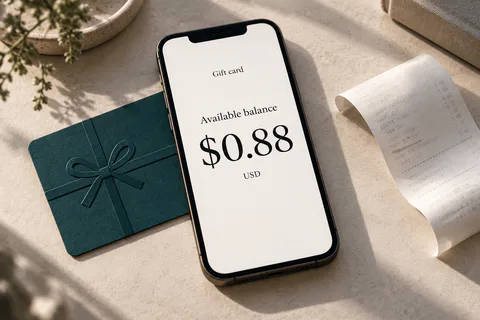
The dispute was about what happened after the gift had arrived.
In September 2025, the Korea Fair Trade Commission reported correcting 85 unfair contract clauses across ten mobile and electronic voucher providers. Among the problems were restrictions on refunds after leaving a membership programme and terms that improperly substituted points for money. Even the starting date mattered: a five-year refund claim should run from purchase or the last top-up, rather than an earlier issuance date. [S01].
It was a revealing intervention in an industry whose public language is usually about speed. A gift can reach a phone almost immediately. Recovering its remaining value may require a much longer conversation.
Across Asia, the digital gift card occupies several different places in daily life. It can be a small gesture inside a messaging conversation, an employer’s reward, a discounted code bought for oneself, or an invitation to choose from a catalogue. Sometimes it represents reusable money at a retailer. Sometimes it buys one particular service. Sometimes the first code must be exchanged for a second before anything can be spent.
These distinctions shape the recipient’s experience more than the image of the card on the screen. They determine whether a balance survives a purchase, whether another payment method can cover the difference, and whether a deadline ends the right to shop or merely changes the route to a refund.
They also explain why Asia is a difficult market to describe with a single growth figure. A Japanese messaging platform, an Indian gift-card processor and a Saudi rewards app can all participate in digital gifting while measuring different activities and operating under different rules.
This article follows digitally delivered gift value across selected Asian markets, including the Gulf. It concentrates on virtual credentials and online use. Where evidence includes other gift-card formats, or digital vouchers that can also be redeemed in person, that boundary is made explicit. Hong Kong and Taiwan are treated as distinct market and regulatory jurisdictions. Australia and New Zealand are outside the geographic scope.
The gift is digital. What has actually been given?
Consider three illustrative recipients. One receives a code that adds money to a retailer account. Another opens a link and chooses a brand from a rewards catalogue. A third receives a prepaid Visa credential with a card number and expiry date.
All three might say they have received a virtual gift card. Yet they are being asked to do different things. The first needs to connect a balance to an order. The second must decide where to lock in the value. The third must navigate a payment card’s acceptance and authorisation rules.
The distinctions are worth making before discussing market size or consumer behaviour.
T01. Five products behind the virtual gift-card label
| Product a recipient encounters | What it provides | The question that matters at redemption |
|---|---|---|
| Money-denominated merchant gift card | Spending value within an identified merchant programme | Does unused value remain, and can another payment method cover a shortfall? |
| Item or single-use service voucher | A defined entitlement or discount, sometimes consumed in one transaction | Is the whole entitlement used at once, and is any difference forfeited? |
| Choice gift or reward link | A right to select another gift from a catalogue | What changes when the recipient chooses a merchant, including expiry and reversibility? |
| Rewards or employee-benefits balance | Value inside a platform, potentially from several funding sources | Can it be transferred, and do purchased funds and earned rewards have different rules? |
| Virtual network prepaid card | A payment credential for eligible merchants on a card network | What currency, country, merchant and transaction restrictions apply? |
These are analytical categories, not a single legal taxonomy used by every Asian regulator. A provider can operate in several of them. A merchant can appear in several catalogues without issuing the same product through each one.
There is a further distinction between the delivery channel and the place of use. A voucher received entirely through a phone may still be restricted to a particular service or redemption channel. Japan’s LINE GIFT, for example, separates electronic tickets from gifts involving delivered merchandise; its electronic offers also have their own redemption instructions. A platform’s total gifting activity therefore cannot automatically be counted as virtual gift-card spending online. [S02].
When a conversation becomes a gift
In messaging-based gifting, the relationship already exists before the payment screen appears. That changes the commercial setting. The sender is choosing how to acknowledge a birthday, offer encouragement or return a favour within an existing conversation.
A 2025 study by YeEun Lee and colleagues at Seoul National University, published in Proceedings of the ACM on Human-Computer Interaction, interviewed 26 university students in their twenties: 11 Korean, seven Japanese and eight Chinese participants, each with at least a year of messenger-gifting experience. The researchers recruited through university communities, social media and exchange networks, with additional referrals for Japanese and Chinese participants; interviews were conducted in Korean or English. Korean participants described small KakaoTalk gifts as everyday support, alongside pressure created by gift histories and birthday reminders. Japanese participants discussed careful accompanying messages and discomfort around visible prices. Chinese participants described playful group exchanges through WeChat hongbao. Those red packets are monetary transfers, rather than merchant gift cards. The study was qualitative and deliberately small; it does not establish national attitudes or adoption rates. It does suggest a tension worth investigating: making gifts easier to send can also make reciprocity more visible. [S03].
The practical consequence for product design is subtle. A sender needs confidence that the gesture will feel appropriate. A recipient needs confidence that accepting it will be straightforward. A beautifully presented gift that leads to an unfamiliar registration process can interrupt that exchange. This is an interpretation of the product journey, rather than a measured country-level effect.
A Korean café voucher makes that connection tangible. In Opensurvey’s August 2022 survey, reproduced by Statista, 91.8% of previous coffee-voucher gift givers selected KakaoTalk gifts as a purchase channel. Coffee-shop apps drew 19.7%, general shopping apps and websites 16.8%, and second-hand platforms 6.4%. Respondents could choose several channels. [S64]
F01. KakaoTalk stood out as a café-gift purchase channel
South Korea, 7–8 August 2022. Purchase channels reported by previous coffee-voucher gift givers.
%
Tap or hover for details. All values are also available in the data table.
Respondents could select several channels. Statista lists an overall sample of 1,000 adults aged 20–59; the question covers prior gift givers, with no separate response base stated. These are respondent shares, not spending, transaction or national adoption shares. Labels shortened.
Explore the data table
| Category | Respondents selecting the channel |
|---|---|
| KakaoTalk gifts | 91.8% |
| Coffee-shop apps | 19.7% |
| Shopping apps and websites | 16.8% |
| Second-hand apps and websites | 6.4% |
The commercial lesson is about where the gift begins. A messaging service can place the purchase beside a conversation that is already happening; a merchant app asks the sender to begin elsewhere. The survey does not establish why respondents chose each channel, but it gives the product-design question a concrete setting. Nor does choosing a channel tell us whether the recipient later spent the voucher, recovered an expired balance or left a remainder.
Japan supplies a different measure of scale. LY Corporation said approximately 20 million unique people sent or received something through LINE GIFT between 1 February 2024 and 31 January 2025. That figure includes the wider service, including delivered goods. It demonstrates the reach of social gifting, but cannot be relabelled as 20 million virtual gift-card customers. [S04].
The reporting challenge is to preserve those distinctions while explaining why the services matter. Messaging provides access to the relationship. The gift programme still has to provide access to usable value.
What a matched Gulf comparison reveals
The clearest country comparison in this research comes from two online surveys conducted by YouGov for YOUGotaGift in February 2024. The published results cover 1,004 respondents in the United Arab Emirates and 1,006 in Saudi Arabia, with fieldwork on 20–27 February.
Among UAE respondents, 62% preferred a gift card to a traditional gift; the Saudi figure was 67%. Preference for an employee gift card over a traditional corporate gift was 68% and 78%, respectively. Yet reported experience of buying or receiving a gift card was higher in the UAE: 66%, against 61% in Saudi Arabia. UAE survey [S05] and Saudi survey [S06].
F02. Preference and experience tell different stories in the Gulf
Three separate questions in YouGov’s February 2024 surveys for YOUGotaGift. All gift-card formats; country samples: UAE 1,004, Saudi Arabia 1,006.
% of respondents
Tap or hover for details. Select a series above to show or hide it.
Fieldwork: 20–27 February 2024. Question-specific bases, weighting and confidence intervals were not published. The employee-gift comparator was a traditional corporate gift, not cash or salary. “Bought or received” combines two activities without a published recall period. Country differences are descriptive, not established as statistically significant. The sponsor sells gift cards.
Explore the data table
| Category | United Arab Emirates | Saudi Arabia |
|---|---|---|
| Prefer a gift card to a traditional gift | 62 % of respondents | 67 % of respondents |
| Prefer an employee gift card to a traditional corporate gift | 68 % of respondents | 78 % of respondents |
| Have bought or received a gift card | 66 % of respondents | 61 % of respondents |
The results distinguish preference from experience. They do not explain the difference between the countries, measure annual spending or show that employees prefer vouchers to cash. Cash was not the published comparator in the workplace result.
The UAE publication also contains a directly relevant format comparison: 54% preferred a digital gift card, against 46% choosing the physical format. The Saudi publication does not provide the matching measure, so it cannot support a two-country ranking of digital preference. [S05].
F03. Digital edged ahead of physical in the UAE survey
Stated gift-card format preference in the UAE. YouGov for YOUGotaGift, 20–27 February 2024; full country sample: 1,004.
% of respondents
Tap or hover for details. All values are also available in the data table.
Format preference, not purchasing, redemption or spending share. The question-specific base was not separately published. No matching Saudi format result was supplied, so this figure cannot establish a country ranking.
Explore the data table
| Category | UAE respondents |
|---|---|
| Digital gift card | 54 % of respondents |
| Physical gift card | 46 % of respondents |
These results cannot be combined with platform user counts to calculate Asian adoption: the years, populations, questions and products differ. The useful comparison is narrower: in two Gulf markets studied at the same time, gift-card preference and previous exposure did not follow the same pattern.
Twenty providers and programmes to understand
The important companies occupy different positions. Some operate a consumer destination. Some issue or process a merchant’s gift value. Others distribute rewards to employees, customers or research participants. A global catalogue can connect several of these layers without becoming the legal issuer of every product it lists.
The directory below identifies 20 relevant providers and merchant programmes, with links to their own services or documented redemption instructions. It is a researched selection, not a ranking by Asian market share. Entries within the same corporate group are identified, and merchant programmes are distinguished from distribution platforms.
T02. Twenty providers and programmes across selected Asian markets
| Provider or programme | Position in the ecosystem | Asian relevance and practical boundary |
|---|---|---|
| Consumer social-gifting platform; also bulk gifting | South Korea. Gifts enter an existing messaging relationship; each digital product still has its own terms. Consumer service [S07] · Business support [S08]. | |
| Local social-gifting services | Japan and Taiwan have distinct storefronts and local offers. A shared LINE identity is not evidence that a voucher works in both markets. Japan [S09] · Taiwan [S10]. | |
| 3. giftee Group / giftee | Merchant e-gift infrastructure, consumer gifting and business incentives | Japan-rooted group with regional operations. Parent-company reach must be distinguished from an individual card’s acceptance. Group structure [S11] · Service and operating metrics [S12]. |
| Digital voucher and employee-benefit infrastructure | Taiwan. Local merchant relationships connect corporate rewards with online shopping. Service [S13] · Coupang voucher announcement [S14]. | |
| Gift-programme issuance, processing and distribution | Important India-facing infrastructure and consumer distribution. A Woohoo catalogue contains distinct merchant products. Pine Labs gift-card services [S15] · Woohoo app [S16]. | |
| 6. GyFTR / Vouchagram India | Digital gift distribution and brand-code redemption | India. Its guidance distinguishes single-use from multiple-use products, with different treatment of unused value. Service and FAQs [S17] · Gift-voucher helpdesk [S18]. |
| 7. Xoxoday Plum | Corporate reward marketplace and distribution | Global catalogue with local rewards. Catalogue coverage does not make each selected voucher internationally spendable. [S19]. |
| 8. GrabGifts | Country- and service-specific digital gift vouchers | Relevant across Southeast Asian Grab markets. These are service offers with redemption conditions; they should not be confused with unrestricted GrabPay money. GrabGifts [S20] · Singapore product terms [S21]. |
| 9. WOGI | Digital reward distribution, APIs and campaign tools | Singapore-based access to local merchant gifts and business delivery. The catalogue and the downstream issuer have separate roles. API offering [S22] · Singapore store [S23]. |
| 10. Giftano | Choice gifting and corporate distribution | Singapore. Recipients select from a gift catalogue; the selected product determines actual redemption. [S24]. |
| 11. Giftaway | Philippine e-gift distribution and merchant programmes | Digital credentials are subject to the relevant merchant’s conditions and supported channels. Service [S25] · Terms [S26]. |
| Programme management and gift distribution | Singapore-facing gift and e-gift services form part of a wider global business. A US network-card offer should not be assumed available through every Asian operation. [S27]. | |
| 13. Tremendous | Business reward and payout distribution | Local merchant rewards coexist with a USD virtual Visa product. Product and recipient eligibility require separate checks. Service [S28] · Virtual Visa use [S29]. |
| 14. YOUGotaGift / HappyYOU | Choice gifts and local e-gift distribution | Gulf-facing platform identified as a giftee company. Country catalogues are distinct; choosing a merchant creates another redemption step. UAE storefront [S30] · HappyYOU instructions [S31]. |
| 15. Resal | Rewards balance, points conversion and gift-card distribution | Saudi Arabia. The source of a balance affects its terms; the selected merchant card can introduce another deadline. App [S32] · Terms [S33]. |
| 16. LikeCard | Digital-product and gift-code distribution | Dubai-based service with regional offers. Region and account compatibility remain product-specific. Company [S34] · Business distribution [S35] · Country and currency guidance [S36]. |
| 17. Merit Incentives | Business rewards, points exchange and gifting tools | Riyadh-headquartered business with regional operations. Its corporate role differs from that of a single merchant issuer. [S37]. |
| 18. Amazon.sg gift card | Merchant gift programme | Singapore storefront redemption; the documented local issuer is Amazon Asia-Pacific Holdings Private Limited. Local programme listing [S38] · Redeem at Amazon.sg [S39]. |
| 19. Amazon.ae eGift | Merchant gift programme | UAE storefront value, distributed through local partners. The Amazon name does not establish cross-storefront redemption. [S40]. |
| 20. Flipkart gift card | Indian merchant gift programme | Documented redemption permits a gift card alongside another payment method when the purchase exceeds its value. [S41]. |
The directory deliberately separates visibility from control. The company that sends the email may not hold the monetary obligation. The app that shows the balance may not set the final retailer’s checkout rules. For a recipient, the distinction becomes urgent only when something fails. For a business choosing a partner, it should be clear before the first reward is sent.
The larger providers are connecting different parts of the journey
giftee offers a useful example of how the industry stretches from local merchant infrastructure to international distribution. Its group structure includes operations in Malaysia and Indonesia, while YOUGotaGift provides a Gulf-facing business. The company moved to a holding-company structure under the name giftee Group in July 2026; the operating company giftee remains part of the group. Its Vietnam subsidiary is described as supporting group development, which is different from evidence of a consumer gift-card issuing business there. giftee group structure [S11] · Holding-company transition [S42].
The company reports more than 620 million cumulative e-gifts issued through December 2025, alongside 302 e-gift-issuing companies as of December 2025 and 2,276 business client companies during 2025. These figures describe different aspects of its operations. Cumulative issuance does not show how many gifts were redeemed, and a client count does not establish regional market share. [S12].
Pine Labs places merchant gift programmes within a payments and prepaid infrastructure offering. Its gift-card services support digital delivery through channels including SMS and WhatsApp. That positions the infrastructure provider close to the merchant’s issuance and fulfilment process, while a consumer may encounter the result through Woohoo or another distribution route. [S15].
Edenred’s Taiwan business illustrates the importance of local merchant access. On 7 September 2026, it announced a Coupang Taiwan voucher, adding another online shopping destination to an employee-benefits ecosystem that already included channels such as momo, Shopee and Books.com.tw. Edenred reported more than 3,000 corporate clients and over 300 million electronic vouchers issued cumulatively. Those are company-reported measures, not independently established market shares. [S14].
The commercial significance is the connection between reward budgets and ordinary online purchases. A gift does not need to remain a special-occasion purchase if it can cover something the household was already going to buy. Whether that creates additional spending or substitutes for the recipient’s own money is a separate empirical question; the existence of an integration cannot answer it.
Regional reach therefore has several meanings. A provider might have a legal entity in a country, an employer client there, a local merchant catalogue, or a product that actually works for a resident at online checkout. A serious conversation about scale needs to identify which of those claims is being made.
Thirteen markets, several kinds of protection
Digital delivery does not create a common Asian rulebook. A jurisdiction may protect monetary vouchers from expiry, regulate a broader prepaid account, or exempt a narrowly defined merchant instrument from payment-services licensing. These approaches cannot responsibly be reduced to a league table of “years until expiry.”
The comparison below records the most useful verified distinctions. Where the available evidence establishes classification rather than a general expiry entitlement, the table says so. It does not suggest that a rule applies simply because a product is marketed as a gift card.
T03. Gift-value protections across thirteen markets
| Market or jurisdiction | Verified rule or regulatory distinction | What it means for a virtual gift |
|---|---|---|
| Japan | Prepaid-instrument regulation distinguishes own-business and third-party issuers. Instruments valid for no more than six months are exempt from that regime. [S43]. | Six months is an exemption boundary, not a guaranteed minimum validity period. |
| South Korea | A 2025 KFTC action corrected unfair voucher terms; revised standard terms also addressed expired-voucher refunds. Adoption of those standard terms is voluntary. [S01]. | Check the provider’s adopted terms and product. The intervention is not a universal promise of full cash recovery. |
| Mainland China | Official guidance expressly includes virtual credentials in the single-purpose commercial prepaid-card regime, within specified industries and issuer networks. [S44]. | A merchant or same-brand network card needs different analysis from a general payment wallet. |
| Hong Kong | Single-purpose facilities fall outside the stored-value-facility definition used in the licensing regime. [S45]. | Do not assume a merchant gift voucher receives the protections of a licensed general-purpose wallet. |
| Taiwan | Mandatory terms for covered goods-and-services vouchers prohibit expiry and unusable residual value. Refund fees may not exceed 3% of the amount returned, and no fee may be charged where the reason for returning the voucher is not attributable to the consumer. [S46]. | A covered electronic voucher’s value and its financial protection arrangement have separate clocks. |
| India | RBI-regulated gift PPIs are capped at ₹10,000 and nonreloadable. Merchant-only closed systems are outside RBI PPI supervision. [S47]. | Determine the legal instrument before applying regulated-wallet protections or assuming UPI interoperability. |
| Singapore | The Monetary Authority of Singapore excludes payment services involving only qualifying limited-purpose e-money from regulation under the Payment Services Act. Its guidance includes physical or electronic mall vouchers that meet the statutory criteria. [S48]. | A restricted voucher should not be assumed to carry the same regulatory protections as a regulated payment account. The exclusion does not itself establish a voucher expiry rule. |
| Malaysia | Approved e-money issuers and conditional limited-purpose exemptions have different requirements. The limited-purpose order took effect on 2 January 2025. BNM FAQ [S49] · Exemption order [S50]. | Identify whether the value is purchased, a reward or a refund, and which regime covers its issuer. |
| Thailand | Covered e-money providers must disclose redemption conditions and provide ways to check balance and expiry. A request satisfying those conditions must be refunded within 15 days of submission. [S51]. | These are conditional e-money rights, not a general promise that every retailer voucher is refundable. |
| Indonesia | Bank Indonesia’s payment-industry regulation PBI 10/2025 took effect on 31 March 2026 and includes e-money among sources of funds. [S52]. | Current product classification and licensing need checking under the updated framework; old summaries are insufficient. |
| Philippines | The Gift Check Act protects purchased monetary gift instruments, including codes, against expiry and refusal of unused value. Promotional rewards and specified-product vouchers are excluded. [S53]. | A monetary gift code and a free promotional entitlement can have different rights even when delivered by the same app. |
| United Arab Emirates | The central bank’s stored-value regime distinguishes single-purpose facilities from facilities requiring prior licensing. [S54]. | A merchant gift balance does not automatically receive the safeguarding applicable to a licensed stored-value provider. |
| Saudi Arabia | SAMA’s cited prepaid-payment rules expressly concern bank-issued prepaid products and address residual value on expired or dormant nonreloadable cards. [S55]. | Those provisions should not be applied indiscriminately to all retail codes and rewards vouchers. |
The table describes selected operative distinctions, rather than every consumer, payments, tax or data-protection obligation. A local legal assessment still depends on the issuer, funding source, acceptance network and contract.
Expiry can mean several different things
Taiwan offers an especially clear example. Its rules for covered vouchers prohibit expiry while requiring a qualifying performance-protection arrangement lasting at least one year from sale. The issuer’s obligation continues after that protection period ends. Free promotional discount coupons and separately regulated electronic stored-value tickets are outside this particular voucher framework. A date describing the guarantee must therefore not be presented as the date on which the gift disappears. [S46].
Japan exposes another distinction: permission to spend and protection if the issuer fails. Official guidance says qualifying issuers generally must secure at least half of the entire outstanding balance once it exceeds ¥10 million on a reference date, subject to the regime’s arrangements and exceptions. That is not full deposit insurance. The guidance also requires relevant balance-checking and validity information for electronic instruments. [S56].
If a covered Japanese programme closes, a specific refund procedure comes into play. The Japan Payment Service Association explains that holders receive a claim window of at least 60 days; its issuer-failure guidance also recommends preserving evidence such as account identifiers and recorded balances. This is distinct from an everyday right to withdraw a few unused yen. [S57].
In South Korea, the revised voluntary standard terms described in the 2025 action set expired-voucher refund rates of 90% for vouchers worth up to ₩50,000 and 95% above that threshold, applied to the eligible unused balance. A 100% return in points is an option only where the issuer operates a points scheme and the customer requests it. The ten reviewed providers agreed to adopt the changes. These provisions should not be described as a universal right to recover the full face value in cash. KFTC action and standard-term changes [S01] · KFTC amended clauses [S58].
For the person looking at a phone, all these questions may be compressed into one word: “expired.” Yet an unusable code, an expired commercial offer, an ongoing refund claim and the end of a guarantee are different events. A useful interface needs to explain which one has occurred.
A monetary code and a reward are not always treated alike
The Philippines makes the product boundary unusually visible. The Gift Check Act covers monetary instruments bought for consideration and accepted at a single merchant or an affiliated group, expressly including codes. It prohibits expiry of the instrument and its stored value, and refusal to honour an unused balance. But the law excludes specified promotional, loyalty and reward instruments, along with vouchers for a predetermined good or service. Its enforcement provisions should not be mistaken for a general right to cash out any gift. [S53].
This distinction is directly relevant to an app that distributes both purchased value and promotional offers. A shared interface cannot make those underlying contracts identical. Nor does a published product restriction, by itself, settle whether that restriction is legally enforceable for every transaction.
India’s regulated gift PPIs also have a particular identity. They are nonreloadable spending instruments, with normal cash-out and transfers prohibited, an express route back to the funding account with holder consent, and revalidation on request. Interoperability is optional for gift PPI issuers. A recipient therefore should not assume that a gift automatically becomes an unrestricted balance spendable through any UPI app. These provisions concern the RBI-regulated category, rather than every merchant-only code. [S47].
Malaysia’s limited-purpose exemption distinguishes purchase, reward and refund categories. Qualifying purchase- and refund-category issuers must facilitate transfers of stored funds to the user’s own bank account; reward-category transfers are subject to the issuer’s terms. These categories have specific eligibility conditions, so the exemption is not a blanket rule for all merchant vouchers. Separately, approved e-money issuers must refund balances when a customer closes an account, is wrongly charged or disputes a transaction. The normal deadline is 14 days from the claim, without additional cost; complex cases must be completed within 30 days, with reasons for delay communicated to the customer. Actual costs may be charged when a requested refund is remitted overseas. Limited-purpose exemption order [S50] · BNM e-money policy, paragraphs 20.10–20.14 [S59].
Commercial platforms can add another layer. Resal’s Saudi terms, updated on 1 September 2026, distinguish types of balance, including value converted from loyalty programmes. They assign converted loyalty value a 12-month period unless other terms apply. A user’s general understanding of an app balance is therefore insufficient: the origin of the value and the terms of a later gift-card purchase both matter. [S33].
The analytical lesson is to follow the value, rather than the branding. Who funded it? What did the recipient acquire? Has selecting a merchant replaced one obligation with another? These questions explain more than whether the gift came by email, SMS or a familiar app.
The border remains inside the virtual card
A digital gift can be sent abroad without becoming a cross-border spending product.
Amazon.sg and Amazon.ae illustrate the basic distinction: the documented products are attached to their respective storefronts. The retailer name is shared; the redemption destination is local. Amazon.sg programme information [S38] and Amazon.ae eGift information [S40].
A choice platform can make local gifts available in several countries, but the recipient still has to choose an eligible product for the appropriate market. YOUGotaGift’s country storefronts illustrate that distribution model. Its HappyYOU instructions take the recipient through an app and a brand-selection step before generating the selected e-gift. The original choice value and the merchant voucher are separate stages of the journey. YOUGotaGift storefront [S30] and HappyYOU redemption guide [S31].
Virtual network prepaid cards introduce a different set of constraints. Tremendous describes its Virtual Visa as a USD-denominated product that can convert purchases made in other currencies. Its guidance says it does not charge a currency-conversion fee, while the local-currency equivalent can change with exchange rates. A recipient seeing the equivalent of a local amount is still using a dollar balance. [S60].
The same provider’s use guidance limits eligible transactions and excludes uses such as subscriptions, instalments and bill payments. Its cards cannot be reloaded or combined. Consequently, “virtual Visa” does not promise every kind of online transaction or the ability to merge several small rewards. Where the Virtual Visa works [S29] and reloading and combining rules [S61].
Tremendous’s issuer disclosure identifies Sutton Bank in the United States. This is a documented example of a global reward product reaching users through a payment network, not evidence of locally issued gift cards throughout Asia. Tremendous issuer disclosure [S28]. Country eligibility, issuing entity and currency require product-level confirmation.
Even a familiar wallet logo can obscure the distinction. Edenred Taiwan describes an NFC voucher that can be held in Apple Wallet. A voucher stored there is not, merely by virtue of its presentation, a Visa or Mastercard credential. The storage interface and the underlying payment instrument are separate facts. [S62].
What the recipient is trying to accomplish
Receiving, checking and spending a gift are different psychological moments. Treating them as one conversion funnel can hide the reason a recipient hesitates.
The following framework is an editorial interpretation of the documented product journeys. It is not a survey claiming that every Asian consumer thinks alike. Its purpose is to identify the practical uncertainty a digital gift can create.
T04. What recipients need at each stage
| Moment | Likely question to investigate with users | Information the service should make easy to find |
|---|---|---|
| An unfamiliar gift arrives | “Is this really from the person or company named?” | Sender, programme identity and a route to verify the gift within the official service. |
| The recipient opens a choice link | “Am I committing to this brand if I click?” | Available brands, country restrictions, conversion consequences and relevant deadlines. |
| A balance is checked before shopping | “Can this pay for what I want?” | Current usable value, currency, supported channel and whether another payment can cover a difference. |
| A purchase leaves a small amount | “Can I use the rest without doing a lot more?” | Residual balance, minimum redemption, split-payment rules and any lawful recovery route. |
| A gift is close to a deadline | “Do I need to buy something now?” | The exact deadline and whether extension, refund or another claim remains available. |
| A transaction or code fails | “Have I lost the gift?” | Whether value was deducted, transaction status and the responsible support contact. |
Several motives can coexist. A person may want to respect the sender’s gesture, obtain something enjoyable, avoid losing money and avoid the effort of another account. A business should test these motives rather than assume that the largest balance always creates the greatest urgency.
The sender and recipient may also value different parts of the experience. Presentation, a personal message and scheduled delivery matter before the gift is opened. Clear restrictions and a usable remainder matter after the first purchase. A gift programme can succeed at the first task and still leave the recipient disappointed at the second.
For employee rewards, the emotional context changes again. The recipient may interpret the gift as recognition, compensation-adjacent value or a budget for necessary purchases. The Gulf survey establishes preference against traditional corporate gifts; it does not determine which of these interpretations dominates. Interviews and transaction data would be needed to connect those attitudes to actual redemption.
The last dollar, rupee or yen is a product-design test
There is no verified universal psychological cliff at US$3, US$2 or US$1 across Asian consumers. Those dollar amounts do not represent equivalent purchasing power, nor do local denominations map neatly onto them. A numerical threshold becomes meaningful only in relation to what the balance can do. The same distinction runs through What people want when they check a gift card balance: a number is useful when it helps the holder decide how to spend it.
Three circumstances are especially useful to distinguish. A small balance may be easy to apply to an already planned order. It may require a new purchase that the recipient would otherwise avoid. Or it may be unusable under the product’s minimum denomination or single-use rule. These are different consumer problems even if the screen displays the same amount.
T05. Four ways a small balance can behave
| Illustrative situation | What the remaining amount actually permits | Likely friction to investigate |
|---|---|---|
| A reusable ₹100 balance can contribute to a ₹750 order | The gift covers part of the order; another payment covers ₹650 | Whether the checkout makes that option visible and reliable. |
| A S$2 service voucher excludes certain fees | Only eligible charges can be offset | Whether the recipient understands exclusions and any forfeited difference. |
| A choice balance is below an available merchant denomination | The selection step may prevent the remaining value becoming a usable code | Whether smaller denominations, combination or another contractual remedy are offered. |
| A small USD prepaid balance faces a local-currency checkout | The charge must fit the available balance after conversion and applicable authorisation rules | Uncertainty about the amount that will actually be authorised. |
The rupee example is illustrative arithmetic, grounded in a real redemption mechanism: Tremendous’s Flipkart instructions allow a gift card to be supplemented with another payment method when an order costs more. A small amount can therefore contribute to an existing purchase, subject to the programme’s conditions. [S41].
GrabGifts in Singapore shows why the product type matters. The documented WOGI listing includes S$1, S$2 and S$3 denominations, so a low face value can be intentional. Its terms also specify irreversible service and denomination choices, excluded fees and forfeiture of unused amounts. These constraints should be visible before a recipient selects a service. [S21].
GyFTR’s distinction between single-use and multiple-use vouchers creates a similar editorial question: does “balance” mean value preserved for another order, or simply the face value of an entitlement that will be consumed once? The provider’s own guidance says unused value can be forfeited on single-use products. [S17].
HappyYOU permits its choice value to be used across brands and purchases, according to its support documentation. That flexibility at the selection stage does not guarantee that every merchant voucher subsequently generated can itself be divided in the same way. [S63].
For research purposes, the useful question is therefore more precise than “What do people do below $2?” It is: when the remaining value becomes small relative to the effort needed to use it, what does the recipient do next?
A programme could test that question by comparing users with similar balances but different checkout options. Does visible split payment increase complete redemption? Does a reminder help when a usable purchase is available? Does it merely create irritation when the balance is below the smallest eligible denomination? These are proposed research questions, not findings from the available surveys.
A balance screen should explain the next usable action
The most helpful balance check answers more than “how much?” It connects the amount to the recipient’s next decision.
For a reusable merchant gift, that means showing the current value alongside where it works and how to pay a difference. For a choice gift, it means making the consequences of selecting a brand visible before the choice becomes final. For a network prepaid card, it means identifying the issuing currency and the relevant transaction restrictions.
Expiry deserves equally precise language. “Use by,” “choose your reward by,” “request a refund by” and “guarantee valid until” should not be collapsed into one ambiguous date. Taiwan’s voucher framework demonstrates why these distinctions have legal significance; Japan’s closure procedures show why saving a record of the balance may matter later.
Thailand makes access to balance and expiry information an explicit requirement for the regulated e-money providers covered by its notification. The rule illustrates a broader point: the balance screen is part of the service’s practical accountability, not just a convenient accessory. [S51].
A programme should also distinguish an unspent balance from value temporarily unavailable during an unresolved transaction, and identify which organisation can resolve the problem. The recipient should not have to reconstruct the commercial chain between employer, rewards distributor, issuing entity and merchant simply to find a support address.
This is particularly important when reporting unused value. An issued gift, an opened gift, a chosen merchant voucher and a completed purchase are separate events. Counting distribution as redemption can make a programme look successful while leaving the consumer’s central task unfinished.
The questions large providers should be ready to answer
For a business selecting a provider, brand counts and country counts supply only part of the story. The more revealing questions concern what happens to the value after the recipient receives the message.
-
Who owes the recipient the value? Identify the issuing entity, the distributor and the merchant obligation for each product and market. Explain what changes when a choice gift becomes a merchant voucher.
-
What does regional coverage mean? Separate local issuance, local-currency settlement, available catalogues, resident eligibility and proven online redemption. A multinational client is not evidence of every one of these capabilities.
-
Can the recipient use the last unit? Demonstrate a low-balance online transaction, including split payment, minimum denominations, excluded fees and the treatment of unused value on single-use products.
-
Which deadlines survive conversion? Show the expiry and recovery rules before and after brand selection, and distinguish purchased funds from loyalty rewards and promotional value.
-
How much value reaches a completed purchase? Publish cohort-based redemption, time-to-redemption and residual-value measures, separating consumer gifts, employee rewards and promotional campaigns. Explain refunds and reversals.
-
What happens when something goes wrong? Describe support ownership, lost credentials, disputed transactions, account closure and issuer failure. Show the consumer-facing process, not only the business contract.
These are due-diligence questions arising from the documented product differences, rather than responses gathered in interviews for this article.
The defining moment in digital gifting may be the one after the celebratory message has disappeared. The recipient returns to a balance, considers a purchase and asks a simple question: can I use what I have been given?
Across the markets examined here, the answer depends on much more than whether the gift is virtual. It depends on the local rules, the issuing relationship and the product decisions made between delivery and checkout. That is where a convenient gift becomes usable value—or remains an unfinished promise on a phone. It is also the point at which this market connects with the wider gift-card breakage question and Europe’s different rules for digital gifts.
How this article was researched
This report combines regulator and government publications, provider documentation, original YouGov–YOUGotaGift survey releases and a full reading of the 2025 messenger-gifting study. The review was completed on 17 September 2026. Company figures remain attributed to their publishers and are not treated as independently audited market shares. Older survey dates appear with the figures.
The Gulf charts reproduce the published observations in a new interactive format. YouGov conducted the online fieldwork on 20–27 February 2024; the full country samples were 1,004 in the UAE and 1,006 in Saudi Arabia. The publications do not provide question-specific bases, a full questionnaire, weighting details or confidence intervals. YOUGotaGift, the commissioning company, sells gift cards. The comparisons describe reported responses, without claims about statistical significance, transaction share or 2026 adoption.
The Korean purchase-channel data come from Opensurvey’s online panel survey, published by Statista. Its eligible group and August 2022 dates are kept separate from the Gulf surveys and platform user counts. The chart describes purchasing channels, not redemption. [S64]
The behavioural framework and small-balance examples are editorial analysis, not measured psychological thresholds or national characterisations. No purchases, gift redemptions or provider interviews were conducted for this article. The interview findings discussed in the text come from the cited academic research and are limited to its student sample.
The country table identifies selected product and regulatory distinctions. Rights depend on the instrument, issuer, funding source and applicable terms. The amended RBI Master Directions were used for India; a separately posted 2026 draft was not treated as operative law. Indonesia’s March 2026 framework change is reflected in its row. All references are collected below, and the figures and tables are available through the article’s CSV download.
Sources and documents
Collapse
- [S01] Korea Fair Trade Commission: Korean government account of the KFTC action, 16 September 2025 — Korea Fair Trade Commission
- [S02] LY Corporation: LINE GIFT service guide — LY Corporation
- [S03] arXiv: Lee and colleagues, 2025 — arXiv
- [S04] LY Corporation: LINE GIFT’s tenth-anniversary announcement — LY Corporation
- [S05] YOUGotaGift: UAE survey — YOUGotaGift
- [S06] YOUGotaGift: Saudi survey — YOUGotaGift
- [S07] Kakao: Consumer service — Kakao
- [S08] Kakao: Business support — Kakao
- [S09] LY Corporation: Japan — LY Corporation
- [S10] LY Corporation: Taiwan — LY Corporation
- [S11] giftee Group: Group structure — giftee Group
- [S12] giftee Group: Service and operating metrics — giftee Group
- [S13] Edenred Taiwan: Service — Edenred Taiwan
- [S14] Edenred Taiwan: Coupang voucher announcement — Edenred Taiwan
- [S15] Pine Labs gift-card services — Pine Labs
- [S16] Google Play: Woohoo app — Google Play
- [S17] Vouchagram India: Service and FAQs — Vouchagram India
- [S18] Vouchagram India: Gift-voucher helpdesk — Vouchagram India
- [S19] Xoxoday: Gift-card marketplace — Xoxoday
- [S20] GrabGifts — Grab
- [S21] WOGI: Singapore product terms — WOGI
- [S22] WOGI: API offering — WOGI
- [S23] WOGI: Singapore store — WOGI
- [S24] Giftano gift card — Giftano
- [S25] Giftaway: Service — Giftaway
- [S26] Giftaway: Terms — Giftaway
- [S27] Blackhawk Network: Singapore services — Blackhawk Network
- [S28] Tremendous: Service — Tremendous
- [S29] Tremendous: Virtual Visa use — Tremendous
- [S30] YOUGotaGift: UAE storefront — YOUGotaGift
- [S31] YOUGotaGift: HappyYOU instructions — YOUGotaGift
- [S32] Resal: App — Resal
- [S33] Resal: Terms — Resal
- [S34] LikeCard: Company — LikeCard
- [S35] LikeCard: Business distribution — LikeCard
- [S36] LikeCard: Country and currency guidance — LikeCard
- [S37] Merit Incentives: Services — Merit Incentives
- [S38] WOGI: Local programme listing — WOGI
- [S39] Redeem at Amazon.sg — Amazon
- [S40] YOUGotaGift: Local product and instructions — YOUGotaGift
- [S41] Redemption guidance from distributor Tremendous — Tremendous
- [S42] giftee Group: Holding-company transition — giftee Group
- [S43] Japan Financial Services Agency: FSA FAQ — Japan Financial Services Agency
- [S44] Wuhan Municipal Commerce Bureau: Commerce bureau guidance — Wuhan Municipal Commerce Bureau
- [S45] Hong Kong Monetary Authority: HKMA guideline, section 1.1.2 — Hong Kong Monetary Authority
- [S46] Taiwan Ministry of Economic Affairs: MOEA legal text — Taiwan Ministry of Economic Affairs
- [S47] Reserve Bank of India: RBI Master Directions — Reserve Bank of India
- [S48] Monetary Authority of Singapore: MAS guidance, questions 7.3 and 11 — Monetary Authority of Singapore
- [S49] Bank Negara Malaysia: BNM FAQ — Bank Negara Malaysia
- [S50] Bank Negara Malaysia: Exemption order — Bank Negara Malaysia
- [S51] Bank of Thailand notification — Bank of Thailand
- [S52] Bank Indonesia: Official regulation summary — Bank Indonesia
- [S53] Supreme Court of the Philippines: Republic Act 10962 — Supreme Court of the Philippines
- [S54] Central Bank of the United Arab Emirates: SVF regulation — Central Bank of the United Arab Emirates
- [S55] Saudi Central Bank: SAMA rulebook — Saudi Central Bank
- [S56] Tohoku Local Finance Bureau guidance — Tohoku Local Finance Bureau
- [S57] Japan Payment Service Association: JPSA consumer-protection explanation — Japan Payment Service Association
- [S58] Korea Development Institute: KFTC amended clauses — Korea Development Institute
- [S59] Bank Negara Malaysia: BNM e-money policy, paragraphs 20.10–20.14 — Bank Negara Malaysia
- [S60] Tremendous currency guidance — Tremendous
- [S61] Tremendous: reloading and combining rules — Tremendous
- [S62] Edenred Taiwan: Edenred’s NFC voucher description — Edenred Taiwan
- [S63] YOUGotaGift: HappyYOU multi-brand use — YOUGotaGift
- [S64] Opensurvey: café-gift purchase channels, South Korea, August 2022; data table published by Statista on 22 March 2023 — Opensurvey / Statista
In this article

Oliver Reed
Oliver Reed covers industry acquisitions, investment and market research for Gift Card News.