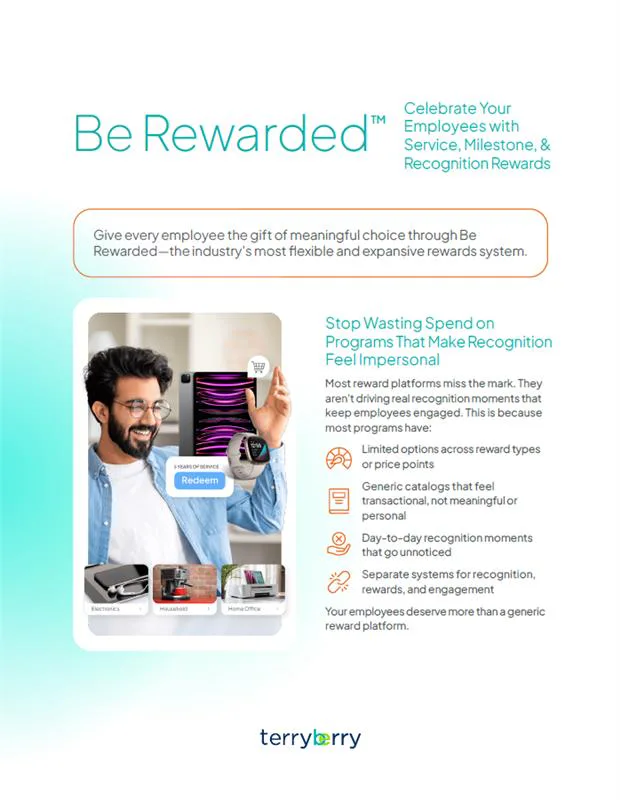
Terryberry's Be Rewarded brochure places reward choice at the centre of its employee-recognition proposition. The accompanying product offering includes gift cards alongside merchandise and experiences, with an important commercial distinction: Terryberry says it invoices for rewards when employees redeem them. [S01] [S02]
For the gift-card industry, this is a distribution channel inside an employer's recognition programme. The supplier is selling the administration and selection experience around the reward, rather than simply asking an employer to buy a stack of cards in advance.
From jewellery maker to reward platform
Terryberry traces its history to a custom jewellery business founded in Grand Rapids, Michigan, in 1918. It expanded into employee recognition and later introduced online reward redemption and social-recognition services during the 2000s. The company still supplies physical awards while operating digital engagement programmes. [S03]
That background helps explain the breadth of its catalogue. A commemorative award and a retailer gift card perform different jobs, but both can sit within the same employer relationship. Offering both gives Terryberry a route to serve formal milestones and smaller, recurring recognition occasions.
The commercial inference is that a broad programme can extend the supplier's involvement beyond the individual award purchase. Employers are buying a mechanism for allocating and delivering recognition as well as access to rewards. The brochure does not disclose Terryberry's revenue split between software, administration and reward fulfilment.
What invoice-upon-redemption changes
Be Rewarded supports points, reward levels or a combination of the two. The product page lists gift cards among the available award types and describes billing at redemption, rather than requiring every promised reward to be purchased immediately. [S02]
That can change the timing of an employer's cash outflow. A points balance represents a reward still to be selected; purchasing a merchant gift card in advance commits money to a specific product. Paying later can reduce money tied up in unselected rewards, although the employer still has to budget for employees exercising their entitlement.
There are also two different redemption events. Exchanging programme points for a gift card is not the same as spending that card at the retailer. Terryberry's billing description should not be read as a promise that employers pay only after a recipient makes a retail purchase.
Reward choice comes within a wider system
Terryberry's current FAQ describes Be Rewarded as a feature of Be Recognized. The broader Be Engaged offering connects recognition, rewards, wellbeing and employee-listening tools. The current configuration therefore needs to be understood as part of a software relationship, not a standalone card shop. [S02]
Consolidation can spare an employer separate administrative systems, but it also ties reward distribution to the supplier's wider platform. Whether that tradeoff is attractive depends on the services an organisation actually needs and the commercial terms it agrees.
The public materials establish the catalogue and billing proposition. They do not quantify savings or demonstrate that gift-card choice causes better retention. Terryberry's immediate business argument is more concrete: it combines multiple reward formats and delays reward invoicing until selection, while making its platform the place where that selection happens.
In this article

Daniel Brooks
Daniel Brooks covers payment networks, financial technology, payment security, gift card fraud and PCI DSS for Gift Card News.