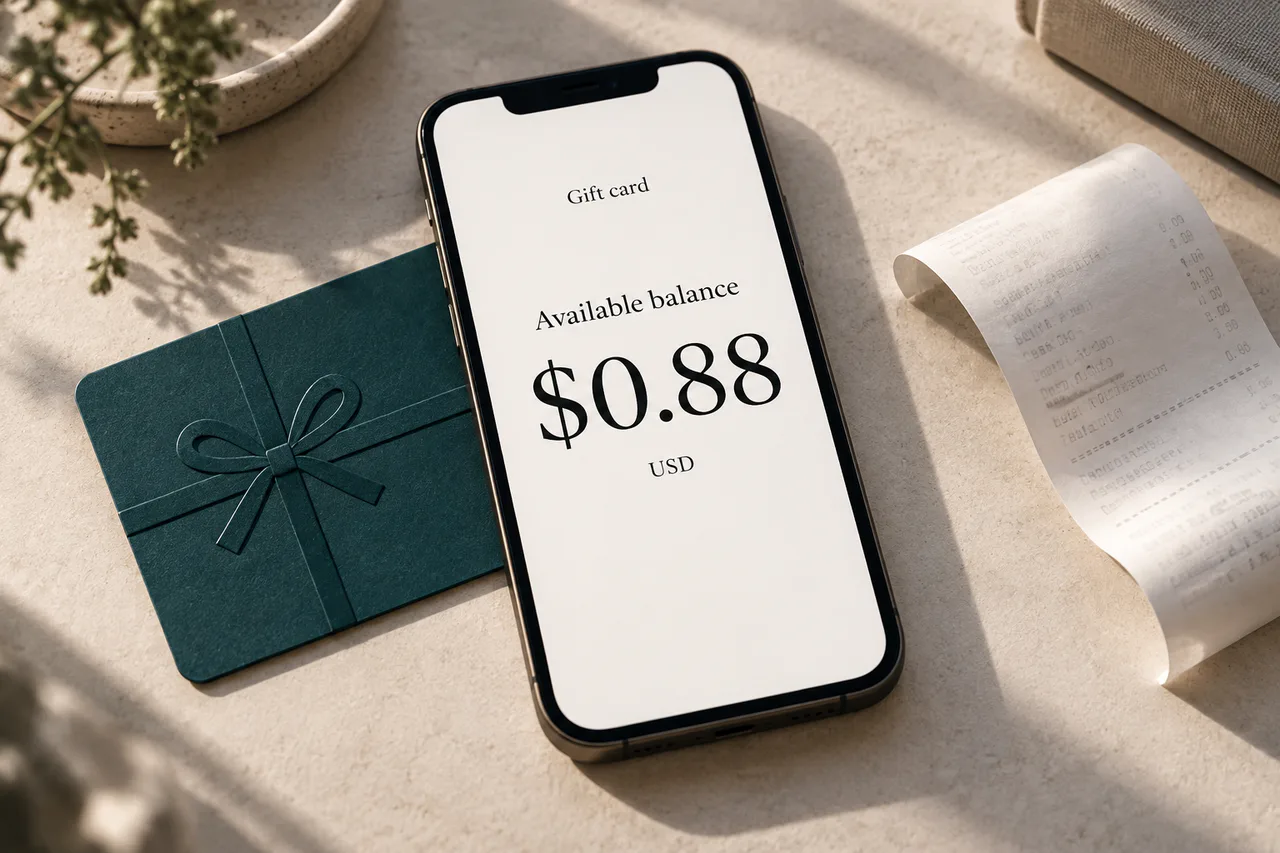
A balance page says $2.37. For someone about to buy groceries, that is money to put toward the bill. For someone who thought the card held $50, it is a discrepancy to investigate. For someone facing several screens, an unsuccessful payment and another trip to a store, it may be a task to leave until later.
The amount is identical. The problem the person wants solved is not.
Checking a gift card balance answers an obvious question: how much money is left? Its usefulness often depends on the next answer: what can I do with that money, here and now? A precise number helps, but so do the right payment instructions, an explanation for a missing balance and a way to use the remainder without an unwanted purchase.
Research on small gift cards and spending behavior challenges the idea that people inevitably stop caring below $3, $2 or $1. Some say they would keep even 50 cents for a future purchase. Others are willing to use a sub-dollar card. What the research does not supply is a universal amount at which interest disappears.
This article brings together that evidence, the payment rules that make small balances easier or harder to use, and official balance-checking links for 20 brands and programs. Dollar examples are in US dollars; the practical directory and legal examples primarily concern US products.
A 2024 US survey makes the practical demand explicit: 36% wanted simpler balance checks, and 35% wanted reminders about unused balances. Accenture’s findings, reproduced by Statista, connect the act of checking a card with the longer task of remembering and using its value. [S45]
A small balance can still be worth keeping
Two consumer surveys offer unusually direct evidence about tiny amounts.
Fiserv's Q1 2023 Gift Card Gauge reported that 71% of respondents would save a gift card with 50 cents left for a future purchase. The survey covered more than 1,000 US adults. That is a finding about keeping value for later, rather than spending it immediately. It also does not tell us what happened to the cards afterward. [S01].
An earlier Fiserv study found that nearly four in five consumers surveyed said they would visit a store to redeem an 88-cent gift card. Its consumer sample comprised 1,084 adults aged 18–76, surveyed in spring 2019. The separate sample of small-business owners was not part of that consumer denominator. The finding records an intention in a small-business setting; it does not establish actual store visits or a willingness to make a special journey solely for 88 cents. [S02].
| Research | Amount described | Reported response | What the response tells us |
|---|---|---|---|
| Fiserv, Q1 2023 | $0.50 left on a card | 71% would save it for a future purchase | A small remainder can retain future value to its holder. |
| Fiserv, 2019 | A card valued at $0.88 | Nearly four in five would visit the store to redeem it | Sub-dollar value can attract stated interest in redemption. |
These are different questions, asked in different years and settings. They are not points on a measured redemption curve. Together, however, they undermine a blanket assumption that a balance below $1 is worthless to its owner.
Keeping a card and spending it are also different decisions. Someone can care enough to save 50 cents while having no reason to buy anything today.
Official gift card balance checks for 20 brands and programs
The first practical step is finding the service for the actual card. A merchant gift card, an account balance and a Visa- or Mastercard-branded prepaid card can require different routes, even when they are associated with the same store.
The retailer and prepaid links below concern US programs. Google Play and Roblox show credit associated with the signed-in account and its region. Some services require sign-in or additional verification.
Retailers, restaurants and entertainment
| Brand or program | Official balance link | What to expect |
|---|---|---|
| Sign in to the Amazon.com account holding the funds. This displays credit already applied to the account, rather than anonymously checking an unredeemed card. [S03]. | ||
| Have the gift-card number and PIN ready. Walmart Visa products use their own program instructions. [S04]. | ||
| Enter the gift-card number and access number/PIN. The guest form checks native Target Gift Cards. | ||
| Follow the card-information and sign-in prompts. Credit already redeemed to an Apple Account has a separate balance view. [S05]. | ||
| Have the card number and security code ready for an unregistered card. Registered cards can also be viewed through the account's card-management controls. | ||
| Have the card number and PIN ready; eGift cards also provide these details. | ||
| Find Check Balance & Add to Wallet, then enter the card number and PIN. Store merchandise credits require an in-store check. [S06]. | ||
| The portal expects a 16-digit card number and four-digit PIN. For a card without a PIN or with a different number length, it provides an automated telephone route at 877-500-9706. Darden's official gift-card page links to this portal [S07]. | ||
| Have the card number and PIN ready and follow any account prompts. Gap's service covers its family of brands, including Old Navy. [S08]. | ||
| Use the balance form with the card number and PIN. Cards without a PIN require a restaurant check. | ||
| Disney Gift Card | Enter the gift-card account number and EAN/security code. Cards without an EAN cannot use this online service. [S09]. | |
| Have the gift-card number and CID security code ready. | ||
| Sign in, then use the gift-card number and PIN. [S10]. | ||
| Have the card details ready and follow the balance-check prompts. [S11]. |
Digital account balances
| Brand | Official balance link | What the balance represents |
|---|---|---|
| Google Play | Sign in to the account holding the credit. This includes gift-card funds already redeemed to that account. [S12]. | |
| Sign in through a web browser and look for Available Credit. Gift-card credit is distinct from a Robux balance; viewing existing credit does not require redeeming another code. [S13]. |
Network-branded gift-card programs
The Visa or Mastercard logo alone does not identify a universal balance checker. Match the program name on the card or original eGift message to the provider. Visa's gift-card balance directory can help identify the correct route.
| Program | Official balance link | What to expect |
|---|---|---|
| Vanilla Gift — US | Card number, valid-through date and security code for the applicable US Vanilla program. [S14]. | |
| Giftcards.com Visa / Mastercard — US | Card number, expiration date and three-digit CVV; follow any registration prompts. The card or original eGift should identify Giftcards.com. Other Blackhawk Network products may use different portals. | |
| Card number, valid-through date and security code. This portal serves the named program, not every Mastercard gift card. [S15]. | ||
| American Express Gift Cards — US | Card number, expiration date and four-digit security code. This is separate from an ordinary American Express credit-card account. [S16]. |
A zero account balance does not prove that a separate, unredeemed gift card is empty. Redeeming a code and viewing credit that is already in an account are different actions.
The destination matters, too. The Better Business Bureau describes fraudulent balance-checking sites that collect card numbers and security codes to drain the funds. Start with the service named by the card provider or its official website. [S17].
If value appears to have been stolen, contact the gift-card company through its official details and keep the card and purchase receipt. Ask about recovery; a refund is not guaranteed. [S18].
The same balance check can serve very different needs
A balance lookup can happen before a purchase, after one, during a failed payment or months after a card has been put away. The words typed into a search box may be identical in each case.
Consider these common kinds of task. The examples describe possible situations; they are not a survey of how often people check.
| Situation | What the person needs to resolve | A useful answer goes beyond the number |
|---|---|---|
| Planning a purchase | How much of the bill the card can cover | Explain how to pay any remainder. |
| Standing at checkout | The exact amount available to charge | Show cents accurately and give the applicable payment instructions. |
| Payment has declined | Whether value is insufficient or another restriction applies | Distinguish balance, holds and acceptance rules. |
| Returning after a purchase | Whether another use is possible | Show the remaining value and relevant transaction history. |
| Finding an old card | Whether it is still worth keeping | Explain availability, card status and applicable validity terms. |
| Waiting for a refund | Whether the money has returned | Distinguish posted activity from pending amounts. |
| Seeing unexpectedly little money | What happened to the expected balance | Provide activity and a specific support route. |
This changes how to interpret a short visit to a balance page. Someone who checks, reads the number and leaves may have completed the task. Someone who stays much longer may be struggling to find a workable next step.
It also separates recovering existing value from wanting a new purchase. A person determined to recover 88 cents can still be unwilling to buy anything extra.
Expectations change the meaning of $2.37
A small balance is not necessarily a small concern. If a person expected $50, the unexplained difference is $47.63. That subtraction does not diagnose fraud: purchases, temporary holds, refunds and mistaken expectations can all require investigation. It does explain why displaying the balance alone can leave the real question unanswered.
| Before checking | Result | What the result could mean | Next information needed |
|---|---|---|---|
| The card was thought to be empty | $2.37 | An unexpected amount still available | An easy supported use |
| About $2.37 was expected | $2.37 | Confirmation | Exact payment instructions |
| About $10 was expected | $2.37 | A discrepancy | Purchases, refunds and holds |
| An unused card was thought to hold $50 | $2.37 | A substantial unexplained difference | Transaction history and provider support |
| A final purchase was just completed | $0.00 | The card may be exhausted | Confirmation and any refund considerations |
| No use was expected | $0.00 | The result needs explanation | Activation status, activity and support |
The table is an illustration of context, not a measurement of emotion. Its practical lesson is straightforward: a balance service is also an explanation service when the number differs from what the person expected.
What becomes harder below $3, $2 and $1
The studies discussed here do not establish a psychological switch at any of these dollar amounts. But as the recoverable amount shrinks, a fixed task takes a larger share of its value.
A $2.37 card can contribute to a purchase already planned. A $1.42 card can still be useful if the checkout accepts it without trouble. At 9 cents, several minutes of searching or a separate trip becomes harder to justify, while automatic application during an ordinary purchase could still be worthwhile.
These are differences in the task, not demonstrated personality changes at dollar boundaries.
| Remaining balance | What can preserve its usefulness | What can get in the way |
|---|---|---|
| $2.00–$2.99 | Applying it to something already being bought | An otherwise unwanted purchase, travel or shipping |
| $1.00–$1.99 | A clear way to charge the exact amount | Repeated declines or a checkout that cannot combine payments |
| $0.50–$0.99 | Immediate use, an ordinary future visit or an eligible cash-out | Manual entry and uncertainty about acceptance |
| $0.01–$0.49 | Low-effort application or supported consolidation | Any substantial fixed task or minimum amount |
| $0.00 | A clear explanation of completed spending | A lookup error, pending refund or unexplained loss |
The intervals avoid overlap: every amount below $1 is also below $2 and $3. They organize the discussion; they are not measured abandonment thresholds.
Holding the balance constant makes the role of context clearer. Each of the following situations starts with the same $2.37.
| Situation | A reasonable response | Why |
|---|---|---|
| An ordinary grocery purchase can accept the card and another payment | Use it now | Little additional effort or spending |
| An online checkout cannot combine this prepaid card with another payment | Look for another supported route or wait | The funds exist, but that checkout cannot apply them as intended. |
| Using it would require an unwanted $25 purchase | Keep it or decline the purchase | Spending more is not automatically a gain. |
| The merchant is visited every week | Save it for the next visit | An ordinary future opportunity may be enough. |
| The program permits combining several balances | Consolidate them | Fewer separate items to manage |
| The card should have held $50 | Investigate the difference | Recovering missing value is a different task from spending the displayed remainder. |
Several small cards create another distinction. Twenty balances of 80 cents add up to $16, but the arithmetic does not make them one payment instrument. Each can retain its own restrictions and administrative effort.
Why people say they leave a balance unused
A small remainder is sometimes a reason for non-use. It is one reason among several, and the best evidence here asks people who actually had an unused balance. In Accenture’s 2024 US survey, reproduced by Statista, 25% of 483 such respondents said the value was too small to bother using. The question does not identify a dollar cutoff: it cannot tell us whether the respondent meant 10 cents, $2 or a larger amount. [S44]
Two other answers were more common: 34% had forgotten the card, and 34% said it was restricted to only a few brands or stores. Redemption problems also featured. A single permitted channel and technical difficulties each drew 23%, while 18% cited having to sign up for something first. Those answers make it difficult to read an unused balance as a simple measure of how much its owner cares.
Unused balances have more than one explanation
All 12 reported reasons in the 2024 US survey. Respondents could select more than one.
% of respondents with an unused balance
Tap or hover for details. All values are also available in the data table.
Accenture Holiday Shopping 2024, as reproduced by Statista; online US survey, n=483 consumers with unused balances. Multiple answers allowed, so percentages must not be added. Reasons are self-reported; no balance-size threshold or subsequent redemption is measured. Labels shortened for display.
Explore the data table
| Category | Selected this reason |
|---|---|
| Limited brands or stores | 34 % of respondents with an unused balance |
| Forgot about the card | 34 % of respondents with an unused balance |
| Could not find items to buy | 28 % of respondents with an unused balance |
| No time to use it | 28 % of respondents with an unused balance |
| Unappealing available options | 28 % of respondents with an unused balance |
| Value too small to bother | 25 % of respondents with an unused balance |
| Only one redemption channel | 23 % of respondents with an unused balance |
| Technical redemption problems | 23 % of respondents with an unused balance |
| Expired before use | 22 % of respondents with an unused balance |
| Insufficient flexibility | 20 % of respondents with an unused balance |
| Sign-up required | 18 % of respondents with an unused balance |
| Lost the card | 17 % of respondents with an unused balance |
Someone could find a balance too small and also find the checkout inconvenient. Multiple selections mean these figures cannot be turned into mutually exclusive groups, or added into a total “friction rate.” They record respondents’ explanations, not a controlled estimate of what would happen if each obstacle were removed.
The 25% result also does not contradict the earlier finding that 71% would save 50 cents. The surveys ask different populations different questions: why a balance remained unused versus whether a hypothetical small remainder would be kept. Saving a card, remembering it and successfully spending it are separate steps. A useful balance page can help with the second and third without assuming the first has failed.
The history of the money matters
Psychology offers reasons why equal balances may be treated differently. The strongest way to use that evidence is to keep the studied outcome visible: willingness to spend, an actual purchase, the kind of product chosen or satisfaction afterward.
A remainder can feel easier to spend than a fresh allocation
Siyuan Yin and Marissa A. Sharif's published 2024 paper reports seven studies involving 8,667 participants. It finds a greater propensity to spend from previously used accounts, linked to comparisons with the resources those accounts originally held.
In one study, 1,129 participants imagined a clothing-store gift card and rated their willingness to spend $5 on a drink. Some saw a remainder from an originally $40 card; others saw an unused card with the same current value. [S19].
The same balance, with a different spending history
Published 2024 experiment; current card balance is shown on the horizontal axis.
Mean likelihood rating (0–100)
Tap or hover for details. Select a series above to show or hide it.
Hypothetical purchase of a $5 drink; 1,129 analyzed participants. Differences significant at $8 and $16, not $24. Ratings, not purchase percentages.
Explore the data table
| Category | Remainder from an originally $40 card | Unused card with equal current value |
|---|---|---|
| $8 | 58.20 Mean likelihood rating (0–100) | 43.89 Mean likelihood rating (0–100) |
| $16 | 52.66 Mean likelihood rating (0–100) | 42.42 Mean likelihood rating (0–100) |
| $24 | 42.24 Mean likelihood rating (0–100) | 45.37 Mean likelihood rating (0–100) |
The figures are mean ratings on a 0–100 likelihood scale, not percentages of participants who made a purchase. Differences were statistically significant at $8 and $16, but not at $24.
The account's history changed the response even when the current amount was equal. That makes a leftover card an interesting psychological object. It does not establish the same effect for an 88-cent remainder or identify a threshold below $3.
Even a dollar's form can change a real decision
Priya Raghubir and Joydeep Srivastava's 2008 research included a small but consequential choice: keep value or spend it on candy. In Study 4, 130 students received either $1 in cash or a certificate that could also be exchanged for cash.
The authors report pooled totals across three salience conditions: 31 of 62 certificate recipients bought candy, compared with 12 of 68 cash recipients: 50% versus 17.6%. Keeping the payment in a wallet for an hour attenuated the difference; highlighting a dollar bill restored it. [S20].
A dollar in a certificate was spent differently from cash
% of participants
Tap or hover for details. All values are also available in the data table.
Pooled results as reported: 31 of 62 certificate recipients and 12 of 68 cash recipients. Salience conditions affected the difference. Student experiment; not website conversion.
Explore the data table
| Category | Bought candy |
|---|---|
| Certificate | 50.0 % of participants |
| Cash | 17.6 % of participants |
The study shows that presentation can affect what happens to a dollar. It does not give a purchase-conversion forecast for a modern gift-card website: these students were not checking residual balances, and their certificates did not face today's prepaid checkout restrictions.
Gift money can make a treat feel more permissible
Chelsea Helion and Thomas Gilovich's 2014 work examined hypothetical choices, an experiment and university-bookstore transactions. In a within-person comparison involving 332 customers who used both gift and credit cards, average spending in hedonic departments was 52% with gift cards and 21% with credit cards. [S21].
The same customers chose a different spending mix
% of spending
Tap or hover for details. All values are also available in the data table.
332 customers using both payment forms, Cornell campus store. Mean of individual spending shares. Observational payment choices; departments proxy for products. Not a breakage measure.
Explore the data table
| Category | Average hedonic spending share |
|---|---|
| Gift card | 52 % of spending |
| Credit card | 21 % of spending |
That evidence offers a possible reason to spend a remaining balance on a small treat. But the application to balance checking is an inference. The transaction comparison concerned a particular store, payment choices were observational, and department categories stood in for the nature of individual purchases. It did not measure permanent non-use or demonstrate a stronger effect below $1.
The merchant can influence what the money seems to be for, too. Across six studies, Nicholas Reinholtz, Daniel M. Bartels and Jeffrey R. Parker found that retailer-specific gift cards shifted preferences toward products typical of that retailer compared with less restricted funds. A remaining balance at a store someone regularly uses for essentials may therefore sit in a different mental category from the same amount at a specialist retailer. The study did not directly test $2 remainders. [S22].
Keeping a card can be a plan
Saving value for a future purchase can be a coherent plan. The 50-cent survey shows willingness to keep a small remainder, while the difference between intention and later action leaves room for missed opportunities.
An ordinary future visit can provide a use that would be inconvenient today. That makes a saved balance different from an explicit decision to give up on it. Without observing what happens next, an idle card cannot tell us which decision its holder made.
CivicScience’s January 2025 reporting, also available through Statista, makes that distinction visible. Among adults who typically buy or receive gift cards, 11% said they had many unused cards, 29% had a few, and another 21% selected the answer saying they planned to spend them soon. The remaining 39% reported none. [S47] [S49]
| Unused-card position | 2025 response share |
|---|---|
| Yes, I have many | 11% |
| Yes, I have a few | 29% |
| Yes, but I am planning to spend them in the near future | 21% |
| No, I don't have any | 39% |
The 21% with near-term plans are not evidence of completed redemption; they do show why “unused” cannot automatically mean “unwanted.” This is a snapshot among people who typically buy or receive gift cards. Its population and product wording differ from Bankrate’s survey of all US adults, so the ownership percentages should not be treated as a like-for-like trend. [S47] [S49]
More time can become more postponement
In a 2010 experiment, Suzanne B. Shu and Ayelet Gneezy gave 64 students vouchers for cake and a drink. Ten of 32 recipients redeemed a voucher with a three-week deadline; two of 32 did so with two months available. A separate group had predicted greater use with the longer window. [S23].
More time did not mean more voucher use in one experiment
% of recipients
Tap or hover for details. All values are also available in the data table.
64 students: 10/32 versus 2/32. Cake-and-drink vouchers, not small remaining balances. Does not establish an optimal gift-card expiry policy.
Explore the data table
| Category | Redeemed voucher |
|---|---|
| Three-week deadline | 31.25 % of recipients |
| Two-month deadline | 6.25 % of recipients |
The experiment illustrates how a plausible plan can fail to become action. It does not establish how visitors to balance pages behave, measure a sub-dollar remainder, or justify a universal gift-card expiry policy.
Why a few minutes can matter more than a few cents
Recovering a balance brings a monetary benefit, but the route can require time, fees, an additional purchase or a risk of failure. Some people also value the satisfaction of finishing the task. None of those factors is visible in the displayed balance alone.
A simple calculation isolates the time component. Suppose the entire balance can be recovered, with no fee, no extra spending and no other benefit. At an assumed value of time, the break-even duration is:
Minutes = 60 × balance recovered ÷ assumed hourly value of time.
Fixed effort uses up more of a small balance
Minutes
Tap or hover for details. Select a series above to show or hide it.
Assumed hourly values, not measured wages or preferences. Full recovery; no fees, additional spending or nonmonetary benefits. Separate balance categories are equally spaced.
Explore the data table
| Category | Illustrative $12/hour | Illustrative $30/hour |
|---|---|---|
| $0.10 | 0.50 Minutes | 0.20 Minutes |
| $0.50 | 2.50 Minutes | 1.00 Minutes |
| $0.88 | 4.40 Minutes | 1.76 Minutes |
| $1.00 | 5.00 Minutes | 2.00 Minutes |
| $2.00 | 10.00 Minutes | 4.00 Minutes |
| $3.00 | 15.00 Minutes | 6.00 Minutes |
These are arithmetic illustrations, not measured wages or willingness to wait. An uncertain chance of success reduces expected recovery. Satisfaction, financial need and an easy opportunity during an existing purchase can change the calculation in the other direction.
The distinction that matters is additional effort. Applying 10 cents in a checkout already underway is different from arranging an entirely new purchase around those 10 cents. Deciding against the second task does not prove the person places no value on the money.
Payment rules can look like psychological thresholds
A person can want to use a card and still be unable to complete a particular payment. That makes product rules essential to understanding small balances.
Merchant-specific gift cards and network prepaid gift cards are different payment tools. Whether a card was a present, a reward or a self-purchase does not by itself determine split-payment support, reloadability, expiry or cash-redemption rights.
A merchant gift card can cover part of a larger order
Shopify's documentation allows its store gift cards to contribute toward an order total, including shipping and taxes, with another payment method covering an insufficient balance. Multiple gift cards can be used on an order, and remaining value can be used again. [S24].
That kind of checkout does not require finding a product priced exactly $2.37. The remainder can simply reduce the amount owed on something already being purchased.
A prepaid network card can need a different route
Tremendous describes a route for supported virtual prepaid cards: add the card to a supported digital wallet and, at a physical store that permits the transaction, ask for the exact remaining amount to be charged before paying the rest another way. The merchant and payment setup still have to support it. [S25].
Its cards also cannot be reloaded or merged into a single card. Three separate 80-cent balances therefore do not automatically become one $2.40 payment. [S26].
The provider's documented Amazon account-funding route requires a prepaid balance of at least $5. That particular route cannot solve an 88-cent remainder. The minimum is a product constraint, not evidence that people stop caring below $5. [S27].
The merchant and the channel both matter
Target permits up to ten native Target Gift Cards in a transaction and applies them before a credit or debit payment. Its specific guidance for third-party prepaid gift cards is different: one such card per order and no combination with a credit card. A general promise that “Target accepts split payment” would miss the distinction a holder of a small Visa gift-card balance needs. [S28], [S29].
Chick-fil-A illustrates a channel difference within one merchant. Mobile and web orders paid from a Chick-fil-A One Card must be covered by that balance, with an option to add the exact shortage. At participating restaurants, the balance can instead be applied and the remainder paid another way. [S30].
These distinctions can explain why a card works at a counter but presents a problem online. They also explain why searching for another method after a decline is not necessarily low interest in recovering the money.
A lower available balance can reflect a hold
Pending authorizations and settled charges are different. A temporary reservation can reduce the amount available before the final transaction is posted. Looking at activity can therefore be as important as checking the current number. [S31].
A zero balance also does not always mean the record should be discarded. Visa notes that keeping a zero-balance card can matter if a refund becomes necessary. [S32].
Sometimes the useful next step is cash, not shopping
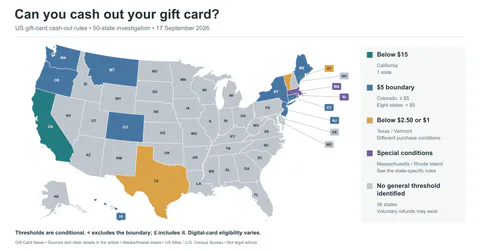
For an eligible card, a small-balance cash-redemption rule can change the decision completely. The holder may be able to recover money without arranging another purchase.
The following are selected US examples. Product coverage, statutory exclusions and the circumstances of redemption determine whether a particular card qualifies.
| Jurisdiction | Relevant small-balance rule | Important boundary |
|---|---|---|
| California | Qualifying gift certificates with a balance below $15 are redeemable in cash under the provision operative from 1 April 2026. | Specified multi-seller products and conditional promotional exceptions are treated differently; do not assume every network gift or reward card qualifies. |
| Connecticut | For a covered gift card, the business accepting it must refund a remaining balance below $5 after a purchase in cash on request. | Exclusions include general-use prepaid cards, specified free promotional cards, cards sold below face value, cards sold by retailers without a Connecticut establishment, and paper-only certificates. |
| Rhode Island | The statute provides for remaining redeemed-certificate value through reissue, or cash when the balance due is below $1. | Specified free promotional and financial-institution/multi-merchant products are excluded. Exactly $1 does not satisfy an under-$1 condition. |
Sources: [S33], [S34], [S35], [S36], [S37].
A boundary around $1 can therefore have a practical explanation. Where a qualifying legal remedy begins below that amount, different behavior on either side need not be caused by the psychology of the digit itself.
Expiry also needs a product-specific explanation. Card credentials and underlying funds can have different lifetimes, while federal rules distinguish covered gift cards from qualifying loyalty, award and promotional products. The card's name or network logo cannot settle those questions alone. [S38], [S39].
What a useful balance result actually provides
Consumers have been asked directly what would make the experience better. In Accenture’s 2024 US survey, reproduced by Statista with a base of 1,501 respondents, 36% selected simpler balance-check options and 35% wanted regular reminders about unused balances. Easier redemption across online and in-store channels and more versatile use each attracted 32%. [S45]
Easier balance checks lead the requested improvements
A balance number is more useful when the process around it is easy to understand and use.
% of surveyed US consumers
Tap or hover for details. All values are also available in the data table.
Accenture Holiday Shopping 2024, as reproduced by Statista; online US survey, n=1,501. Multiple answers possible. This differs from the n=483 unused-balance group in the reasons chart. Neither balance amounts nor observed redemption effects are measured. Labels shortened for display.
Explore the data table
| Category | Selected this improvement |
|---|---|
| Simpler balance checks | 36 % of surveyed US consumers |
| Reminders for unused balances | 35 % of surveyed US consumers |
| Easier online/in-store redemption | 32 % of surveyed US consumers |
| More versatile use | 32 % of surveyed US consumers |
| More personalization | 30 % of surveyed US consumers |
| Option to upgrade the gift card | 26 % of surveyed US consumers |
| Clearer usage instructions | 23 % of surveyed US consumers |
| Better technical support | 23 % of surveyed US consumers |
The one-point gap between balance checks and reminders is a descriptive ordering, not evidence of a meaningful statistical difference. More useful is the combination of requests: people want to see the amount, remember it later and have a workable way to use it. Clearer instructions and technical support each received 23%, reinforcing the importance of what happens after the lookup. [S45]
Fiserv's Q4 2025 survey gives some evidence about features that could encourage interest in gift-card budgeting tools. 52% expressed interest in spending tracking, and 52% in balance alerts and reminders. The survey was conducted in September 2025 with more than 1,000 US adults. These are separate feature-interest measures; they should not be added together. [S40].
Consumers expressed interest in keeping track
%
Tap or hover for details. All values are also available in the data table.
September 2025 US survey, more than 1,000 adults. Features that could encourage interest in gift-card budgeting tools; not current usage. Responses are separate and not additive.
Explore the data table
| Category | Feature interest |
|---|---|
| Spending tracking | 52% |
| Balance alerts and reminders | 52% |
The same report describes how respondents spend relative to a card’s value: 42% above it, 40% exactly its value and 18% below it. These are self-reported spending patterns, not records of individual transactions or explanations for leaving a remainder.
Self-reported spending relative to a gift card’s value
%
Tap or hover for details. All values are also available in the data table.
Self-report from the September 2025 survey. Does not isolate small balances, identify motives or establish that full-value spending occurs in one transaction.
Explore the data table
| Category | Reported spending pattern |
|---|---|
| Above card value | 42% |
| Exactly card value | 40% |
| Below card value | 18% |
The Accenture and Fiserv surveys use different questions, samples and contexts, so the 35% and 52% reminder figures are not a time series. Neither isolates sub-$3 balances. Together with the payment rules, they help identify the information that can turn a lookup into a usable answer.
| Information | Why it matters |
|---|---|
| Exact amount and currency | Rounding 88 cents to $1 produces the wrong payment instruction. |
| A recognizable, masked card identity | People may hold several cards or separate account credits. |
| Available funds and pending activity | A reservation is different from completed spending. |
| A clear status | A failed lookup must not be mistaken for a genuine zero. |
| Relevant transaction history | An expected remainder needs a different response from missing money. |
| Product-specific payment instructions | The route must work for that card and channel. |
| Applicable minimums and restrictions | An otherwise valid method can fail at a tiny amount. |
| A direct support route | An unexplained discrepancy calls for an explanation. |
After the number appears, the appropriate next step depends on what it means. An expected positive balance may need payment instructions. An unexpected low balance needs history or support. An error needs a reliable lookup. Treating all three as opportunities to promote another purchase can leave the person's original problem unresolved.
Large unused-balance totals do not explain a tiny remainder
Bankrate's August 2024 YouGov survey found that 43% of US adults held unused gift cards, vouchers or store credits. Among those holders, the mean total was $244 and the median was $100. The sample covered 2,373 adults, including 1,010 with unused value. [S41].
Those numbers describe people's combined holdings across a broader product group. They do not tell us the average amount left on an individual card, the balance most lookup visitors see, or how much will never be used. A person holding $244 can have one large card, many small remainders or both.
Statista’s generation breakdown adds detail to this same Bankrate/YouGov survey. Among holders of unused value, millennials averaged $332, Gen X $255, baby boomers $227 and Gen Z $142. These are mean combined holdings per person, covering gift cards, vouchers and store credits. They are not the average balance on one card. [S46] [S48]
Unused value differs across generations of holders
Mean total unused value per holder in the August 2024 Bankrate/YouGov survey. The overall holder mean was $244.
USD per holder of unused value
Tap or hover for details. All values are also available in the data table.
US online survey, 19–21 August 2024: 2,373 adults, including 1,010 holders of unused gift cards, vouchers or store credits. Ages are at the time of the survey. Generation-specific sample sizes and confidence intervals are not reported in the release. Means do not establish a statistical difference, permanent loss or per-card balances.
Explore the data table
| Category | Mean combined unused value |
|---|---|
| Gen Z (18–27) | 142 USD per holder of unused value |
| Millennials (28–43) | 332 USD per holder of unused value |
| Gen X (44–59) | 255 USD per holder of unused value |
| Baby boomers (60–78) | 227 USD per holder of unused value |
The overall mean of $244 sits well above the $100 median, showing why a single average is an incomplete guide to a typical holder’s situation. The generation figures describe differences in combined holdings; they do not establish why those differences exist. Receiving more cards, holding higher-value cards and keeping cards for different lengths of time could all matter, but this breakdown does not separate those possibilities. It offers no basis for assuming that millennials care less about an 88-cent remainder than Gen Z does. [S41] [S46]
The accounting consequences of unredeemed value are examined separately in Gift Card Breakage - The money left behind.
Several other distinctions matter just as much:
| What is observed | What it does not establish |
|---|---|
| A positive unused balance today | That the money will never be spent |
| An intention to use the card later | That redemption eventually occurs |
| Several balance checks | Several different shoppers or purchases |
| A click through to a provider | A completed payment |
| A cash-out or consolidation | A merchandise purchase |
| No redemption during a limited period | Permanent abandonment |
Search wording has similar limits. A query such as “check gift card balance” names an information task; adding a merchant identifies a likely service. Neither reveals whether the person is about to shop, trying to explain a decline or examining a forgotten card. Google's search-interest indices are normalized signals rather than counts of cardholders or measures of their balances. [S42].
It would take evidence connecting the lookup, the person's expectations, the displayed amount and subsequent action to answer the full behavioral question. A survey of intentions or a laboratory spending task can illuminate part of it. Neither should stand in for the entire sequence.
Recovering value is a different goal from spending more
The useful distinction is not between people who care about small amounts and people who do not. It is between situations in which recovering the amount is easy, situations in which it requires more than the person wants to give, and situations in which the displayed amount points to a different problem altogether.
Someone may use 50 cents on a purchase already planned, keep it for next week, seek an eligible cash refund or decide that another attempt is not worthwhile. The same person could make a different choice with a different merchant, checkout or expectation.
A balance check succeeds when the person understands both the number and the available next step. Sometimes that leads to a purchase. Sometimes it leads to a saved card, an explanation, a refund request or a decision to stop trying. The amount remaining is the start of that decision, not its answer.
Sources include the complete academic papers, original reports and Statista data tables linked below. Statista is credited as the data publisher where used, alongside the named survey organization; a republication of the same survey is not treated as independent evidence. Survey intentions, reported reasons, experimental outcomes and illustrative examples are distinguished. Payment and legal guidance reflects the cited US sources reviewed on 16 September 2026; eligibility depends on the particular product.
Sources and documents
Collapse
- [S01] Fiserv, Q1 2023 Gift Card Gauge
- [S02] Fiserv, 2019 Small Business Gift Card Study
- [S03] Amazon guidance
- [S04] Walmart guidance
- [S05] Apple guidance
- [S06] Sephora guidance
- [S07] Darden's official gift-card page
- [S08] Gap guidance
- [S09] Disney guidance
- [S10] Home Depot guidance
- [S11] Nordstrom guidance
- [S12] Google's instructions
- [S13] Roblox's instructions
- [S14] Vanilla instructions
- [S15] Program instructions
- [S16] Gift-card instructions
- [S17] BBB gift-card guidance
- [S18] FTC gift-card scam guidance
- [S19] Yin and Sharif, published 2024 paper
- [S20] Raghubir and Srivastava, 2008
- [S21] Helion and Gilovich, 2014
- [S22] Reinholtz, Bartels and Parker, 2015
- [S23] Shu and Gneezy, Procrastination of Enjoyable Experiences, Experiment 4
- [S24] Shopify gift-card redemption guidance
- [S25] Tremendous guidance on spending virtual prepaid cards
- [S26] Tremendous guidance on combining cards
- [S27] Tremendous Amazon account instructions
- [S28] Target Gift Card guidance
- [S29] Target prepaid gift-card guidance
- [S30] Chick-fil-A balance-payment guidance
- [S31] Tremendous guidance on pending transactions
- [S32] Visa gift-card balance guidance
- [S33] California Civil Code §1749.5
- [S34] California definitions
- [S35] Connecticut General Statutes §42-461
- [S36] Connecticut consumer guidance
- [S37] Rhode Island §6-13-12
- [S38] MastercardGiftCard.com cardholder agreement
- [S39] CFPB Regulation E §1005.20
- [S40] Fiserv, Q4 2025 Gift Card Gauge
- [S41] Bankrate's original survey account
- [S42] Google Trends methodology
- [S43] Original illustrative arithmetic: minutes = 60 × recovered balance ÷ assumed hourly value of time
- [S44] Accenture Holiday Shopping 2024: reasons for unused balances; 483 US respondents with unused balances (Statista, 12 November 2024) — Accenture / Statista
- [S45] Accenture Holiday Shopping 2024: requested gift-card improvements; 1,501 US respondents (Statista, 12 November 2024) — Accenture / Statista
- [S46] Bankrate / YouGov: mean unused value among holders by generation, August 2024 (Statista, 7 March 2025) — Bankrate / YouGov / Statista
- [S47] CivicScience: unused gift-card ownership and plans for use, 2025 snapshot (Statista, 7 March 2025) — CivicScience / Statista
- [S48] Bankrate gift card survey: original release, generation definitions and methodology, 23 September 2024 — Bankrate / YouGov
- [S49] CivicScience: post-holiday gift-card spending and unused-card ownership, 7 January 2025 — CivicScience
In this article

Oliver Reed
Oliver Reed covers industry acquisitions, investment and market research for Gift Card News.