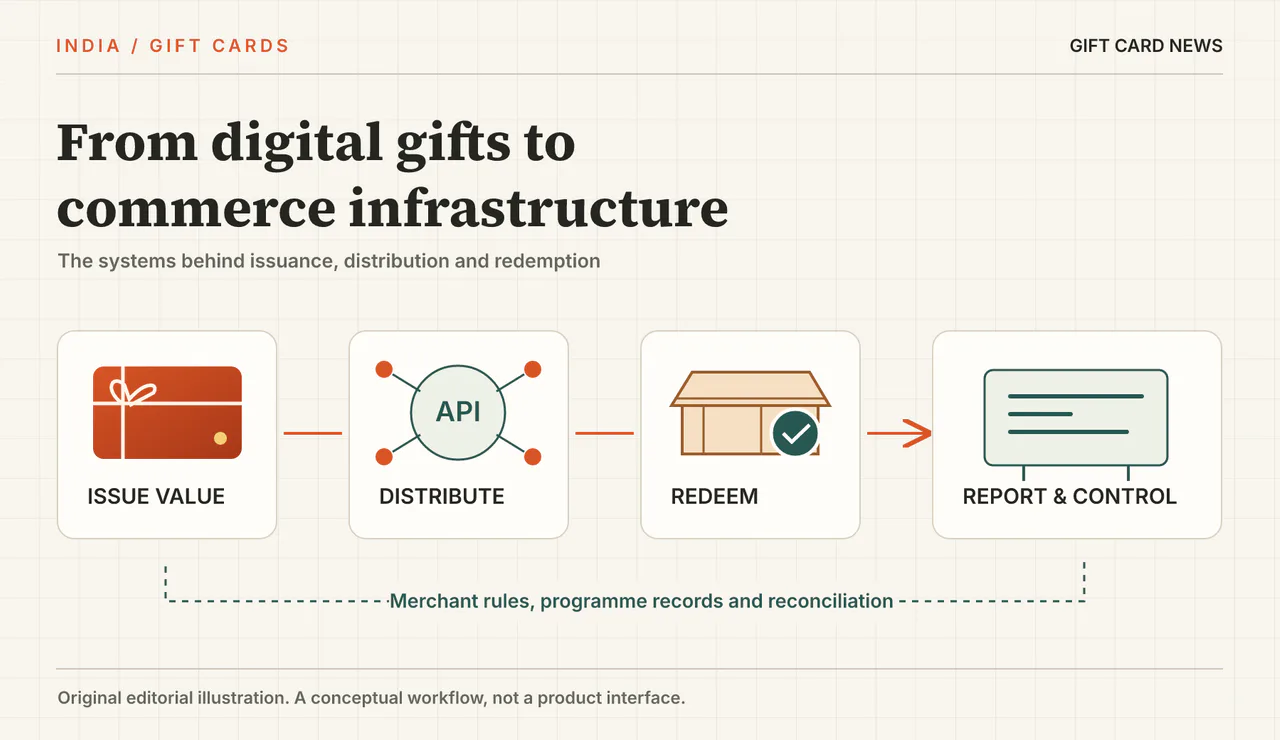
Sachin Kumar sees India’s gift-card business becoming a network of issuing systems, distribution APIs and merchant relationships. In a written editorial outline supplied to GiftCard.News on October 13, the Valuedesign India chief executive described digital stored value moving through corporate rewards, loyalty platforms, e-commerce and fintech channels.
His argument brings an operating question into a market usually described through growth forecasts: what makes a gift card work across the systems that sell it, deliver it and accept it? For a merchant, the experience continues through activation, redemption and reporting. For a distributor, access to a catalogue has to translate into a usable programme for buyers and recipients.
Two published forecasts put India’s 2026 market at US$11.85 billion and US$13.65 billion respectively. Those estimates describe different broad market scopes. The infrastructure thesis is more useful when it is examined alongside those definitions, concrete merchant implementations and the regulatory limits attached to different forms of stored value. [S01] [S02]
Programme technology and corporate distribution work together
Valuedesign’s submitted perspective separates issuing and processing from digital distribution. The first maintains the brand’s gift-card programme, including issuance, activation, redemption and records. The second connects participating brands with marketplaces, corporate reward providers and other sales channels. Kumar argues that a shared API connection can give distributors access to multiple brands while widening the channels available to each merchant.
“API-led digital value ecosystem connecting brands, consumers and distribution platforms.”
Sachin Kumar, Valuedesign India, written editorial outline supplied October 13, 2026
That distinction changes the commercial unit being sold. A merchant can require both the technology to honour a gift balance and access to buyers outside its own website. A corporate rewards platform needs a catalogue its recipients can actually use, together with delivery and programme records. Connecting those functions can create a distribution proposition for the merchant and an administration proposition for the employer; the value of each depends on how the programme performs.
Mordor’s 2026 report estimates that corporate buyers represented 61% of India’s gift and incentive card market in 2025. This modelled mix gives context to employer and channel-reward distribution, without measuring any provider’s results. [S02]
Corporate buyers lead Mordor’s estimated 2025 mix
India gift and incentive cards, by consumer segment. Individual share is calculated as the remainder of the two-category segmentation. [S02]
%
Tap or hover for details. All values are also available in the data table.
Source
Publisher model, not an official census or a consumer survey. India, 2025 estimate; proprietary framework as of January 2026. Individual share = 100% - 61% corporate share. Scope includes physical and electronic gift and incentive cards. Full model inputs and sampling detail are not public. These figures do not measure Valuedesign’s customers or market share.
Show data tableHide data table
| Category | Estimated consumer-segment share |
|---|---|
| Corporate | 61% |
| Individual (calculated remainder) | 39% |
An August 14 announcement by Valuedesign described an end-to-end digital-gift programme for Meghavi Wellness Spa. The stated scope included issuance, activation, redemption processing, digital delivery, distribution and real-time reporting. SMS and email delivery, alongside Adivaha Shop channels for consumers, companies and HR departments, show how a service merchant’s gift programme can reach several buyer groups. [S03]
In a separate August 13 announcement, the Indian subsidiary connected its gift-card platform with The Reward Store, operated by Vananam Enterprise Pvt. Ltd. Valuedesign described issuing, distribution and use management for employee recognition, customer loyalty and channel incentives, with API integration into existing systems. These are dated examples of the infrastructure model Kumar discusses in October. [S04]
GiftCard.News has previously reported on the Meghavi programme and The Reward Store integration. Their relevance here is the combination of processing and distribution capabilities, rather than a newly announced October partnership.
The forecasts describe scale, with different boundaries
The PayNXT360 Q1 2026 report, announced by Research and Markets on March 3, forecast an Indian gift-card market of US$11.85 billion in 2026 and US$20.49 billion by 2030, with a stated 14.7% compound annual growth rate over 2026–2030. Its published contents separately identify a digital gift-card segment, so the headline total cannot simply be relabelled as a digital-only market. [S01]
Mordor Intelligence’s primary report page, updated July 13, puts India’s gift and incentive card market at US$13.65 billion in 2026 and US$20.71 billion by 2031, with 8.70% annual compound growth over 2026–2031. Its scope includes physical and electronic products. The 2031 endpoint corrects the 2030 date in the submitted outline. [S02]
Two estimates of India’s 2026 market
Published commercial estimates for 2026, shown separately because the reports use different scopes and methods. [S01] [S02]
USD billion
Tap or hover for details. All values are also available in the data table.
Both figures are publisher estimates covering broader markets, including physical products. They are not verified digital-only totals, an official transaction census or platform revenue. Forecast vintages are Q1 2026 for PayNXT360 and the July 13, 2026 primary-page update for Mordor.
Show data tableHide data table
| Category | 2026 estimated market size |
|---|---|
| PayNXT360: gift cards | 11.85 USD billion |
| Mordor: gift and incentive cards | 13.65 USD billion |
Show data tableHide data table
| Source and scope | 2026 estimate | Forecast endpoint | Stated CAGR |
|---|---|---|---|
| PayNXT360: gift cards | US$11.85 bn | US$20.49 bn in 2030 | 14.7%, 2026–2030 |
| Mordor: gift and incentive cards | US$13.65 bn | US$20.71 bn in 2031 | 8.70%, 2026–2031 |
These forecasts provide a range of published perspectives, not a single reconciled total. Their different horizons also make the two terminal values unsuitable for a same-year comparison. Both are background to Kumar’s contribution; the forecasts were published earlier in 2026.
Statista measures a different part of the picture
Statista’s latest India series covers prepaid cards and/or vouchers used for online payments or at a physical point of sale through the second quarter of 2026. Its public description reports a decline in POS usage between 2018 and Q2 2026. The survey concerns the residential online population aged 18–64, with a stated base of 12,000-plus respondents per country and a rolling 12-month measure. [S05]
That provides a useful check on the language of growth. A survey response about using a broad prepaid category differs from the monetary value assigned to an entire gift-card market. The user groups, products and units are different. The same person may use more than one payment method, and the survey is not a census of all Indian residents or a gift-card-only adoption measure. [S05]
The checked Statista table
Continue reading for free.
Create your account or sign in to get unlimited access.
No payment required. Newsletter signup is optional.
Already registered? Sign inIn this article

Suzie Elis
Suzie Elis covers gift card products, digital gifting and distribution for Gift Card News.