Research reviewed through 17 September 2026.
A corporate customer sends money to a rewards platform. The platform orders virtual cards. A bank issues the Visa or Mastercard credentials. Recipients open an email and begin spending.
It looks like one transaction. Now stop the sequence halfway through: the platform has the customer’s money, but the cards have not been issued. If the platform fails at that moment, who still owes the customer? That question brings the licensing problem into focus.
The customer sees one product. The law may see several activities: collecting funds, holding an unallocated balance, arranging issuance, distributing prepaid access and servicing the resulting cards. A bank's participation is highly relevant. It does not, by itself, establish the legal treatment of every activity before and after issuance.
The central finding of this investigation is that a structure without the platform's own state money transmitter licence can be legally supportable. Express statutory exemptions and published regulatory interpretations provide real routes. But “we use an issuing provider and a bank” is a description of a supply chain, not a completed licensing analysis. Federal MSB classification must also be considered separately.
This investigation follows that question through the federal framework and all 50 states, with the District of Columbia examined separately. Delaware and Wyoming receive particular attention because their appeal as incorporation jurisdictions can obscure a different question: which laws govern the customers and transactions the business actually serves?
What the 50-state map reveals
The interactive map above classifies the route established by the authorities reviewed for this investigation. Hover over a state, select it, or use the state menu to see the conditions and primary sources. Each state also links to its full entry below. The map’s downloadable data is included in the article CSV.
F02. How the 50 states divide by the route identified
Editorial classification of the legal authorities reviewed through 17 September 2026. Each state appears in one category; the District of Columbia is additional.
States
Tap or hover for details. All values are also available in the data table.
These counts describe the research classification, not permission to operate or an approval probability. Federal MSB analysis is separate. Future-effective legislation is not counted as a current exemption. Delaware commencement remains unresolved.
Explore the data table
| Category | States |
|---|---|
| Express bank-agent route | 29 States |
| Specific or fact-dependent route | 8 States |
| No broad bank-agent route established | 11 States |
| No general state MTL requirement | 1 States |
| Commencement remains unresolved | 1 States |
These are counts of editorial classifications, not the percentage of the country in which a particular company can operate. A state with an express route may impose demanding conditions. A state without a broad bank-agent exemption may still recognise a narrower product exclusion, a licensed-delegate arrangement or an activity that falls outside its statute. Federal MSB classification remains a separate nationwide enquiry.
Incorporation does not determine the whole licensing map
The first misconception is also the most consequential: a Delaware company does not operate solely under Delaware money transmission law when it serves customers elsewhere. The same is true of a Wyoming LLC.
Texas makes the distinction particularly concrete. Its territorial definitions look to the location of the person requesting a transaction. For electronic or telephone transactions, relevant information includes an individual's residential address or a business customer's principal place of business or other physical address. Selling stored value to, or receiving transmission funds from, a person located in Texas can fall within the chapter. The incorporation state of the service provider is not the controlling test. [S01]
Consider a hypothetical Delaware corporation that serves an employer in Texas and arranges cards for employees in several states. At least three different locations appear in the facts: the platform's formation state, the purchasing employer's location and the recipients' locations. Counsel must identify which person and which activity each applicable statute regulates. It would be equally inaccurate to assume that only Delaware matters or that every recipient's state necessarily requires a separate licence in every programme.
The practical research question is therefore: which jurisdictions have a legally relevant connection to this particular collection, issuance and distribution arrangement? A registered agent's address cannot answer it. Nor does relocating the incorporation certificate eliminate the need to analyse the customers already being served.
Connecticut illustrates why recipients cannot simply be ignored: its territorial section includes money transmitted to a person in the state, alongside other connections. A national corporate programme therefore needs to identify both the paying customer and the recipients before selecting the relevant state tests. [S02]
There is a related distinction between corporate registration and payments regulation. A company may face ordinary corporate qualification, tax or employment questions because it does business in a state. Those questions do not establish whether a particular payment service requires an MTL. Each regulatory test has its own subject.
MTL and MSB answer different questions
An MTL is commonly the licence a state requires for activities defined in its money transmission legislation. MSB, or money services business, is also a federal Bank Secrecy Act classification administered by FinCEN. Some state statutes use similar terminology, so the jurisdiction matters whenever the acronym appears.
The two enquiries should run alongside each other. A federal filing does not decide whether a state's licence or exemption applies. Conversely, a state exemption does not settle the federal classification. The federal rules distinguish money transmission, providing prepaid access and selling prepaid access; these are not interchangeable labels. [S03]
T01. Five questions that sound similar but decide different things
| Question | What the answer establishes | What it does not establish |
|---|---|---|
| Does the activity require a state MTL? | Whether that state's licensing framework covers the activity, subject to its exemptions. | The result in other states or under federal MSB rules. |
| Is the company a federal MSB? | Whether its actual activities fall within a federal category. | That every MSB category has the same registration requirements. |
| Must this MSB register with FinCEN? | Whether the registration rule applies to this entity and its roles. | A nationwide permission to conduct regulated business. |
| Is the company appointed by a bank? | A potentially important contractual fact. | That every state's bank exemption extends to the company. |
| Is the processor licensed? | The processor's status for its licensed activities. | That every customer of that processor is an authorised delegate. |
Registration is particularly easy to misstate. The current federal rule expressly excepts sellers of prepaid access from its registration requirement. It also excepts a person that is an MSB solely because it is an agent of another MSB. A company conducting independent MSB activities needs a separate analysis. The latter exception cannot simply be renamed the “bank-agent exception”: a bank is excluded from the federal MSB definition. [S04]
Thus, “we do not need to register as an MSB” and “we are not an MSB” can describe different legal conclusions. That distinction becomes especially important in Wyoming, whose statute contains an exemption linked to federal MSB status.
Follow the obligation as carefully as the money
The most useful question in a programme review is often a counterfactual: if the platform receives the customer's money and fails before remitting it, who must still honour the customer's entitlement?
That question exposes a difference a standard flow-of-funds diagram can hide. Two arrangements may send money through identically named accounts while allocating the customer's loss to different parties. A contract in which the bank becomes responsible only after a card is funded leaves a different period to analyse from a contract in which responsibility begins when an appointed agent accepts the payment.
The three designs below are analytical examples. They are not findings that any particular design qualifies for exemption in every state.
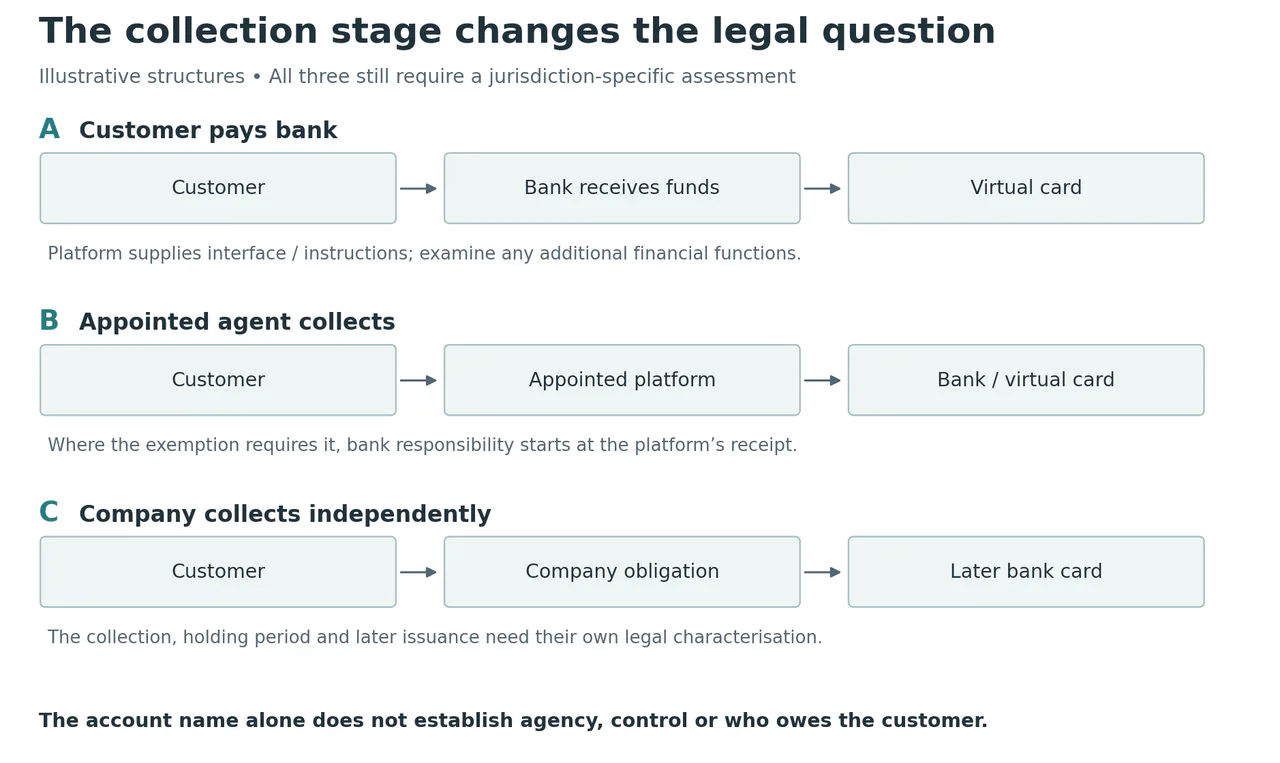
Direct collection by the bank. The customer pays the bank under the bank's programme arrangements. The platform provides the interface and transmits instructions. Review still has to establish whether the platform also sells a regulated instrument, controls customer funds or provides another financial service. Removing physical possession of funds can simplify the facts; it does not substitute for examining the remaining functions.
Collection by an appointed bank agent. The platform accepts payment in a defined representative capacity. The relevant state may recognise an exemption if the appointment, functions and bank responsibility meet statutory conditions. A platform contract with an issuing processor alone may leave the necessary relationship with the bank unproven.
Independent collection followed by a purchase of cards. The company receives money under its own promise and later obtains bank-issued cards. The outcome depends on what the company is selling and promising, and on any applicable product or agency exemption. The company must establish the legal treatment of the initial collection and any period during which it owes the customer an unallocated balance.
A serious review separates the card purchase price from service fees; identified card orders from reusable funding balances; and bank-controlled programme functions from decisions the platform can make independently. It also follows failed card orders, cancellations, refunds and surplus funds. Those are ordinary programme events, and they may reveal obligations absent from the happy-path diagram.
What the California, New York and Texas authorities actually prove
California, New York and Texas provide three different forms of evidence: a regulator’s interpretation of a product exemption, a programme-specific agency opinion and an express statutory provision. Read together, they show why a bank relationship matters—and why its precise legal basis matters just as much.
California: the card sale and the donation were different businesses in law. In its 19 February 2020 corporate-rewards opinion, the California Department of Financial Protection and Innovation’s predecessor examined a platform offering bank-issued open-loop gift cards alongside other rewards. Corporate clients could prefund the platform’s operating account. The bank-issued cards did not provide cash access, and the issuer, rather than the platform, owed recipients the remaining card value. The regulator concluded that the sale of gift cards issued by the qualifying banks was exempt under 10 CCR §80.3002(a)(1). The collection arrangement did not erase that product-specific exemption. [S05]
The same letter reached a different conclusion for money accepted for donations to non-profit organisations. That activity involved receiving money for transmission; the claimed agency reasoning did not establish an exemption on the submitted facts. One platform and one corporate customer relationship could therefore contain both an exempt card sale and a regulated donation service. Calling the whole business “B2B rewards” would have concealed the distinction. The letter is evidence about the facts and exemption it analysed, not blanket clearance for every platform balance, refund or charitable-payment feature. [S05]
New York: a programme-specific agency opinion. In its 16 March 2007 Green Dot letter, the New York Banking Department considered bank-issued Visa/Mastercard cards, Green Dot, TSYS and retailers. Customer funds initially entered retailers' accounts. Crucially, the bank remained liable even if a retailer failed to remit. The no-licence conclusion depended on specified bank agency agreements. The letter expressly excluded MoneyPak and bill-payment business lines from its opinion. It is persuasive evidence for those programme facts, not approval of every subsequent prepaid arrangement. [S06]
Texas: an express statutory route. Section 152.004(15) addresses an appointed service provider or agent of a qualifying exempt institution. It requires written functions and the institution's assumption of all loss risk and legal responsibility for outstanding transmission obligations when the agent receives the money. Section 152.005 permits the commissioner to demand evidence supporting an exemption claim. [S01]
T02. Three authorities, three different grounds
| Authority | What supported the route | What the source does not establish |
|---|---|---|
| California’s February 2020 opinion | A regulatory exemption for selling gift cards issued by qualifying banks, on the described corporate-rewards facts. | That all activities of the platform were exempt; the donation branch received a different analysis. |
| New York’s March 2007 opinion | Defined bank agency, bank control and bank liability even when a retailer failed to remit. | Approval for MoneyPak or bill payment, which the letter expressly left outside its scope. |
| Texas Finance Code §152.004(15) | Express appointment, a written account of functions, and the institution’s responsibility and loss risk from receipt by its agent. | That a processor contract alone establishes the required bank relationship. |
Sources: the California opinion, New York opinion and Texas statute cited immediately above. This comparison describes their reasoning; it does not rank the states by ease of entry.
The federal prepaid-access analysis
FinCEN's guidance supplies a significant route that is often overlooked. Its prepaid-access FAQ explains that when a bank exercises principal oversight and control, no programme participant must register as the prepaid-access provider. The bank itself is outside the MSB definition. A nonbank that nevertheless registers as provider assumes the associated responsibilities. The same FAQ separately explains that distribution to businesses for onward sale or distribution to end users is outside the intended seller definition, even when an order exceeds $10,000. That is a distribution-channel clarification, not immunity for every activity described commercially as B2B. [S07]
The contractual title “programme manager” therefore does not answer the federal question. A review needs to establish who exercises control in practice and whether any participant has already registered as the provider. The same business can occupy different roles in different programmes; a conclusion for one product cannot simply be copied to another.
T03. Federal prepaid-access exclusions have different boundaries
| Arrangement | Key limit or condition | Why the distinction matters |
|---|---|---|
| Closed-loop prepaid access | No more than $2,000 associated with the device or vehicle on any day. | The closed-loop definition concerns defined merchants or locations; a generally usable network card is a different product. |
| Low-value prepaid access | No more than $1,000 maximum value and daily loading, use or withdrawal; no international use, person-to-person transfers or non-depository reloads. | Nonreloadable status by itself does not establish the exclusion. |
| Employment benefits, incentives, wages or salaries | The qualified exclusion also depends on the prohibited international, person-to-person and non-depository reload features. | It is a separate limb of the rule, not simply another name for the $1,000 exclusion. |
These are exclusions from the federal definition of a prepaid programme. They do not decide the state MTL question or classify independent services around the card. [S03]
Product restrictions matter. The federal $1,000 exclusion limits both maximum value and daily amounts loaded, used or withdrawn, and permits no international transmission, user-to-user transfers or additional non-depository loads. Nonreloadable status alone is insufficient. The separate $2,000 closed-loop exclusion does not automatically describe a generally usable Visa or Mastercard. Only providing prepaid access is excluded from the money-transmitter category; prepaid-provider/seller classification and additional activities remain relevant. [S03]
The seller rules require their own care. FinCEN's 2016 guidance explains both sales of programme access usable before identity verification and sales above $10,000 per person per day without reasonably adapted prevention policies. The latter does not mean every large corporate distribution automatically establishes seller status or associated AML duties. The B2B clarification above must be considered first. [S08]
Where provider or seller obligations apply, a written AML programme, identification procedures, records and suspicious-activity reporting can remain material even when a registration exception exists. The detailed duties depend on the role and activity. [S09]
For a rewards platform, the analytical lesson is to classify the customer-funding service separately from the delivered card. A tightly restricted card does not, merely by having a low face value, classify an independent wallet or refund service operated around it.
Delaware and Wyoming deserve separate answers
Delaware: separate the incorporation decision from a law in transition. The official legislative record shows SB18 signed on 6 July 2026. It replaces Chapter 23 with the Delaware Money Transmission and Virtual Currency Modernization Act. The record also describes implementation as the earlier of one year after enactment or the Commissioner's notice that final regulations have been promulgated. The signature date and the date the new framework becomes applicable are therefore not interchangeable. This research did not verify an accelerating notice. The map marks that unresolved commencement issue rather than assuming the published replacement code is already operative. [S10]
The replacement §2305(a)(13) contains a bank-service-provider/agent exemption: express appointment, written functions and institutional loss risk and legal responsibility beginning when the provider receives the money. That is a concrete future or conditionally commenced route to examine, not a basis for ignoring the application provision. The predecessor bank exemption referred to banks operating through authorised agents or contractors; its effect on the outside company's own activities needs separate treatment. [S11]; [S12]
The predecessor §2311 also excludes agents of §2304-exempt persons from that section's requirements. It would therefore be inaccurate to assume that the older law simply prohibits a bank-agent model. Its licensing, bank-exemption and agency provisions need to be read together. [S13]
The replacement definitions also make customer location explicit: electronic transaction requests are assessed using residential or business-location information, and the transmission definition reaches relevant sales to or receipts from persons in Delaware. These provisions concern transaction nexus, not merely where the provider was formed. Because their commencement remains unresolved here, they should be read as part of the new framework rather than retroactively applied. [S14]
For an entrepreneur comparing Delaware and Wyoming, the question “Where should we incorporate?” therefore remains distinct from “Which payment activities can this entity perform for these customers?” The analysis should identify both the governing version of Delaware law and any other state connected to the service. A favourable provision in the replacement law is useful in programme planning; its existence alone does not establish a present exemption.
Wyoming: a federal classification can matter directly. Chapter 22 covers payment instruments, expressly including prepaid access. Its territorial provision includes internet services offered or supplied to Wyoming residents for personal, family or household use. The bank exemption excludes banks issuing or selling instruments through nonbank authorised delegates or subdelegates. A separate exclusion covers a money-transmission business outside the federal MSB definition incorporated as of 1 January 2020. That is a status test, not simply an exemption from filing a federal registration. Licensed-transmitter delegates have a separate route. [S15]
The question is whether the platform falls outside that incorporated definition, or belongs to an MSB category exempt from registration. The federal seller distinction illustrates why these differ. The statutory reference date must also be preserved.
Wyoming's regulator separately directs money-transmitter applications through NMLS. Registering an LLC and obtaining or establishing an exception from a financial-services licence are different processes. [S16]
A hypothetical Wyoming LLC serving a Virginia business illustrates the national issue. Virginia's current territorial definitions look to the requester and relevant address information for electronic transactions. The LLC's formation address does not relocate that customer. This establishes a reason to analyse Virginia law; it does not predetermine the result for every corporate rewards purchase. [S17]
Neither state is a nationwide licensing passport. Delaware's commencement issue and Wyoming's federal-status condition make the comparison more specific than a general ranking of business-friendly incorporation jurisdictions.
Four legal routes that should not be confused
The state survey reveals several types of possible route. Their requirements differ, and a programme may need different legal reasoning in different states.
T04. Four distinct ways a company’s role may be covered
| Route | The proposition that needs support | Typical evidence to examine |
|---|---|---|
| Activity falls outside the statutory definition | The company is not conducting the regulated activity described by that state. | Customer promises, ownership of the obligation, product restrictions and the complete funds flow. |
| Bank-agent or bank-service-provider exemption | The state extends an exemption to this relationship and these functions. | The bank's appointment, written functions and any required allocation of customer-facing liability. |
| Product or distribution exemption | The particular card or sale meets the state's narrower exclusion. | Public versus corporate distribution, redemption conditions, the issuer and any insurance requirements. |
| Authorised delegate of a licensed transmitter | A properly licensed principal has appointed the company for the relevant activity. | The principal's state licence, appointment, scope, required notices and continuing supervision. |
An agent of a payee is another concept again. That route commonly concerns collection of a payment owed for goods or services, with payment to the agent extinguishing the payer's obligation. Buying a financial product through an intermediary is not automatically the same factual situation. The precise state's wording matters.
Nor does using a nationally chartered bank remove the state enquiry. Federal law expressly addresses the continuing application of state law to nonbank subsidiaries, affiliates and agents of national banks. A bank-related business should identify the actual exemption or preemption argument rather than assume that the bank's charter travels through every commercial contract. [S18]
The questions an issuing provider and bank should be able to answer
A licensing discussion becomes more productive when it moves from “Are we covered?” to a review of particular obligations. The following questions are an editorial framework derived from the distinctions examined in this article; they are not model legal clauses.
-
Which legal entity appoints the platform? Identify the actual bank, processor, programme manager and any licensed transmitter. A group brand is not a substitute for an entity name.
-
What is the platform authorised to do? Selling cards, accepting funding, instructing loads, storing balances and issuing refunds are different functions that need to fit the documented role.
-
When does the bank become responsible? Test receipt by the platform, receipt by a processor, acceptance of an order and card loading as separate moments.
-
Who bears a failure to remit? Establish the customer's rights if the platform or an intermediary fails before the bank receives settlement.
-
Who controls the programme in practice? Review activation, freezing, refunds, product changes and selection of participants, not simply a contractual declaration of control.
-
What happens to money that never becomes a card? Unallocated funding, rejected orders, residual balances and refunds deserve explicit treatment.
-
What is the basis in each relevant state? Ask for the statute, opinion or approved delegate arrangement, including its conditions and effective date.
-
What is the federal classification? Separate provider, seller, transmission and registration conclusions, including any reliance on bank control or the B2B guidance.
Bank oversight can remain substantial even where the platform needs no separate MTL. The interagency third-party guidance addresses the bank's management of those relationships across their lifecycle. Separately, prepaid-card CIP guidance identifies general-purpose cards with reload or credit/overdraft features as accounts for the relevant analysis, including cards marketed through third-party programme managers. A licensing exemption should not be described to customers or partners as an absence of compliance obligations. [S19]; [S20]
The virtual format does not remove consumer-product rules either. Regulation E expressly reaches qualifying codes and electronic devices, while loyalty, award and promotional products have their own exclusions and disclosure conditions. Whether a product is a consumer gift card, an incentive or another prepaid account remains a separate question from who needs an MTL. [S21]
A national programme requires a state-by-state answer
There is a sound, evidence-backed proposition available to a platform approaching issuing partners: some structures permit the platform to distribute bank-issued virtual cards without obtaining its own MTL in the relevant jurisdiction. The research does not support replacing that proposition with “bank-issued cards are exempt everywhere.”
For a proposed Delaware or Wyoming company, the useful next document is a legal analysis tied to an actual product specification, actual contracts and the locations of the relevant customers. The survey below identifies the authorities that analysis should address. Where an express route exists, it supplies conditions to test. Where the law is narrower or a public interpretation is unavailable, it identifies the point that must be resolved before treating the programme as covered.
The 50-state register
This alphabetical register covers every state. The District of Columbia follows separately. Each classification identifies the route supported by the reviewed material, with the controlling conditions and legal provisions. It does not determine whether an unreviewed programme qualifies.
Select a state on the hero map to jump directly to its analysis. The table below provides a compact index; the source references open the full bibliography at the end.
T05. State-by-state index of the legal routes
| State | Route identified | Principal provisions |
|---|---|---|
| No broad bank-agent route established | Ala. Code §§8-7A-2(10),(15), 8-7A-3(7), 8-7A-5(a), 8-7A-11 | |
| No broad bank-agent route established | AS 06.55.101; AS 06.55.802(4); AS 06.55.990(15),(23); SB86 §§44,82 | |
| Express bank-agent route | A.R.S. §§6-1201(10),(17),(25); 6-1202(A)(7),(13),(B) | |
| Specific or fact-dependent route | Ark. Code §§23-55-102,23-55-103(4),(12),23-55-201; 23 CAR §§302-102,302-201 | |
| Specific or fact-dependent route | Cal. Fin. Code §§2003,2010(d),(l),(m),2030(a); 10 CCR §80.3002(a)(1); DBO opinion, February 19, 2020 | |
| Express bank-agent route | C.R.S. §§11-110-201,11-110-301(1)(g),(m),11-110-302,11-110-501 | |
| No broad bank-agent route established | Conn. Gen. Stat. §§36a-596,36a-597(a),36a-607,36a-609(1) | |
| Commencement remains unresolved | Former 5 Del. C. §§2302–2304,2311; new §§2303–2305;85 Del. Laws, c.338, §3 | |
| No broad bank-agent route established | Fla. Stat. §§560.103(3),(16),(27),(32),(39),(41),560.104,560.204 | |
| Express bank-agent route | O.C.G.A. §§7-1-680(14),(20),(26),7-1-682(1),(14),(17); Rule 80-3-1-.01,.03,.06 | |
| Express bank-agent route | HRS §§489D-4, 489D-5(a)(8), 489D-5(b), 489D-9.5, 489D-21 | |
| No broad bank-agent route established | Idaho Code §§26-2902(11),(13), 26-2904(1)(d),(2), 26-2918 | |
| Express bank-agent route | 205 ILCS 658/2-1, /3-1(7),(13),(16), /3-2, /8-1, /12-3 | |
| Express bank-agent route | IC 28-8-4.1-201(19),(25),(28), -301(7),(8),(14), -302, -501, -801; HEA1042/P.L.49-2026 §12 | |
| Express bank-agent route | Iowa Code §§533C.102(19),(30), 533C.103(4),(19), 533C.301, 533C.501 | |
| Express bank-agent route | K.S.A. §§9-555, 9-556(a)(7),(13), 9-579; 2026 HB 2591 §16 | |
| Express bank-agent route | KRS §§286.11-003(17),(22),(28), 286.11-007(4),(5), 286.11-035, 286.11-037 | |
| Express bank-agent route | La. R.S. §§6:1033(18),(31), 6:1034(7),(13), 6:1035, 6:1054; Act 888 of 2026 | |
| Express bank-agent route | 32 M.R.S. §§6071(18),(25),(28), 6074(7),(8),(14), 6087, 6100-H | |
| Specific or fact-dependent route | Md. Code Financial Institutions §§12-401(p),(s),(u), 12-402(a)(1)-(5),(8),(10), 12-413 | |
| Express bank-agent route | M.G.L. c.169B §§1, 2(a)(vii), 2(a)(xiii), 4(a)(2)(i) | |
| Express bank-agent route | MCL 487.1003(c); 487.1004(d), (e), (f) | |
| Express bank-agent route | Minn. Stat. §§53B.28 subd.18/28; 53B.29(7)/(13); 53B.36(b) | |
| Express bank-agent route | Miss. Code §75-16-7(g)/(m); HB1428/2025 §§3–4; §75-16-89 | |
| Express bank-agent route | Mo. Rev. Stat. §§361.906(18)/(27); 361.909(7)/(13); 361.912 | |
| No general state MTL requirement | Official Montana Division of Banking statement: no general money-transmission licensing regime | |
| Express bank-agent route | Neb. Rev. Stat. §§8-2702(22)/(32); 8-2703(7)/(13); 8-2704 | |
| Express bank-agent route | NRS 671.0045; 671.013; 671.018; 671.020(1),(14); 671.021 | |
| Express bank-agent route | RSA 399-G:2 II/XVIII/XXVIII; 399-G:3 I/XVII/XVIII | |
| No broad bank-agent route established | N.J.S.A.17:15C-2; 17:15C-3(a)(4)/(b); 17:15C-17 | |
| No broad bank-agent route established | NMSA §§58-32-102(Q),(T),(Z); 58-32-103(D),(I),(M); 58-32-201 | |
| Specific or fact-dependent route | Banking Law §§640–641; DFS opinion dated March 16, 2007 | |
| Specific or fact-dependent route | G.S. §§53-208.42(8),(13),(19); 53-208.44(a)(4),(7),(8),(b),(c) | |
| Express bank-agent route | NDCC §§13-09.1-01(19),(24),(28); 13-09.1-02(7),(13); 13-09.1-03; 13-09.1-09(2)(a) | |
| Express bank-agent route | ORC §§1315.01; 1315.02(A)(4),(7),(11),(B) | |
| No broad bank-agent route established | Currently effective: 6 O.S. §§1512–1513; HB3521 §§4,55–56, future §1554(13) | |
| No broad bank-agent route established | ORS 717.200;717.205;717.210(1)(a),(b),(h)–(j),(2)–(3);717.270 | |
| Express bank-agent route | 7 P.S. §§6102–6103,6112;Act 249/1965, §§2,3,12,as amended by Act 7/2025 | |
| No broad bank-agent route established | R.I. Gen. Laws §§19-14-1(4),(39),(43); 19-14.3-1(1),(3),(4),(5) | |
| Express bank-agent route | S.C. Code §§35-11-105(22),(28),(29),(34); 35-11-110(A)(4),(11),(15),(B); 35-11-200; 35-11-400 | |
| Express bank-agent route | SDCL 51A-17-52(2), (10), (17), (23), (27); SDCL 51A-17-53(7), (13); SDCL 51A-17-59(2) | |
| Express bank-agent route | TCA 45-7-103(20), (25), (29); TCA 45-7-104(6), (7), (13); TCA 45-7-105; TCA 45-7-110 | |
| Express bank-agent route | Finance Code 152.003(16), (22), (30), (34); Finance Code 152.004(7), (15); Finance Code 152.005; Finance Code 152.101(c)(1) | |
| No broad bank-agent route established | Utah Code 7-25-102(2), (9), (12); Utah Code 7-25-201; Utah Code 7-25-202(3) | |
| Express bank-agent route | 8 VSA 2503(1), (10), (17), (20), (24); 8 VSA 2504(7), (14) | |
| Express bank-agent route | Virginia Code 6.2-1922; Virginia Code 6.2-1923(7), (13); Former Virginia Code 6.2-1903: repealed July 1, 2026 | |
| Specific or fact-dependent route | RCW 19.230.010(4), (18), (20), (24); RCW 19.230.020(4), (9)(b), (9)(c), (12), (14) | |
| Specific or fact-dependent route | West Virginia Code §§32A-2-1(j),(z),(cc),32A-2-3(a)(1),(11)(B),(b),(c) | |
| Express bank-agent route | Wisconsin Statutes 217.02(2), (17), (23), (27); Wisconsin Statutes 217.03(1)(g), (m), (o), (2) | |
| Specific or fact-dependent route | Wyoming Statutes 40-22-102(a)(xiii), (xv); Wyoming Statutes 40-22-103(b), (e); Wyoming Statutes 40-22-104(a)(iv), (vi), (viii); Wyoming Statutes 40-22-118 |
The map, chart and index use the same 50-state register. The categories do not estimate market size, transaction volume or the likelihood that a regulator will approve a programme.
Alabama
No broad bank-agent route established. Bank exemption exists; general nonbank bank-agent coverage not established.
Alabama regulates issuing or selling payment instruments and stored value, alongside receiving funds for transmission. Section 8-7A-3(7) excludes specified banking institutions, but the reviewed chapter does not establish a general exemption for an independent company merely because it contracts with a bank. The separate authorised-delegate route concerns a licensed money transmitter: §8-7A-5(a) permits that relationship, and §8-7A-11 requires a written agreement and restricts subdelegation. For this card programme, the practical question is whether the company itself conducts regulated activity and, if so, has a qualifying exemption or licensed principal. A sponsor-bank contract alone does not resolve those questions. The payment-instrument definition excludes instruments redeemable by their issuer for goods or services; a broadly usable Visa/Mastercard card should not be treated as that merchant-only product.
Principal provisions: Ala. Code §§8-7A-2(10),(15), 8-7A-3(7), 8-7A-5(a), 8-7A-11.
Sources: Alabama Securities Commission: Chapter 8-7A [S22]; Alabama money-transmission licensing instructions [S23].
Alaska
No broad bank-agent route established. Restrictive current text; new bank-agent provision starts July 2027.
Alaska requires particular care with dates. Its existing bank exclusion, AS 06.55.802(4), contains a restriction on distributing payment instruments or stored value through nonbank authorised delegates. Bank sponsorship therefore does not establish an unrestricted exemption for the proposed company. In June 2026, Alaska enacted SB86. Its new §06.55.802(a)(12) expressly addresses bank-appointed providers and agents, requiring a written agreement and the exempt institution’s responsibility and risk assumption from the agent’s receipt of funds. Those substantive changes take effect July 1, 2027, under §82, rather than upon enactment. The amended bank paragraph also retains a distribution restriction, making coordination of the provisions important even after commencement. As of September 17, 2026, the future provision is not a current licensing solution. Authorized-delegate arrangements with an actual licensee remain a separate route.
Principal provisions: AS 06.55.101; AS 06.55.802(4); AS 06.55.990(15),(23); SB86 §§44,82.
Sources: Alaska regulator: Money Services Businesses [S24]; AS06.55.802: 2025 statutory reproduction [S25]; SB86 enrolled legislative text, reproduced by LegiScan [S26]; Orrick: Alaska modernization enacted June 2026 [S27]; Alaska Legislature: SB86 passed bill text, §82 [S28].
Arizona
Express bank-agent route. Express bank-agent exemption requires written scope and bank liability at receipt.
Arizona provides a direct statutory route. Section 6-1202(A)(13) covers a provider or agent expressly appointed by a banking entity exempt under paragraph (7). The agreement must identify the functions performed on the institution’s behalf; the institution must assume all relevant loss risk and legal responsibility for outstanding transmission obligations when its provider or agent receives the funds. The director may demand evidence supporting the exemption. This is different from simply buying cards through a bank-connected processor. Section 6-1201 includes electronic stored value and applies transmission rules to transactions involving people located in Arizona, with address-based rules for remote transactions. Certain closed-loop products and rewards not sold to the public are excluded from relevant definitions. Whether an employer-funded card programme satisfies the rewards wording requires separate analysis; calling an ordinary retail card a reward is insufficient.
Principal provisions: A.R.S. §§6-1201(10),(17),(25); 6-1202(A)(7),(13),(B).
Sources: Arizona: §6-1201 definitions [S29]; Arizona: §6-1202 exemptions [S30].
Arkansas
Specific or fact-dependent route. Bank-agent regulatory pathway requires documented liability; restrictive statute needs reconciliation.
Arkansas illustrates why reading exemptions alone can mislead. Section 23-55-103(4) restricts the banking exclusion where instruments, stored value or prepaid access are distributed through a nonbank authorised delegate. However, 23 CAR §302-102 provides a bank-agency evidentiary pathway: on request, staff can require a business plan, a bank officer’s letter assuming legal responsibility from receipt of customer funds and the customer’s loss risk, plus an executed agency agreement defining authority. This is a meaningful route to investigate, not an automatic conclusion that every bank-sponsored distributor qualifies. Counsel must reconcile the contractual arrangement with the statutory distribution language and any regulator interpretation. Section 23-55-201 also recognizes licensed-transmitter delegates. Under §302-201, conducting transmission for Arkansas customers can create state coverage even without an Arkansas office. Issuing or selling stored value and receiving funds are separately relevant activities.
Principal provisions: Ark. Code §§23-55-102,23-55-103(4),(12),23-55-201; 23 CAR §§302-102,302-201.
Sources: Arkansas regulator: Uniform Money Services Act [S31]; Arkansas regulator: current posted Money Services Rules [S32]; Arkansas §23-55-103: 2025 statutory reproduction [S33].
California
Specific or fact-dependent route. Bank-issued product exemption supported by a verified corporate-rewards opinion; other activities remain separate.
California has a product-specific route as well as statutory agency provisions. A February 19, 2020 regulatory opinion applied 10 CCR §80.3002(a)(1) to the sale of Visa and Mastercard gift cards issued by an FDIC-insured bank. The business received corporate prepayments in its operating account, bought cards through a programme manager and owed recipients no outstanding card value; the issuer remained liable for that value. The opinion rejected a general business-to-business exemption and required licensing for its separate nonprofit-donation activity. It therefore supports the described bank-card sales, not every wallet, collection or refund service. Sections 2030(a) and 2010 separately address genuine agency and qualifying intermediary arrangements. Each activity must fit the authority invoked.
Principal provisions: Cal. Fin. Code §§2003,2010(d),(l),(m),2030(a); 10 CCR §80.3002(a)(1); DBO opinion, February 19, 2020.
Sources: California DBO, February 19, 2020: corporate rewards, bank-issued cards and donations [S05]; California §2030: statutory reproduction [S34]; California §2010: statutory reproduction [S35]; California §2003: statutory reproduction [S36]; Official California Financial Code §2030 [S37].
Colorado
Express bank-agent route. Modernized statute expressly covers qualifying bank-appointed agents and providers.
Colorado replaced its earlier framework through HB25-1201, effective August 6, 2025 according to the legislature’s session-law record. Section 11-110-301(1)(m) expressly covers a provider or agent appointed by an institution within the banking exemption in paragraph (g). It requires a written agreement describing the functions and the exempt institution’s assumption of all relevant loss risk and legal responsibility from the provider’s receipt of customer funds. Section 11-110-302 allows the Banking Board to require evidence. The exclusion therefore depends on who receives the money, in whose capacity, and when the bank becomes responsible—not simply the Visa/Mastercard brand. Section 11-110-501 separately permits authorised delegates of licensed transmitters. Stored-value and qualifying closed-loop or promotional definitions still require product-specific review; activities outside the established exemption cannot be assumed covered.
Principal provisions: C.R.S. §§11-110-201,11-110-301(1)(g),(m),11-110-302,11-110-501.
Sources: Colorado HB25-1201 signed act [S38]; Colorado HB25-1201 enactment and effective date [S39].
Connecticut
No broad bank-agent route established. Bank exemption expressly restricts transmission through independent nonbank partners.
Connecticut is a particularly important exception to any nationwide bank-sponsorship theory. Section 36a-609(1) conditions the bank exemption on using specified institutions, a licensed transmitter or its authorised delegate, or narrowly listed exempt persons. It does not provide unrestricted coverage for independent nonbank partners. Section 36a-607’s delegate mechanism concerns an actual licensee. Section 36a-597(a) also establishes several territorial connections, including funds received from a person in Connecticut and money transmitted to a person there. Consequently, a company incorporated elsewhere can still face Connecticut requirements. A proposed programme needs a documented activity exclusion, a suitable licensed-delegate structure, or another demonstrable legal basis; an issuing-bank contract alone does not establish one.
Principal provisions: Conn. Gen. Stat. §§36a-596,36a-597(a),36a-607,36a-609(1).
Sources: Connecticut Money Transmission Act, §§36a-595–614 [S40]; Connecticut 2026 supplement, Chapter668 [S41].
Delaware
Commencement remains unresolved. Replacement bank-agent exemption enacted; its implementation date requires separate confirmation.
Delaware enacted SB18 on July 6, 2026, replacing Chapter 23 with a modern money-transmission framework. Section 3 distinguishes immediate enactment from implementation: the latter occurs one year after enactment or earlier upon the State Bank Commissioner’s published notice that final implementing regulations have been promulgated. New §2305(a)(13) expressly covers qualifying bank agents with written functions and institutional responsibility from receipt of money. The map does not treat publication of the replacement code as proof that this implementation trigger has occurred. The predecessor provisions also recognise bank operations through authorised agents or contractors and require their own analysis. Neither version makes Delaware incorporation a licence to serve customers nationwide.
Principal provisions: Former 5 Del. C. §§2302–2304,2311; new §§2303–2305;85 Del. Laws, c.338, §3.
Sources: Delaware SB18 official status and implementation synopsis [S10]; New Delaware Chapter23, general provisions [S14]; New Delaware Chapter23, licensing and exemptions [S11]; Former Delaware §2304, 2025 statutory reproduction [S12]; Delaware SB18 final engrossed act [S42]; Delaware State Bank Commissioner: regulations and Register links [S43].
Florida
No broad bank-agent route established. Bank exclusion does not establish general coverage for independent card distributors.
Florida exempts listed financial institutions under §560.104; that section does not establish a general exemption for their independent nonbank distributors. Section 560.204 requires a licence for compensated payment-instrument selling or money transmission unless exempt. The 2026 definitions expressly cover electronic instruments and stored value, and selling includes issuing, providing or delivering an instrument. For receipt-and-transfer activity, §560.103(27) focuses on an intermediary with the ability unilaterally to execute or indefinitely prevent the transaction. Lack of that control may matter to this definition, but it does not automatically eliminate the separate payment-instrument-selling issue. Florida’s authorised-vendor definition concerns appointment by a licensed money-services business. The proposed card programme therefore requires analysis of both product distribution and funds control, with a licensed-vendor arrangement or other established basis where applicable.
Principal provisions: Fla. Stat. §§560.103(3),(16),(27),(32),(39),(41),560.104,560.204.
Sources: Florida 2026: §560.103 definitions [S44]; Florida 2026: §560.104 exemptions [S45]; Florida 2026: §560.204 licensing [S46].
Georgia
Express bank-agent route. Express bank-agent exemption; generic outsourced services alone do not qualify.
Georgia expressly exempts qualifying providers and agents under §7-1-682(17). The appointing institution must belong to the banking categories in paragraphs (1) or (14), the agreement must specify the functions, and the institution must assume the relevant loss risk and legal responsibility when its agent receives the customer’s money. The state’s definition of payment instruments includes stored value and open-loop transactions. Accordingly, Visa/Mastercard distribution is not automatically a closed-loop activity. The official rules also distinguish authorised agents from generic outsourced service providers: Rule80-3-1-.06 does not permit an ordinary service provider to conduct transmission or control customer funds unless licensed or otherwise exempt. Remote customers can establish Georgia location under Rule80-3-1-.01. The crucial question is whether this company actually satisfies the statutory agency conditions, rather than merely supplies software to a regulated business.
Principal provisions: O.C.G.A. §§7-1-680(14),(20),(26),7-1-682(1),(14),(17); Rule 80-3-1-.01,.03,.06.
Sources: Georgia §7-1-682 statutory reproduction [S47]; Georgia §7-1-680 statutory reproduction including July 2026 amendment [S48]; Georgia official rules 80-3-1 [S49]; Georgia regulator: MSB laws and rules [S50].
Hawaii
Express bank-agent route. Express bank-agent exemption requires written duties and immediate bank liability.
Hawaii expressly covers selling or issuing payment instruments or stored value and receiving money for transmission (§489D-4). Banks and specified financial institutions receive their own exemption under §489D-9.5. A separate exemption, §489D-5(a)(8), reaches an expressly appointed bank agent or third-party service provider when a written agreement specifies its functions and the exempt institution assumes all risk of loss and legal responsibility for outstanding transmission obligations when the agent receives the money. A bank issuing the card later is insufficient by itself. Closed-loop value and value not sold to the public but distributed through qualifying loyalty, reward or promotional programmes are excluded from stored value; independent prefunding still needs analysis. Section 489D-5(b) separately permits a licensed transmitter’s authorised delegate under a compliant written contract. The commissioner can require evidence supporting an exemption.
Principal provisions: HRS §§489D-4, 489D-5(a)(8), 489D-5(b), 489D-9.5, 489D-21.
Sources: Hawaii §489D-5: exclusions [S51]; Hawaii §489D-9.5: exempt financial institutions [S52]; Hawaii §489D-4: definitions [S53].
Idaho
No broad bank-agent route established. Bank exemption contains restrictive language concerning nonbank payment-instrument delegates.
Idaho’s Department of Finance expressly identifies open-loop and semi-closed-loop stored-value issuers and sellers as businesses it licences. Its guidance addresses cards ultimately issued by a bank: under §26-2904(1)(d), the banking exemption contains a restriction on issuance or sale through nonbank delegates. The regulator says nonbank retail sellers must hold a money-transmitter licence or be authorised delegates of a licensed transmitter. That published interpretation provides more than statutory silence. Section 26-2904(2) separately permits representatives of a licensee within a written contract conforming to §26-2918. A digital rewards platform still needs its actual functions analysed; a bank named on the card does not itself establish exemption for the platform’s sale or initial collection.
Principal provisions: Idaho Code §§26-2902(11),(13), 26-2904(1)(d),(2), 26-2918.
Sources: Idaho Department of Finance: money transmitters and bank-issued open-loop cards [S54]; Idaho Department of Finance: Money Transmitters Act [S55].
Illinois
Express bank-agent route. Express exemption ties bank agents to written duties and bank liability.
The Uniform Money Transmission Modernization Act expressly protects qualifying bank agents. Section 3-1(13) covers an expressly appointed agent or third-party provider of an institution exempt under §3-1(7) or (16), with specified written duties and the institution taking all risk and legal responsibility when the agent receives funds. Bank affiliation alone does not satisfy this test; §3-2 allows documentation demands and places the exemption burden on the claimant. Section 2-1 covers payment instruments, stored value and receipt for transmission, while excluding specified closed-loop and nonpublic reward instruments. A licensed transmitter’s delegate follows the separate §8-1 route. P.A. 103-991 took effect August 9, 2024; January 1, 2026 concerns transition for newly covered activities, subject to regulatory extension.
Principal provisions: 205 ILCS 658/2-1, /3-1(7),(13),(16), /3-2, /8-1, /12-3.
Sources: Illinois General Assembly: §3-1 exemptions [S56]; Illinois General Assembly: Uniform Money Transmission Modernization Act [S57]; Illinois General Assembly: §12-3 transition [S58].
Indiana
Express bank-agent route. Express bank-agent route starts the bank’s responsibility when funds arrive.
Indiana’s §28-8-4.1-301(14) provides an express bank-agent and service-provider exemption. The institution must qualify under subdivision (7), appoint the provider, specify duties in writing and assume all relevant loss risk and legal responsibility when the provider receives the money. The separate institutions listed in subdivision (8) are not automatically interchangeable with that cross-reference. A licensed transmitter’s authorised delegate follows a different route under §§501 and 801. Indiana also amended §201 through HEA1042, effective July 1, 2026, to exclude development or use of software for noncustodial transfer of digital assets from the definition of money transmission. That software exclusion is not a general exemption for a company collecting customer funds or selling stored value. Source basis: the bank-agent provision is reported from the 2025 published code and DFI’s modernisation guidance; the 2026 enrolled amendment reviewed here concerns the separate definition of money transmission.
Principal provisions: IC 28-8-4.1-201(19),(25),(28), -301(7),(8),(14), -302, -501, -801; HEA1042/P.L.49-2026 §12.
Sources: Indiana §301: exemptions, statutory mirror [S59]; Indiana §201: definitions, statutory mirror [S60]; Indiana DFI: current legal resources and Money Transmission Modernization Act guidance [S61]; Indiana DFI: SEA458 guidance, framework effective January1,2024 [S62]; Indiana HEA1042 (2026) enrolled act: §12 amends money-transmission definition, reproduced by LegiScan [S63].
Iowa
Express bank-agent route. Written bank appointment and liability from receipt support exemption.
Iowa’s 2026 code gives a clear conditional route. Section 533C.103(4) exempts qualifying banks and other financial institutions; subsection (19) separately covers their expressly appointed agents and third-party service providers. A written agreement must specify functions, and the exempt institution must take all risk of loss and legal responsibility from the provider’s receipt of money. The superintendent can demand evidence of the exemption. Section 533C.102 covers issuing or selling payment instruments and stored value, and receiving money for transmission. Its stored-value definition excludes closed-loop value and qualifying nonpublic loyalty, rewards or promotional value; this does not itself resolve a separate customer-funding stage. Sections 533C.301 and .501 provide the distinct licensed-transmitter/authorised-delegate route. For an online programme, Iowa residence or the business customer’s principal address can establish the state connection under §533C.201. The official 2026 code was read directly.
Principal provisions: Iowa Code §§533C.102(19),(30), 533C.103(4),(19), 533C.301, 533C.501.
Sources: Iowa Code 2026, chapter 533C [S64]; Iowa §533C.103: exemptions [S65].
Kansas
Express bank-agent route. 2026 amendment corrects the statutory bank-agent exemption cross-reference.
Kansas requires reading the 2026 session law alongside the online code. The modern act became operative January 1, 2025. Section 9-556(a)(13) supplies the express bank-agent route: express appointment, written functions and the exempt institution’s full loss and legal responsibility upon receipt by its agent. Crucially, 2026 HB 2591 §16 corrects its cross-reference from subsection (a)(6) to the financial-institution exemption in (a)(7), effective July 1, 2026. The official codification inspected still displayed the earlier reference; that discrepancy should not be copied into an analysis. Section 9-555 reaches payment instruments, stored value and receipt for transmission, with specified closed-loop and nonpublic reward exclusions. Section 9-579 separately governs authorised delegates of licensed transmitters, requiring contracts, controls, background investigation and trust treatment of collected money. Official statute and enacted amendment were inspected.
Principal provisions: K.S.A. §§9-555, 9-556(a)(7),(13), 9-579; 2026 HB 2591 §16.
Sources: Kansas 2026 HB 2591, enrolled act [S66]; [Kansas HB 2591 official legislative history](https://www.kslegislature.gov/b2025_26/bills/HB [S67] 2591/); Kansas §9-556: official codification, cross-reference requires 2026 act [S68]; Kansas §9-579: authorized delegates [S69].
Kentucky
Express bank-agent route. Bank-provider exemption requires written agreement and regulator examination access.
Kentucky has an express bank-service-provider exemption, but its conditions differ from the modern model. Section 286.11-007(4) exempts financial institutions and specified related entities. Subsection (5) exempts a service provider acting for such an entity under a written agreement that allows state or federal banking regulators to examine the provider’s books, records and transactions. That subsection does not state the model act’s separate requirement that the bank assume every obligation at receipt; it would be inaccurate to attribute that wording to Kentucky. Section 286.11-003 broadly reaches receipt for transmission, electronic transfers and issuing stored value; issuer-only goods/services exclusions do not establish a general Visa/Mastercard exemption. Sections 286.11-035 and .037 govern a licensed transmitter’s authorised agents separately.
Principal provisions: KRS §§286.11-003(17),(22),(28), 286.11-007(4),(5), 286.11-035, 286.11-037.
Sources: Kentucky Legislative Research Commission: §286.11-007 exemptions [S70]; Kentucky §286.11-003: definitions, statutory mirror [S71]; Kentucky official statutes verification portal [S72].
Louisiana
Express bank-agent route. July 2026 replacement law expressly exempts qualifying bank agents.
Louisiana materially changed on July 1, 2026. Act 888 replaced its money-transmission chapter with a modern framework. New §6:1034(7) exempts listed financial institutions, including specified wholly owned subsidiaries; subsection (13) separately protects expressly appointed bank agents or service providers. They need written functions, and the exempt institution must assume all risk and legal responsibility from receipt of customer funds. Section 6:1035 permits the commissioner to request exemption evidence. Section 6:1033 includes payment instruments, stored value and receipt for transmission; specified closed-loop and nonpublic reward value falls outside stored value. Section 6:1054 governs a licensed transmitter’s authorised agents separately. Existing licensees receive transition provisions in the Act, but a new entrant should not treat these as a general postponement. The enacted Act and official effective-date listing were inspected; analyses relying only on a 2025 Louisiana compilation risk missing this change.
Principal provisions: La. R.S. §§6:1033(18),(31), 6:1034(7),(13), 6:1035, 6:1054; Act 888 of 2026.
Sources: Louisiana Act 888/HB 1230: enacted replacement law [S73]; Louisiana 2026 acts and effective dates [S74].
Maine
Express bank-agent route. Modern chapter expressly protects properly appointed agents of qualifying banks.
Maine’s operative modern framework is Title 32, chapter 79-A, rather than the repealed predecessor commonly reproduced in older research. Section 6074(7) exempts qualifying financial institutions; subsection (14) expressly covers their appointed agents and service providers where written duties and full institutional responsibility attach when funds are received. The agent provision specifically references subsection (7), so the differently worded supervised-financial-organization exemption in subsection (8) should not be substituted without analysis. Section 6071 captures payment-instrument and stored-value issuance/sales and receipt for transmission, excluding defined closed-loop and nonpublic loyalty, rewards or promotional value. A virtual format does not itself remove the programme from these definitions. Section 6087 supplies licensing rules and §6100-H addresses licensed transmitters’ delegates. The official modern chapter was read; its cited history is PL 2023, c. 662 and the pages identify an October 2025 extraction date.
Principal provisions: 32 M.R.S. §§6071(18),(25),(28), 6074(7),(8),(14), 6087, 6100-H.
Sources: Maine §6074: exemptions [S75]; Maine §6071: definitions [S76]; Maine chapter 79-A official index [S77].
Maryland
Specific or fact-dependent route. Narrow bank-instrument trust-receipt exemption needs product-specific analysis.
Maryland offers a narrower statutory route. Section 12-402 exempts listed banks and depositories; subsection (a)(8) also excludes selling payment instruments on an exempt entity’s behalf when those instruments are received from it under a trust receipt specifically for sale. This is a distribution exception, not the broad model-act exemption for any appointed bank provider. Section 12-401 separately regulates payment instruments, prepaid access and receipt plus transfer of value. A virtual card or access code can constitute prepaid access; issuer-only goods/services exclusions do not automatically cover network-branded cards. Counsel must therefore determine whether the proposed product and contractual delivery mechanism satisfy the trust-receipt wording, and whether a separate prefunding or wallet activity remains regulated. Section 12-402(a)(10) separately permits a licensed transmitter’s authorised delegate under §12-413. Official text was inspected; a general bank-agent exemption was not located in the section reviewed.
Principal provisions: Md. Code Financial Institutions §§12-401(p),(s),(u), 12-402(a)(1)-(5),(8),(10), 12-413.
Sources: Maryland §12-402: scope and exemptions [S78]; Maryland §12-401: definitions [S79].
Massachusetts
Express bank-agent route. Express bank-agent exemption; bank liability begins when the agent receives funds.
The new chapter 169B, effective January 1, 2026, covers payment instruments, stored value and receiving money for transmission. Section 1 limits money transmission to personal, family or household transactions, making a purely commercial flow a separate scope question. Section 2(a)(vii) exempts specified banking entities. Section 2(a)(xiii) expressly exempts their appointed agent or service provider when a written agreement specifies its functions and the bank assumes all loss risk and legal responsibility upon the agent’s receipt. Section 1 also excludes certain closed-loop products and rewards not sold to the public. Section 4(a)(2)(i) separately covers an authorised delegate of a licensed transmitter. A structure without the company’s own MTL is therefore possible, but a processor contract and a promise of later card funding do not establish the bank-agency conditions.
Principal provisions: M.G.L. c.169B §§1, 2(a)(vii), 2(a)(xiii), 4(a)(2)(i).
Sources: Massachusetts General Laws chapter169B §1 definitions [S80]; Massachusetts General Laws chapter169B §2 exemptions [S81]; Massachusetts General Laws chapter169B §4 licensing [S82]; Massachusetts DOB 2026 regulatory reminder [S83].
Michigan
Express bank-agent route. Written bank agency; the exempt entity remains responsible to customers.
MCL 487.1003(c) covers prepaid access, including closed-loop devices. Section 487.1004(d) exempts specified banking entities; paragraph (e) expressly extends exemption to their agents through a written agency relationship, with the exempt entity remaining responsible for money-transmission services to its customers. This wording differs from the MTMA formula assigning all risks upon receipt and should not be described as identical. Paragraph (f) separately exempts qualifying closed-loop devices capped at $2,000 on any day, not every low-value Visa/Mastercard. DIFS separately confirms the licensed-transmitter authorised-delegate route, within contractual authority and subject to oversight and reporting. The contract must establish actual bank agency, rather than merely identify a card issuer.
Principal provisions: MCL 487.1003(c); 487.1004(d), (e), (f).
Sources: DIFS — enacted amendment effective March 28, 2019 [S84]; DIFS — official money-transmission FAQ [S85]; Section 487.1004 — 2025 reproduction [S86].
Minnesota
Express bank-agent route. Express bank-agent exemption; eligible insured institutions were updated in 2026.
Section 53B.28 covers payment instruments, stored value/prepaid access and receiving money for transmission. Closed-loop and qualifying rewards not sold to the public are excluded, but this does not automatically resolve upstream fund collection. Section 53B.29(7) exempts eligible banking entities; paragraph (13) expressly covers their appointed agent or service provider under a written functions agreement when the bank assumes all loss risk and legal responsibility upon the agent’s receipt. Section 53B.36(b)(1) separately protects a licensed transmitter’s authorised delegate. Read the 2025 code alongside 2026 chapter 56, sections 11–12, which expands eligible insured-depository terminology to include certain credit-union share guarantees. The agency conditions remain. Negotiations must identify the eligible bank and its responsibility during the period before card issuance or loading, including a processor’s failure in that interval.
Principal provisions: Minn. Stat. §§53B.28 subd.18/28; 53B.29(7)/(13); 53B.36(b).
Sources: Section 53B.28 — definitions [S87]; Section 53B.29 — exemptions [S88]; Section 53B.36 — licensing and delegates [S89]; 2026 chapter 56, sections 11–12 — enacted amendment [S90].
Mississippi
Express bank-agent route. Express bank agency under 2025 law; delegate disclosures changed in 2026.
HB1428, effective July 1, 2025, introduced the modernized regime; older references to chapter 75-15 are insufficient. Definitions include stored value/prepaid access, with exclusions for closed-loop and certain rewards not sold to the public. Section 75-16-7(g) exempts specified banking entities; paragraph (m) expressly covers an appointed bank agent or service provider through a written functions agreement and the bank’s assumption of all loss risk and legal responsibility upon the agent’s receipt. This creates a conditional route without the company’s own MTL. The separate licensed-transmitter delegate route carries duties even for entirely digital distribution. DBCF’s June 12, 2026 memorandum explains agency disclosures and fraud warnings under section 75-16-89, effective July 1, 2026. Delegates without physical locations must display them on their website without requiring login or payment.
Principal provisions: Miss. Code §75-16-7(g)/(m); HB1428/2025 §§3–4; §75-16-89.
Sources: HB1428 — enacted law published by DBCF [S91]; DBCF — legislation and effective dates [S92]; DBCF — delegate disclosures, June 12, 2026 [S93]; Section 75-16-7 — codification reproduction [S94].
Missouri
Express bank-agent route. Express bank-agent exemption; the director can require supporting evidence.
Section 361.906(18) covers payment instruments, stored value and receiving money for transmission. Paragraph (27) includes digitally recorded claims and prepaid access, excluding closed-loop and certain rewards not sold to the public. Section 361.909(7) exempts eligible banks; paragraph (13) expressly covers appointed agents or service providers under written agreements specifying functions, with the bank assuming all loss risk and legal responsibility upon the agent’s receipt. The current exemption section is effective August 28, 2025. Section 361.912 permits the director to demand evidence of exemption. The company must verify bank responsibility while funds await issuance or loading, not simply identify the bank named on the card. An authorised delegate, separately defined in section 361.906(2), acts for a licensee. A processor’s licences do not automatically make its customer an exempt bank agent.
Principal provisions: Mo. Rev. Stat. §§361.906(18)/(27); 361.909(7)/(13); 361.912.
Sources: Section 361.906 — definitions [S95]; Section 361.909 — exemptions [S96]; Section 361.912 — evidence of exemption [S97].
Montana
No general state MTL requirement. No general state MTL regime; federal and other-state obligations remain separate.
The banking regulator expressly states that Montana does not regulate money transmitters, and money transmission is not defined in state law. This means no general state MTL regime for the activity, not an exemption obtained through the issuing bank. The regulator notes that other activities can still require authorization, including lending, escrow, sales finance and mortgage business. It also explains withdrawing earlier requests for money-transmitter business plans because it lacked jurisdiction over that activity. Accordingly, this review identifies no general Montana MTL to obtain merely for money transmission. That does not determine federal FinCEN/MSB treatment or obligations in customers’ states. Incorporating in Montana is not a legal passport for nationwide virtual-card distribution. The programme’s fund flow and the bank’s contractual duties still need assessment under the rules that apply elsewhere.
Principal provisions: Official Montana Division of Banking statement: no general money-transmission licensing regime.
Sources: Montana Division of Banking — Montana Does Not Regulate Money Transmitters [S98].
Nebraska
Express bank-agent route. Express bank-agent exemption verified against legislation operative in July 2026.
The reviewed versions of sections 8-2702 and 8-2703 are operative July 18, 2026. Definitions cover payment instruments, stored value/prepaid access and receiving money for transmission, excluding closed-loop and certain rewards not sold to the public. Section 8-2703(7) exempts eligible banking entities; paragraph (13) expressly exempts their appointed agent or service provider under a written functions agreement when the bank assumes all loss risk and legal responsibility upon the agent’s receipt. The director may require proof under section 8-2704. A drafting trap matters: excluding gift-card issuance from the narrower definition of an “informal value transfer system,” section 8-2702(15)(c), does not remove the other money-transmission categories. A licensed transmitter’s authorised delegate, defined in section 8-2702(3), is a separate route. Visa/Mastercard products do not become closed-loop through their marketing label or low denomination.
Principal provisions: Neb. Rev. Stat. §§8-2702(22)/(32); 8-2703(7)/(13); 8-2704.
Sources: Section 8-2702 — definitions, operative 2026 text [S99]; Section 8-2703 — exemptions, operative 2026 text [S100]; Section 8-2704 — evidence of exemption [S101].
Nevada
Express bank-agent route. Express bank-agent exemption requires written functions and responsibility from receipt.
NRS 671.020(14) expressly covers a provider or agent appointed by an institution exempt under subsection (1). A written agreement must specify the functions performed for that institution, which must assume all risk of loss and legal responsibility when its provider receives the customer’s money or monetary value. The Commissioner can require proof under NRS 671.021. That protection depends on the actual appointment and collection arrangements; a processor relationship alone does not establish it. NRS 671.013 and 671.018 address money transmission and stored value, including prepaid access, with distinct exclusions for qualifying closed-loop and nonpublic reward products. An authorised delegate under NRS 671.0045 acts for a licensee and follows a different route. The chapter displays both current and future versions of some provisions; future text must not be applied early.
Principal provisions: NRS 671.0045; 671.013; 671.018; 671.020(1),(14); 671.021.
Sources: Nevada Legislature: Chapter 671, money transmission [S102].
New Hampshire
Express bank-agent route. Express bank agency; payroll exemption excludes digital cards supplied to employees.
Current RSA 399-G, effective October 22, 2024, covers payment instruments, stored value/prepaid access and receiving money for transmission. Certain closed-loop and nonpublic reward products are excluded. 399-G:3 I exempts specified banking entities; 399-G:3 XVII expressly covers their appointed agents or service providers under written functions agreements when the bank assumes all loss risk and legal responsibility upon the agent’s receipt. A licensed transmitter’s authorised delegate is separately defined in 399-G:2 II. Two distinctions matter: the retailer gift-card exemption in 399-G:3 V does not automatically establish that every network-card distributor qualifies; and the payroll exemption in 399-G:3 XVIII expressly excludes persons providing stored-value cards, including digital cards, directly to individual employees. An employee reward or payment programme cannot simply invoke a generic payroll exemption. Actual fund handling must match the bank-agency contract.
Principal provisions: RSA 399-G:2 II/XVIII/XXVIII; 399-G:3 I/XVII/XVIII.
Sources: RSA 399-G:3 — exemptions [S103]; RSA 399-G:2 — definitions [S104]; RSA 399-G — consolidated chapter [S105].
New Jersey
No broad bank-agent route established. Bank exemption is restricted; licensed-transmitter delegation remains a separate route.
Section 17:15C-2 covers payment instruments and receiving money for transmission for a fee or benefit; its older terminology does not establish that virtual cards fall outside the law. Section 17:15C-3(a)(4) exempts specified banks subject to an adverse qualification concerning instruments issued or sold through nonbank authorised delegates. This review found no separate general bank-agent exemption comparable to the MTMA formula in the examined provisions. That requires New Jersey-specific analysis, not a conclusion that every bank programme is prohibited. Section 17:15C-3(b) protects a licensee’s delegate within its written authority; NJDOBI confirms registration affiliated with the licensed transmitter. This route must be distinguished from assumed automatic coverage through the issuing bank. Verification used the official enacted statute, current regulator guidance and the 2025 code reproduction. Any federal-preemption argument remains a separate analysis.
Principal provisions: N.J.S.A.17:15C-2; 17:15C-3(a)(4)/(b); 17:15C-17.
Sources: P.L.1998 c.14 — official enacted statute [S106]; NJDOBI — licensing and authorized delegates [S107]; Section 17:15C-3 — 2025 reproduction [S108].
New Mexico
No broad bank-agent route established. The bank exemption does not expressly cover every outside agent.
New Mexico’s Uniform Money Services Act covers issuing or selling payment instruments or stored value and receiving money for transmission. Section 58-32-103(D) excludes banks and specified related institutions, but it does not expressly extend that exclusion to every independent bank contractor. The payment-system provision in subsection (I) concerns processing, clearing or settlement between excluded participants; it should not be treated as a general authorization to collect customer budgets. The director can grant exemptions by rule or order under subsection (M). Section 58-32-201 separately recognizes delegates of licensed transmitters. An issuer-goods-or-services exception for payment instruments does not establish that a generally usable network card or the associated collection activity is exempt. The legal route follows the entity’s real functions and appointment, not the digital format of the card.
Principal provisions: NMSA §§58-32-102(Q),(T),(Z); 58-32-103(D),(I),(M); 58-32-201.
Sources: New Mexico regulator: Uniform Money Services Act [S109]; New Mexico regulator: money services businesses [S110].
New York
Specific or fact-dependent route. A documented bank agency received approval for one specific programme.
Section 641 exempts enumerated banking institutions but does not establish a general exemption for every bank contractor. A licensed transmitter’s agent and issuer-redeemable merchandise instruments are separate categories. In the 2007 opinion, collections initially entered retailers’ accounts, but the bank remained liable to cardholders if a retailer failed to remit. The favourable result depended on documented bank agency and required regulatory submissions. MoneyPak and bill payment were expressly outside the analysis. This supports reviewing a concrete contractual structure, not automatic exemption for every bank-issued card.
Principal provisions: Banking Law §§640–641; DFS opinion dated March 16, 2007.
Sources: Banking Law §641 — licensing [S111]; Banking Law §640 — definitions [S112]; DFS: Green Dot, TSYS and retailers, March 16, 2007 [S06].
North Carolina
Specific or fact-dependent route. Employer payments and payee agency offer narrowly conditional routes.
The Act addresses personal, family or household transactions and includes stored value and incidental holding of funds. The bank exemption in §53-208.44(a)(4) does not expressly extend to every outside contractor. Two other routes matter: exclusively performing specified employer payments under (a)(7), and payee agency under (a)(8). The latter requires a written agreement, public holding-out and recognition of payment when the agent receives funds. Both require a written exemption-verification request to the Commissioner under subsection (b). Corporate rewards require factual classification; not every incentive qualifies as an exempt employer payment. Exclusions for points, miles or merchant-limited value do not make every Visa gift card exempt. A licensed transmitter’s authorised delegate follows a separate route.
Principal provisions: G.S. §§53-208.42(8),(13),(19); 53-208.44(a)(4),(7),(8),(b),(c).
Sources: North Carolina Legislature: Money Transmitters Act [S113]; North Carolina: §53-208.44 exemptions [S114].
North Dakota
Express bank-agent route. Written agency and bank liability upon receipt support express exemption.
Section 13-09.1-02(13) expressly exempts an appointed provider or agent for functions performed on behalf of the exempt institution. The written contract must specify those functions, and the institution must assume loss risk and legal responsibility for outstanding transmission obligations when the agent receives the money. Liability beginning only after subsequent card funding does not establish that condition. Definitions cover payment instruments and stored value, with exclusions for specified closed-loop and non-public reward products. Those exclusions do not automatically resolve separate collection activity. The Commissioner may demand supporting documents. An authorised delegate of a licensed transmitter is a distinct arrangement, requiring written authority.
Principal provisions: NDCC §§13-09.1-01(19),(24),(28); 13-09.1-02(7),(13); 13-09.1-03; 13-09.1-09(2)(a).
Sources: North Dakota Century Code, Chapter 13-09.1 — official text [S115].
Ohio
Express bank-agent route. The statute expressly exempts a bank’s authorised representative.
Ohio expressly exempts the authorised representatives of listed banking institutions and certain related entities under section 1315.02(A)(4). The wording is broader than a bank-only exclusion, but representative status and the activities performed in that capacity still have to be established. It does not reproduce the detailed immediate-liability formula used by several modernized statutes. Section 1315.02 applies to direct or indirect receipt of transmission funds from a person in Ohio, regardless of the provider’s location. A separate rule in subsection (B) requires a licensed transmitter’s delegate to obtain its own license if it also performs the specified accounting, verification or reconciliation work. That rule belongs to the licensed-delegate arrangement; it is not the bank-representative exemption. Prepayment for the seller’s own non-transmission goods or services is another distinct exception.
Principal provisions: ORC §§1315.01; 1315.02(A)(4),(7),(11),(B).
Sources: Ohio Legislature: §1315.02 [S116]; Ohio Legislature: authenticated §1315.02 PDF [S117].
Oklahoma
No broad bank-agent route established. The new bank-agent exemption becomes effective in November 2026.
Oklahoma’s new Money Transmission Modernization Act is enacted but is not yet operative at the September 17, 2026 research date. Section 56 of HB 3521 sets November 1, 2026 as the effective date. New section 1554(13) will expressly cover a bank-appointed provider or agent where the written agreement defines its functions and the exempt institution assumes loss risk and legal responsibility when the agent receives the funds. The September analysis must instead use the preceding framework: its banking exclusion and licensed-transmitter agent provisions do not establish the same general outside-bank-agent exemption. The future route should therefore be treated as a dated change in the legal framework, not as present permission for an unreviewed programme.
Principal provisions: Currently effective: 6 O.S. §§1512–1513; HB3521 §§4,55–56, future §1554(13).
Sources: Title 6 — official compilation of the preceding framework [S118]; HB3521 — official legislative history [S119]; HB3521 — enrolled act and effective date [S120].
Oregon
No broad bank-agent route established. Bank and licensed-delegate exclusions exist; no general outside bank-agent route established.
Oregon’s current consolidated Money Transmitters Act distinguishes exempt financial institutions from an independent company providing services to them. ORS 717.210 lists deposit-taking companies with federal deposit insurance, credit unions, trust companies and specified holding companies. It also exempts a licensed transmitter’s authorised delegates within their written authority. The list does not establish a general exemption for every outside manager of a bank programme. The director has rule and order powers to modify or waive requirements in specified circumstances, but a sponsor-bank relationship is not itself such a waiver. The payment-instrument exclusion for issuer-redeemable goods or services does not turn a generally usable network card into a merchant-only product. A programme therefore needs its own established activity exclusion, licensed-delegate arrangement or other applicable legal basis.
Principal provisions: ORS 717.200;717.205;717.210(1)(a),(b),(h)–(j),(2)–(3);717.270.
Sources: Oregon Legislature: current Chapter 717, Money Transmission [S121].
Pennsylvania
Express bank-agent route. Express bank-agent exemption with statutory written-agreement and financial-responsibility conditions.
Pennsylvania expressly exempts listed banking institutions and their affiliates or agents in section 3(1). Section 12 supplies the operative conditions: written appointment, the principal’s complete financial responsibility from initiation until receipt by the intended recipient, no customer loss if the agent fails to remit, and receipt by the agent treated as receipt by its principal. The customer must also know on whose behalf the agent acts. The exemption is therefore more than the bank’s name on the card. Section 2 separately excludes commercial transmission between businesses unless it involves individuals’ personal or household payments. An employer invoice alone does not settle that distinction. The regulator’s 2002 prepaid-card opinion illustrates the agency issue; the current statute provides the governing framework. Its 2025 notice says the department does not provide individual licensing determinations.
Principal provisions: 7 P.S. §§6102–6103,6112;Act 249/1965, §§2,3,12,as amended by Act 7/2025.
Sources: Pennsylvania General Assembly: current Act 249,as amended [S122]; Pennsylvania regulator: prepaid-card agency opinion, 2002 [S123]; Pennsylvania regulator: Act 7/2025 notice [S124].
Rhode Island
No broad bank-agent route established. Regulator says an outside bank contract does not normally establish exempt agency.
Rhode Island’s regulator draws a clear distinction between an exempt bank and an outside company. Its currency-transmission FAQ explains that a contractual relationship with a bank does not, by itself, make that company an exempt bank agent. The statutory exemptions separately cover specified banking institutions and a licensed transmitter’s agents or authorised delegates, subject to the applicable conditions and supervision. Processing solely between exempt participants is narrower than receiving or holding customer funds for later transmission. The department can also grant fact-specific exemptions. Merchant-limited value and loyalty products require their own analysis; an exclusion from the definition of virtual currency is not an exclusion from ordinary money-transmission rules. The result depends on the actual product, collection role and legal relationship.
Principal provisions: R.I. Gen. Laws §§19-14-1(4),(39),(43); 19-14.3-1(1),(3),(4),(5).
Sources: Rhode Island regulator: Currency Transmission FAQ [S125]; Rhode Island §19-14-1 — official definitions [S126]; Rhode Island §19-14.3-1 — official exemptions [S127].
South Carolina
Express bank-agent route. Express exemption requires written functions and bank liability upon receipt.
Section 35-11-110(A)(11) expressly permits an appointed provider or agent to act for an exempt institution. Functions must be specified in writing, and the institution must assume loss risk and legal responsibility for transmission obligations when the agent receives funds. The Commissioner may request supporting evidence. A contract solely with the issuing intermediary does not automatically establish these conditions. Definitions cover payment instruments and stored value, with exclusions for specified closed-loop and non-public reward products. A separate employer-payment processing exception requires analysis of the actual functions before applying it to incentives. A licensed transmitter’s delegate is another structure. The bank-agent route is expressly supported by the regime effective since 2024, provided it covers initial receipt and every relevant intermediary.
Principal provisions: S.C. Code §§35-11-105(22),(28),(29),(34); 35-11-110(A)(4),(11),(15),(B); 35-11-200; 35-11-400.
Sources: South Carolina Code, Title 35, Chapter 11 — official text [S128].
South Dakota
Express bank-agent route. Express bank-agent exemption; immediate institutional responsibility required.
Section 51A-17-53(13) expressly covers an appointed service provider or agent of an institution exempt under subdivision (7). The written agreement must identify its functions; the institution must assume all loss risk and legal responsibility from the agent’s receipt. The director can demand evidence supporting the exemption. The definitions cover payment instruments, stored value and receipt of money for transmission from an in-state person; online customer location includes residential or business addresses. Closed-loop value and qualifying nonpublic rewards receive separate treatment. A general-purpose Visa/Mastercard should not automatically be classified as closed loop. A licensed transmitter’s authorised delegate is a separate route, dependent on written authority. For this programme, establish whether corporate prefunding already falls within the bank’s assumed obligations.
Principal provisions: SDCL 51A-17-52(2), (10), (17), (23), (27); SDCL 51A-17-53(7), (13); SDCL 51A-17-59(2).
Sources: South Dakota Legislature: §51A-17-53 [S129]; South Dakota Legislature: complete Title 51A statutory text [S130]; South Dakota Division of Banking: money transmitters [S131].
Tennessee
Express bank-agent route. Express appointed-agent exemption under the modernised transmission statute.
The modernised regime took effect on January 1, 2024. Section 45-7-104(13) provides an express route for appointed agents or service providers of institutions covered by subdivisions (6) and (7). A written agreement must specify functions, and the exempt institution must assume all loss risk and legal responsibility from initial receipt. Section 45-7-105 permits requests for exemption evidence. The regulator identifies payment-instrument sales, stored-value sales and receiving transmission funds from an in-state person as covered activities. Qualifying nonpublic rewards and closed-loop value require separate product analysis. A processor’s commercial integration does not by itself establish either this exemption or designation as a licensed transmitter’s authorised delegate.
Principal provisions: TCA 45-7-103(20), (25), (29); TCA 45-7-104(6), (7), (13); TCA 45-7-105; TCA 45-7-110.
Sources: TDFI: current money-transmitter programme [S132]; TDFI: October 2023 commencement memorandum [S133]; 2025 codified exemption reproduction [S134]; Official introduced bill: historical supporting text [S135]; Official enacted Public Chapter 115 [S136].
Texas
Express bank-agent route. Express bank-agent route; liability must begin at receipt.
Texas provides an express route for a third-party provider or agent appointed by an institution within Finance Code 152.004(7). Under section 152.004(15), the written agreement must specify the functions performed for that institution. The institution must assume all risk of loss and legal responsibility when the provider or agent receives the purchaser’s or holder’s money or monetary value. Liability that begins only after a platform has collected and forwarded a budget does not establish that condition. The Commissioner can require proof under section 152.005. A licensed transmitter’s authorised delegate is a different arrangement, recognized by section 152.101. Definitions also address the location of electronically requested transactions, so incorporation elsewhere does not remove Texas customers from the analysis. Closed-loop and qualifying nonpublic-reward exclusions require product-specific review.
Principal provisions: Finance Code 152.003(16), (22), (30), (34); Finance Code 152.004(7), (15); Finance Code 152.005; Finance Code 152.101(c)(1).
Sources: Official Texas Finance Code, Chapter 152 [S01].
Utah
No broad bank-agent route established. Bank exemption identified; no broad bank-agent extension established.
Utah’s regulator identifies an exemption for a depository institution or trust company organised under state or federal law. Section 7-25-202(3) exempts the institution; the reviewed text does not establish an express general exemption for its nonbank agents. Section 7-25-201 separately allows a licensed transmitter to operate through authorised agents, and the definition connects that role to a licensee. The payment-instrument definition excludes instruments redeemable by their issuer for goods or services. That distinction must be tested against the actual card and collection arrangement. A nonbank does not become an exempt institution by maintaining an account at a bank. Ordinary dollar-denominated virtual Visa/Mastercard cards also do not become blockchain tokens merely because they have no physical form.
Principal provisions: Utah Code 7-25-102(2), (9), (12); Utah Code 7-25-201; Utah Code 7-25-202(3).
Sources: Utah DFI: money transmitters [S137]; 2025 statutory reproduction: exemptions [S138]; 2025 statutory reproduction: definitions [S139]; 2025 statutory reproduction: licensing and agents [S140].
Vermont
Express bank-agent route. Express agent route tied to a specifically defined exempt institution.
Section 2504(14) expressly exempts appointed agents or service providers of an institution exempt under subdivision (7). Its written agreement must define the functions, and the institution must bear all loss risk and legal responsibility from the provider’s receipt. The cross-reference matters: another entity’s exemption under a different subdivision does not automatically satisfy this condition. Section 2503 covers payment-instrument sales, stored-value sales and transmission funds from an in-state person; electronic customer location includes residential and business addresses. It separately treats closed-loop value and qualifying nonpublic rewards. An authorised delegate is designated by a licensee. The operational issue is whether customer prefunding is already covered by the bank’s appointment or remains an independent platform obligation before card issuance.
Principal provisions: 8 VSA 2503(1), (10), (17), (20), (24); 8 VSA 2504(7), (14).
Sources: Official Vermont exemptions, 8 VSA 2504 [S141]; Official Vermont definitions, 8 VSA 2503 [S142].
Virginia
Express bank-agent route. Express bank-agent route in the new July 2026 regime.
Virginia changed regimes on July 1, 2026. Current Chapter 19.1, section 6.2-1923(13), expressly covers appointed agents or service providers of institutions exempt under subdivision (7). The agreement must describe their functions, and the institution must accept all loss risk and legal responsibility immediately upon receipt. Section 6.2-1922 includes payment instruments, stored value and receiving transmission funds from an in-state person, with separate exclusions for qualifying nonpublic rewards and closed-loop value. Online customer location considers residential or business-location information. A company incorporated in Wyoming or Delaware can therefore have Virginia transactions. The bank-agent analysis must include prefunding before card creation, not merely the bank’s eventual obligation to the cardholder.
Principal provisions: Virginia Code 6.2-1922; Virginia Code 6.2-1923(7), (13); Former Virginia Code 6.2-1903: repealed July 1, 2026.
Sources: Current official exemptions, 6.2-1923 [S143]; Current official definitions, 6.2-1922 [S17]; Official repeal notice for the former provision [S144].
Washington
Specific or fact-dependent route. Specific bank-processing and immediately insured prepaid-access exclusions.
Washington expressly includes intermediaries for open-loop prepaid access within money transmission. Its definition also states that an exempt entity cannot have an authorised delegate under this chapter. There are nevertheless specific exclusions to evaluate. Section 19.230.020(9)(b) covers a bank-contracted provider performing processing, clearing or settlement. Subdivision (14) covers prepaid-access sellers or issuers when funds are federally deposit-insured immediately upon sale or issue. Actual coverage and timing require confirmation; a sponsor bank’s FDIC membership alone is insufficient evidence. Other provisions address closed-loop access and qualifying payment processing. The director may grant a discretionary waiver, and the claimant bears the burden of establishing an exclusion. A prefunding interval before an insured prepaid balance exists is a material fact.
Principal provisions: RCW 19.230.010(4), (18), (20), (24); RCW 19.230.020(4), (9)(b), (9)(c), (12), (14).
Sources: Official Washington definitions, RCW 19.230.010 [S145]; Official Washington exclusions, RCW 19.230.020 [S146].
West Virginia
Specific or fact-dependent route. Bank-contracted processing exclusion; collection function needs separate analysis.
Section 32A-2-3(a)(11)(B) exempts contracted service providers of specified federally insured institutions when performing processing, clearing or settlement for covered transfers, including prepaid-access transactions. This wording requires a functional analysis: receiving and holding a customer’s advance budget must actually fit the stated service. A generic bank-vendor agreement does not establish that conclusion. The definition reaches generally accepted prepaid cards used in commercial as well as consumer transactions. Separate provisions address qualifying payee processing and closed-loop products. Section 32A-2-3(b) permits authorised delegates of licensed transmitters, limits them to the licensee’s business and prohibits subdelegates. No broader general bank-agent safe harbour was located in the reviewed exemption provision.
Principal provisions: West Virginia Code §§32A-2-1(j),(z),(cc),32A-2-3(a)(1),(11)(B),(b),(c).
Sources: West Virginia Legislature: current Chapter 32A-2 PDF [S147].
Wisconsin
Express bank-agent route. Express bank-agent route; written functions and immediate responsibility required.
Section 217.03(1)(m) expressly covers appointed service providers or agents of the institutions exempt under paragraph (g). A written agreement must identify their functions, and the institution must assume all loss risk and legal responsibility from the agent’s receipt. Subsection (2) permits the division to demand supporting evidence. The payroll exemption also clarifies that direct consumer transmission services and stored-value cards remain regulated to the stated extent. Section 217.02 covers payment instruments, stored value and receiving transmission funds from an in-state person; qualifying nonpublic rewards and closed-loop value have separate treatment. An authorised delegate acts for a licensee. The decisive programme question is whether the bank covers initial collection or enters the legal relationship only when cards are subsequently issued.
Principal provisions: Wisconsin Statutes 217.02(2), (17), (23), (27); Wisconsin Statutes 217.03(1)(g), (m), (o), (2).
Sources: Official Wisconsin exemption provision [S148]; 2025 statutory reproduction: exemptions [S149]; 2025 statutory reproduction: definitions [S150]; Wisconsin DFI: Money Transmitter Modernization Act [S151]; Wisconsin DFI: new money transmitter license commencement [S152].
Wyoming
Specific or fact-dependent route. Federal-MSB-linked exclusion; bank exemption has an important agency condition.
Wyoming’s section 40-22-104(a)(viii) excludes a money-transmission business that does not meet the federal MSB definition in 31 CFR 1010.100(ff), as incorporated as of January 1, 2020. This is a test of substantive federal status. A business exempt from filing an MSB registration may still be an MSB, so the two conclusions cannot be substituted for one another. Separately, the banking exemption in section 40-22-104(a)(iv) contains a restriction concerning payment instruments issued or sold through nonbank delegates or subdelegates. It is not an unrestricted bank-agent safe harbor. Licensed-transmitter delegates have another route under sections 40-22-103(e) and 40-22-118. Chapter 22 includes prepaid access, and its territorial provision reaches relevant online services to Wyoming residents. Forming an LLC in Wyoming determines neither federal classification nor obligations arising from customers in other states.
Principal provisions: Wyoming Statutes 40-22-102(a)(xiii), (xv); Wyoming Statutes 40-22-103(b), (e); Wyoming Statutes 40-22-104(a)(iv), (vi), (viii); Wyoming Statutes 40-22-118.
Sources: Official Wyoming Title 40, Chapter 22 [S15]; Wyoming Division of Banking: applications [S16].
District of Columbia
The District of Columbia is additional to the 50 states on the map. Section 26-1003(a)(4) exempts listed banking institutions subject to a proviso concerning payment instruments issued or sold through nonbank authorized delegates. It does not establish automatic exemption for an independent company merely because a bank issues its cards. Subsection (b) separately permits an actual licensee’s authorized delegates to work within the scope of a written appointment under section 26-1016. Electronic product distribution and receipt of customer money require analysis of the relevant definitions and of the entity performing each function. A bank-issued card and a licensed-transmitter agency agreement are different legal facts.
Sources: D.C. Law Library: definitions [S153]; D.C. Law Library: exemptions [S154]; D.C. Law Library: written delegate agreements [S155].
Methodology, sources and legal notice
This is a public-source journalistic investigation of the licensing questions that arise when a nonbank collects customer funds and arranges bank-issued virtual prepaid or reward cards. It draws on statutes, enacted session laws, regulator opinions and guidance. The 50-state classifications describe the legal route established by the authorities cited; they are editorial assessments, not regulator approvals. The District of Columbia is discussed separately and is not included in the 50-state totals.
The research was reviewed through 17 September 2026. Enacted provisions with a later operative date are identified separately rather than counted as current exemptions. Delaware remains in the unresolved category because the material reviewed did not establish whether the provision for accelerated implementation had been activated. Historical opinions retain their original date and factual scope. A published statute, a bill’s signature date and the date on which its requirements become applicable are different pieces of evidence.
“No broad bank-agent route established” means the cited material does not establish that general exemption. It does not mean that every conceivable programme requires its own licence. Other product, activity or authorised-delegate routes may be relevant. Conversely, an express exemption is not a finding that a proposed contract meets its conditions. No particular company’s contracts, bank appointment, customer-funds arrangement or private legal opinion were reviewed. The survey does not claim to cover every unpublished interpretation, court case or administrative order.
The interactive map, the static sharing image, the comparison chart and the state index use one classification dataset. Geographic outlines come from US Atlas [S156], derived from U.S. Census Bureau boundaries; Alaska and Hawaii appear as insets. US Atlas geometry licence [S157]. The article CSV includes the 50 map records, their conditions and source URLs, the chart values, the tables and the bibliography.
This is a journalistic article for general information, not legal advice or a legal opinion on any particular business or programme. Reading it does not create an attorney–client relationship. A company’s position depends on its actual activities, contracts, customers and the law applicable when those activities occur; programme-specific decisions require advice from appropriately qualified legal counsel.
Sources and documents
Collapse
- [S01] Texas Legislature: Texas Finance Code §152.003(16), (22) — Texas Legislature
- [S02] Connecticut General Assembly: Connecticut §36a-597(a) — Connecticut General Assembly
- [S03] Electronic Code of Federal Regulations: 31 CFR §1010.100(ff) — Electronic Code of Federal Regulations
- [S04] U.S. Government Publishing Office: 31 CFR §1022.380(a), official CFR text — U.S. Government Publishing Office
- [S05] California Department of Financial Protection and Innovation: California corporate-rewards opinion — California Department of Financial Protection and Innovation
- [S06] New York State Department of Financial Services: Official New York opinion — New York State Department of Financial Services
- [S07] Financial Crimes Enforcement Network: FinCEN's prepaid-access FAQ, questions 5 and 9 — Financial Crimes Enforcement Network
- [S08] Financial Crimes Enforcement Network: FinCEN FIN-2016-G002 — Financial Crimes Enforcement Network
- [S09] Electronic Code of Federal Regulations: 31 CFR §§1022.210 and 1022.320 — Electronic Code of Federal Regulations
- [S10] Delaware General Assembly: Official SB18 record — Delaware General Assembly
- [S11] Delaware General Assembly: Replacement exemptions — Delaware General Assembly
- [S12] Justia: predecessor §2304, 2025 reproduction — Justia
- [S13] Justia: Predecessor §2311, 2025 reproduction — Justia
- [S14] Delaware General Assembly: Replacement §2303 — Delaware General Assembly
- [S15] Wyoming Legislature: Wyoming §§40-22-102–104 and 40-22-118 — Wyoming Legislature
- [S16] Wyoming Division of Banking — Wyoming Division of Banking
- [S17] Virginia General Assembly: Virginia §6.2-1922 — Virginia General Assembly
- [S18] Cornell Legal Information Institute: 12 USC §25b(h)(2) — Cornell Legal Information Institute
- [S19] Office of the Comptroller of the Currency: OCC, third-party guidance — Office of the Comptroller of the Currency
- [S20] Federal Reserve, prepaid-card CIP guidance — Federal Reserve
- [S21] Consumer Financial Protection Bureau: 12 CFR §1005.20 and its official interpretations — Consumer Financial Protection Bureau
- [S22] Alabama Securities Commission: Chapter 8-7A — Alabama Securities Commission
- [S23] Alabama Securities Commission: Alabama money-transmission licensing instructions — Alabama Securities Commission
- [S24] Alaska Division of Banking and Securities: Alaska regulator: Money Services Businesses — Alaska Division of Banking and Securities
- [S25] Justia: AS06.55.802: 2025 statutory reproduction — Justia
- [S26] SB86 enrolled legislative text, reproduced by LegiScan — LegiScan
- [S27] Orrick: Alaska modernization enacted June 2026 — Orrick
- [S28] Alaska Legislature: SB86 passed bill text, §82 — Alaska Legislature
- [S29] Arizona State Legislature: Arizona: §6-1201 definitions — Arizona State Legislature
- [S30] Arizona State Legislature: Arizona: §6-1202 exemptions — Arizona State Legislature
- [S31] Arkansas Securities Department: Arkansas regulator: Uniform Money Services Act — Arkansas Securities Department
- [S32] Arkansas Securities Department: Arkansas regulator: current posted Money Services Rules — Arkansas Securities Department
- [S33] Justia: Arkansas §23-55-103: 2025 statutory reproduction — Justia
- [S34] Justia: California §2030: statutory reproduction — Justia
- [S35] Justia: California §2010: statutory reproduction — Justia
- [S36] Justia: California §2003: statutory reproduction — Justia
- [S37] California Legislature: Official California Financial Code §2030 — California Legislature
- [S38] Colorado General Assembly: Colorado HB25-1201 signed act — Colorado General Assembly
- [S39] Colorado General Assembly: Colorado HB25-1201 enactment and effective date — Colorado General Assembly
- [S40] Connecticut General Assembly: Connecticut Money Transmission Act, §§36a-595–614 — Connecticut General Assembly
- [S41] Connecticut General Assembly: Connecticut 2026 supplement, Chapter668 — Connecticut General Assembly
- [S42] Delaware General Assembly: Delaware SB18 final engrossed act — Delaware General Assembly
- [S43] Delaware Office of the State Bank Commissioner: Delaware State Bank Commissioner: regulations and Register links — Delaware Office of the State Bank Commissioner
- [S44] Florida Senate: Florida 2026: §560.103 definitions — Florida Senate
- [S45] Florida Senate: Florida 2026: §560.104 exemptions — Florida Senate
- [S46] Florida Senate: Florida 2026: §560.204 licensing — Florida Senate
- [S47] Justia: Georgia §7-1-682 statutory reproduction — Justia
- [S48] Justia: Georgia §7-1-680 statutory reproduction including July 2026 amendment — Justia
- [S49] Georgia Secretary of State: Georgia official rules 80-3-1 — Georgia Secretary of State
- [S50] Georgia Department of Banking and Finance: Georgia regulator: MSB laws and rules — Georgia Department of Banking and Finance
- [S51] Hawaii State Legislature: Hawaii §489D-5: exclusions — Hawaii State Legislature
- [S52] Hawaii State Legislature: Hawaii §489D-9.5: exempt financial institutions — Hawaii State Legislature
- [S53] Hawaii State Legislature: Hawaii §489D-4: definitions — Hawaii State Legislature
- [S54] Idaho Department of Finance: money transmitters and bank-issued open-loop cards — Idaho Department of Finance
- [S55] Idaho Department of Finance: Money Transmitters Act — Idaho Department of Finance
- [S56] Illinois General Assembly: §3-1 exemptions — Illinois General Assembly
- [S57] Illinois General Assembly: Uniform Money Transmission Modernization Act — Illinois General Assembly
- [S58] Illinois General Assembly: §12-3 transition — Illinois General Assembly
- [S59] Justia: Indiana §301: exemptions, statutory mirror — Justia
- [S60] Justia: Indiana §201: definitions, statutory mirror — Justia
- [S61] www.in.gov: Indiana DFI: current legal resources and Money Transmission Modernization Act guidance — www.in.gov
- [S62] www.in.gov: Indiana DFI: SEA458 guidance, framework effective January1,2024 — www.in.gov
- [S63] Indiana HEA1042 (2026) enrolled act: §12 amends money-transmission definition, reproduced by LegiScan — LegiScan
- [S64] Iowa Legislature: Iowa Code 2026, chapter 533C — Iowa Legislature
- [S65] Iowa Legislature: Iowa §533C.103: exemptions — Iowa Legislature
- [S66] Kansas Legislature: Kansas 2026 HB 2591, enrolled act — Kansas Legislature
- [S67] Kansas Legislature: https://www.kslegislature.gov/b2025_26/bills/HB — Kansas Legislature
- [S68] Kansas Legislature: Kansas §9-556: official codification, cross-reference requires 2026 act — Kansas Legislature
- [S69] Kansas Legislature: Kansas §9-579: authorized delegates — Kansas Legislature
- [S70] Kentucky General Assembly: Kentucky Legislative Research Commission: §286.11-007 exemptions — Kentucky General Assembly
- [S71] Justia: Kentucky §286.11-003: definitions, statutory mirror — Justia
- [S72] Kentucky General Assembly: Kentucky official statutes verification portal — Kentucky General Assembly
- [S73] Louisiana State Legislature: Louisiana Act 888/HB 1230: enacted replacement law — Louisiana State Legislature
- [S74] Louisiana State Legislature: Louisiana 2026 acts and effective dates — Louisiana State Legislature
- [S75] Maine Legislature: Maine §6074: exemptions — Maine Legislature
- [S76] Maine Legislature: Maine §6071: definitions — Maine Legislature
- [S77] Maine Legislature: Maine chapter 79-A official index — Maine Legislature
- [S78] Maryland General Assembly: Maryland §12-402: scope and exemptions — Maryland General Assembly
- [S79] Maryland General Assembly: Maryland §12-401: definitions — Maryland General Assembly
- [S80] Massachusetts General Court: Massachusetts General Laws chapter169B §1 definitions — Massachusetts General Court
- [S81] Massachusetts General Court: Massachusetts General Laws chapter169B §2 exemptions — Massachusetts General Court
- [S82] Massachusetts General Court: Massachusetts General Laws chapter169B §4 licensing — Massachusetts General Court
- [S83] Massachusetts Division of Banks: Massachusetts DOB 2026 regulatory reminder — Massachusetts Division of Banks
- [S84] Michigan Department of Insurance and Financial Services: DIFS — enacted amendment effective March 28, 2019 — Michigan Department of Insurance and Financial Services
- [S85] Michigan Department of Insurance and Financial Services: DIFS — official money-transmission FAQ — Michigan Department of Insurance and Financial Services
- [S86] Justia: Section 487.1004 — 2025 reproduction — Justia
- [S87] Minnesota Revisor of Statutes: Section 53B.28 — definitions — Minnesota Revisor of Statutes
- [S88] Minnesota Revisor of Statutes: Section 53B.29 — exemptions — Minnesota Revisor of Statutes
- [S89] Minnesota Revisor of Statutes: Section 53B.36 — licensing and delegates — Minnesota Revisor of Statutes
- [S90] Minnesota Revisor of Statutes: 2026 chapter 56, sections 11–12 — enacted amendment — Minnesota Revisor of Statutes
- [S91] Mississippi Department of Banking and Consumer Finance: HB1428 — enacted law published by DBCF — Mississippi Department of Banking and Consumer Finance
- [S92] Mississippi Department of Banking and Consumer Finance: DBCF — legislation and effective dates — Mississippi Department of Banking and Consumer Finance
- [S93] Mississippi Department of Banking and Consumer Finance: DBCF — delegate disclosures, June 12, 2026 — Mississippi Department of Banking and Consumer Finance
- [S94] Justia: Section 75-16-7 — codification reproduction — Justia
- [S95] Missouri Revisor of Statutes: Section 361.906 — definitions — Missouri Revisor of Statutes
- [S96] Missouri Revisor of Statutes: Section 361.909 — exemptions — Missouri Revisor of Statutes
- [S97] Missouri Revisor of Statutes: Section 361.912 — evidence of exemption — Missouri Revisor of Statutes
- [S98] Montana Division of Banking and Financial Institutions: Montana Division of Banking — Montana Does Not Regulate Money Transmitters — Montana Division of Banking and Financial Institutions
- [S99] Nebraska Legislature: Section 8-2702 — definitions, operative 2026 text — Nebraska Legislature
- [S100] Nebraska Legislature: Section 8-2703 — exemptions, operative 2026 text — Nebraska Legislature
- [S101] Nebraska Legislature: Section 8-2704 — evidence of exemption — Nebraska Legislature
- [S102] Nevada Legislature: Chapter 671, money transmission — Nevada Legislature
- [S103] New Hampshire General Court: RSA 399-G:3 — exemptions — New Hampshire General Court
- [S104] New Hampshire General Court: RSA 399-G:2 — definitions — New Hampshire General Court
- [S105] New Hampshire General Court: RSA 399-G — consolidated chapter — New Hampshire General Court
- [S106] New Jersey Legislature: P.L.1998 c.14 — official enacted statute — New Jersey Legislature
- [S107] New Jersey Department of Banking and Insurance: NJDOBI — licensing and authorized delegates — New Jersey Department of Banking and Insurance
- [S108] Justia: Section 17:15C-3 — 2025 reproduction — Justia
- [S109] New Mexico Financial Institutions Division: New Mexico regulator: Uniform Money Services Act — New Mexico Financial Institutions Division
- [S110] New Mexico Financial Institutions Division: New Mexico regulator: money services businesses — New Mexico Financial Institutions Division
- [S111] New York State Senate: Banking Law §641 — licensing — New York State Senate
- [S112] New York State Senate: Banking Law §640 — definitions — New York State Senate
- [S113] North Carolina General Assembly: North Carolina Legislature: Money Transmitters Act — North Carolina General Assembly
- [S114] North Carolina General Assembly: North Carolina: §53-208.44 exemptions — North Carolina General Assembly
- [S115] North Dakota Legislative Assembly: North Dakota Century Code, Chapter 13-09.1 — official text — North Dakota Legislative Assembly
- [S116] Ohio General Assembly: Ohio Legislature: §1315.02 — Ohio General Assembly
- [S117] Ohio General Assembly: Ohio Legislature: authenticated §1315.02 PDF — Ohio General Assembly
- [S118] Oklahoma Legislature: Title 6 — official compilation of the preceding framework — Oklahoma Legislature
- [S119] Oklahoma Legislature: HB3521 — official legislative history — Oklahoma Legislature
- [S120] Oklahoma Legislature: HB3521 — enrolled act and effective date — Oklahoma Legislature
- [S121] Oregon Legislative Assembly: Oregon Legislature: current Chapter 717, Money Transmission — Oregon Legislative Assembly
- [S122] Pennsylvania General Assembly: current Act 249,as amended — Pennsylvania General Assembly
- [S123] Pennsylvania Department of Banking and Securities: Pennsylvania regulator: prepaid-card agency opinion, 2002 — Pennsylvania Department of Banking and Securities
- [S124] Pennsylvania Department of Banking and Securities: Pennsylvania regulator: Act 7/2025 notice — Pennsylvania Department of Banking and Securities
- [S125] Rhode Island Department of Business Regulation: Rhode Island regulator: Currency Transmission FAQ — Rhode Island Department of Business Regulation
- [S126] Rhode Island General Assembly: Rhode Island §19-14-1 — official definitions — Rhode Island General Assembly
- [S127] Rhode Island General Assembly: Rhode Island §19-14.3-1 — official exemptions — Rhode Island General Assembly
- [S128] South Carolina General Assembly: South Carolina Code, Title 35, Chapter 11 — official text — South Carolina General Assembly
- [S129] South Dakota Legislature: §51A-17-53 — South Dakota Legislature
- [S130] South Dakota Legislature: complete Title 51A statutory text — South Dakota Legislature
- [S131] South Dakota Division of Banking: money transmitters — South Dakota Division of Banking
- [S132] Tennessee Department of Financial Institutions: TDFI: current money-transmitter programme — Tennessee Department of Financial Institutions
- [S133] Tennessee Department of Financial Institutions: TDFI: October 2023 commencement memorandum — Tennessee Department of Financial Institutions
- [S134] Justia: 2025 codified exemption reproduction — Justia
- [S135] Tennessee Department of Financial Institutions: Official introduced bill: historical supporting text — Tennessee Department of Financial Institutions
- [S136] Tennessee Secretary of State: Official enacted Public Chapter 115 — Tennessee Secretary of State
- [S137] Utah Department of Financial Institutions: Utah DFI: money transmitters — Utah Department of Financial Institutions
- [S138] Justia: 2025 statutory reproduction: exemptions — Justia
- [S139] Justia: 2025 statutory reproduction: definitions — Justia
- [S140] Justia: 2025 statutory reproduction: licensing and agents — Justia
- [S141] Vermont General Assembly: Official Vermont exemptions, 8 VSA 2504 — Vermont General Assembly
- [S142] Vermont General Assembly: Official Vermont definitions, 8 VSA 2503 — Vermont General Assembly
- [S143] Virginia General Assembly: Current official exemptions, 6.2-1923 — Virginia General Assembly
- [S144] Virginia General Assembly: Official repeal notice for the former provision — Virginia General Assembly
- [S145] Washington State Legislature: Official Washington definitions, RCW 19.230.010 — Washington State Legislature
- [S146] Washington State Legislature: Official Washington exclusions, RCW 19.230.020 — Washington State Legislature
- [S147] West Virginia Legislature: current Chapter 32A-2 PDF — West Virginia Legislature
- [S148] Wisconsin Legislature: Official Wisconsin exemption provision — Wisconsin Legislature
- [S149] Justia: 2025 statutory reproduction: exemptions — Justia
- [S150] Justia: 2025 statutory reproduction: definitions — Justia
- [S151] Wisconsin Department of Financial Institutions: Wisconsin DFI: Money Transmitter Modernization Act — Wisconsin Department of Financial Institutions
- [S152] Wisconsin Department of Financial Institutions: Wisconsin DFI: new money transmitter license commencement — Wisconsin Department of Financial Institutions
- [S153] Council of the District of Columbia: D.C. Law Library: definitions — Council of the District of Columbia
- [S154] Council of the District of Columbia: D.C. Law Library: exemptions — Council of the District of Columbia
- [S155] Council of the District of Columbia: D.C. Law Library: written delegate agreements — Council of the District of Columbia
- [S156] US Atlas — US Atlas
- [S157] US Atlas geometry licence — US Atlas
- Kansas HB 2591 official legislative history
In this article

Oliver Reed
Oliver Reed covers industry acquisitions, investment and market research for Gift Card News.