Gift cards give online retailers a way to accept payment before a product is chosen, introduce a brand to a recipient and fund a later purchase. Whether that produces a stronger business depends on what happens between issuance and redemption: delivery, product margins, discounts, repeat orders and the cost of running the program.
1. Follow the whole gift card cycle
A retailer needs to distinguish two transactions. At purchase, somebody pays for stored value that can be used later. At redemption, the recipient chooses products, draws down the balance and may pay an additional amount. The buyer and recipient can be different people: Shopify’s recipient-field documentation, for example, treats their information and notifications separately.
That distinction changes the evaluation. Strong card sales can coexist with a poor recipient experience. A large redemption basket can produce little contribution after discounts and costs. A first-time recipient may disappear once the balance is exhausted.
The relevant sequence is discovery, purchase, delivery, redemption, margin and a subsequent customer relationship. Measuring only the value of cards issued leaves most of that sequence unexplained.
2. What the 2026 digital benchmark shows
The BHN–NAPCO 2026 Best Direct Digital Gift Cards Benchmark Report evaluates 120 existing programs: 110 in the United States and 10 in Canada. It uses 147 criteria across 19 retail categories, examining digital own-brand programs through both purchaser and recipient journeys. Observations were collected from September through December 2025, with holiday promotions reassessed in December 2025. The scores belong to the 2026 report and describe that historical assessment period, rather than a live September 2026 inspection.
Digital experience by channel
The reported experience scores are 81% for desktop, 77% for mobile web, 54% for mobile apps and 59% for device-independent criteria. The composite score is 67%. These percentages describe benchmark performance, not checkout conversion.
Desktop exceeds the app score by a calculated 27 percentage points. That gap identifies an area to investigate; it cannot be converted into a percentage of lost sales. A practical question is whether somebody can complete both purchase and redemption on a phone without being forced into a different device or channel.
Digital gift card experience by channel
Average benchmark scores for desktop, mobile web, mobile apps and device-independent criteria. The 2026 BHN/NAPCO study assessed 120 existing programs: 110 in the United States and 10 in Canada.
%
Tap or hover for details. All values are also available in the data table.
Percentages represent points earned against the benchmark criteria, not purchase conversion, customer adoption or market share. The study used 147 criteria across 19 retail categories. Its overall composite score was 67%; this is a separate reported measure, not the simple average of the four values shown. Data were collected September–December 2025 for the 2026 report; holiday promotions were reassessed in December 2025.
Explore the data table
| Category | Experience score |
|---|---|
| Desktop | 81% |
| Mobile web | 77% |
| Mobile app | 54% |
| Device-independent criteria | 59% |
Feature availability and marketing
Among the evaluated brands, 66% offered SMS delivery, 48% offered scheduled delivery and 5% offered AI-assisted gift recommendations. Separately, 61% met the report’s AI-search visibility criteria. The average marketing score was 34%, which is a score under the report’s methodology rather than the share of brands possessing a particular feature.
Feature presence alone does not establish a sales effect. For a retailer setting priorities, discoverability, correct recipient details and delivery at the promised time deserve attention alongside more advanced tools. A recommendation feature offers limited help if checkout loses the personal message or the card reaches the wrong address.
Which digital gift card features are available?
Share of the 120 assessed US and Canadian brands offering each feature in BHN/NAPCO’s 2026 benchmark.
%
Tap or hover for details. All values are also available in the data table.
These are observed feature-availability rates among existing programs, not adoption rates across all ecommerce merchants or evidence of a conversion lift. Features can coexist, so the percentages do not add to 100%. The report’s separate 34% marketing score measures benchmark points and is not a feature-availability rate. Data were collected September–December 2025 for the 2026 report; holiday promotions were reassessed in December 2025.
Explore the data table
| Category | Brands offering the feature |
|---|---|
| SMS delivery | 66% |
| Scheduled delivery | 48% |
| AI-assisted gifting recommendations | 5% |
Differences between retail categories
The selected category scores are 83% for Online Marketplaces, 74% for Electronics / Office, 73% each for Health / Beauty and Sporting, 69% for Home Furnishings, 64% for Pet Supplies, 63% for Fashion and 57% for Gaming. They cover eight of the report’s 19 categories.
Online Marketplaces was previously classified as Mass Merchant. These are experience scores under the benchmark, not measures of category sales, market size or growth.
Gift card experience across selected retail categories
Average composite experience scores for eight of the benchmark’s 19 retail categories, covering the assessed US and Canadian programs.
%
Tap or hover for details. All values are also available in the data table.
Scores describe performance against the report’s criteria, not sales, conversion rates or market size. This is a selected eight-category view, not the full 19-category ranking. The study covers 110 US programs and 10 Canadian programs; the category results should not be treated as a US-only census. Data were collected September–December 2025 for the 2026 report; holiday promotions were reassessed in December 2025.
Explore the data table
| Category | Composite experience score |
|---|---|
| Online marketplaces | 83% |
| Consumer electronics / office | 74% |
| Health / beauty | 73% |
| Sporting | 73% |
| Home furnishings | 69% |
| Pet supplies | 64% |
| Fashion | 63% |
| Gaming | 57% |
Programs to study
Selected US programs score 107% for Best Buy, 106% for Amazon, 100% for Staples, 96% for Target, 93% for TJ Maxx, 92% each for The Home Depot and Ulta Beauty, and 90% for lululemon. Bonus points allow scores above 100%.
The ranking describes the assessed experience, not gift card sales. These programs provide examples to study, while the appropriate implementation for an independent merchant may be much simpler, particularly with a narrow catalog or a single sales market.
Selected leading US gift card programs
Benchmark scores for eight leading US programs. The denominator is the base benchmark points available; bonus-point opportunities allow a program to exceed 100%.
benchmark %
Tap or hover for details. All values are also available in the data table.
Best Buy’s 107 and Amazon’s 106 include bonus points and are intentionally shown above 100. Scores are not conversion rates, customer satisfaction percentages, sales or market share. This chart selects eight programs rather than reproducing the complete ranking; The Home Depot and lululemon values refer to their US programs. Data were collected September–December 2025 for the 2026 report; holiday promotions were reassessed in December 2025.
Explore the data table
| Category | Experience benchmark score |
|---|---|
| Best Buy | 107 benchmark % |
| Amazon | 106 benchmark % |
| Staples | 100 benchmark % |
| Target | 96 benchmark % |
| TJ Maxx | 93 benchmark % |
| The Home Depot | 92 benchmark % |
| Ulta Beauty | 92 benchmark % |
| lululemon US | 90 benchmark % |
3. Consumer intentions and reported behavior
TSG and Bank of America surveyed 1,002 US adults between February 5 and February 10, 2026. The responses concern gift cards generally, rather than ecommerce alone.
| Reported measure | Result | Interpretation |
|---|---|---|
| Would try a new merchant because of a gift card | 55% | Stated intention; not observed conversion |
| Usually spend more than the card balance | 44% | Reported behavior; not additional profit |
| Usually spend approximately the card balance | 48% | Does not establish single-order redemption |
| Prefer email-only delivery | 52% | Delivery preference; not digital share of spending |
| Would like a gift card from their employer | 81% | Recipient preference |
| Have received a gift card from an employer | 41% | Reported experience |
What US consumers say about gift cards
Selected responses from a TSG/Bank of America survey of 1,002 US adults, conducted February 5–10, 2026.
%
Tap or hover for details. All values are also available in the data table.
These are self-reported intentions, preferences and past behavior from different survey questions. They are not a single set of mutually exclusive answers and should not be summed. Results are not limited to ecommerce purchases. Reported spending above a card’s balance does not establish how much incremental spending the gift card caused.
Explore the data table
| Category | Respondents |
|---|---|
| Would try a new merchant because of a gift card | 55% |
| Usually spend above the card balance | 44% |
| Usually spend about the card balance | 48% |
| Prefer email-only delivery | 52% |
| Would like a gift card from an employer | 81% |
| Have received a gift card from an employer | 41% |
For ecommerce, these findings support investigating new-recipient acquisition, spending beyond the balance and employer distribution. They do not prove that any of those mechanisms produces incremental margin.
A checkout can show that a customer paid more than the value applied from a card. Establishing that the customer spent more than they would have without the program requires a credible comparison with the alternative.
4. Keep four instruments separate
Gift cards, store credit, rewards and vouchers can share technology while creating different economic relationships. Combining them under one sales measure obscures who funded the value and what the merchant still owes.
| Instrument | Funding | Typical purpose | Separate measurement |
|---|---|---|---|
| Purchased gift card | Customer pays for stored value | Gifting or self-use | Cash collected, face value and redemption |
| Promotional credit or bonus | Merchant funds the incentive | Acquisition or a return visit | Incentive cost, redemption and incremental contribution |
| Return credit | Replaces a cash refund under applicable conditions | Maintain the commercial relationship | Cash retained, remaining obligation and cost of the next order |
| Discount coupon | Reduces the price of an eligible purchase | Immediate or later conversion | Effective discount, eligibility and combined promotions |
Shopify’s account-based store credit and Best Buy’s distinction between purchased cards and purchase-linked incentives illustrate why operational and accounting records need these categories.
Issuing $100,000 of free promotional credit is not the same as selling $100,000 of gift cards. Converting a $100 refund into store credit does not automatically create $100 of new revenue. A $100 card sold for $90 creates $100 of recipient purchasing power but only $90 of cash at issuance.
There is also a separate distinction between an own-brand card, redeemable against the merchant’s catalog, and distribution of another brand’s card. The former depends on later product sales and their margins; the latter depends on distribution terms and the intermediary’s revenue. Those activities should remain identifiable in reporting.
5. Seven commercial uses for online retailers
Help a buyer who cannot choose a product
The commercial hypothesis is that a gift card can preserve a purchase that would otherwise be abandoned because the buyer does not know the recipient’s size, preferred color or product choice. Purchases originating on gift-guide pages should be distinguished from direct searches for the brand’s gift card, because the underlying intent may differ.
Denominations also need to make sense against the catalog. If the balance cannot cover almost any complete product, the recipient’s required extra payment may create friction.
Serve a last-minute gift purchase
Rise.ai’s Dr. Squatch case describes gift cards serving shoppers who had missed the practical deadline for physical delivery. The proposed value is timely gifting, which can be assessed separately from a price promotion.
Relevant measures include conversion after the shipping cutoff, actual digital delivery times and incidents that prevent receipt. Payment review can delay issuance, so a digital format alone does not support an unconditional instant-delivery promise.
Introduce a recipient to the brand
A buyer can introduce the merchant to somebody who has not bought from it before. Evaluation should distinguish new recipients, existing customers receiving cards and buyers using their own cards.
Counting new customers only in the issuance order can miss the acquisition event. The recipient may first enter the product-purchase relationship at redemption.
Encourage a second purchase
Credit awarded after a transaction may be intended to encourage another order. The Kosas case below follows that logic by linking samples with a later full-size purchase.
The analysis needs both the probability of another order and contribution across the two orders. A higher repeat-purchase rate can coexist with subsidies to customers who would have returned without the offer.
Handle returns and service recovery
Store credit can support retention, refund workflows and service gestures. Ordinary returns should be distinguished from compensation for delayed deliveries, damaged goods or service errors.
The retained cash is only one part of the outcome. Product cost, another shipment, customer satisfaction and the possibility of accidentally issuing both credit and a cash refund all affect the result.
Open a subscription relationship
Bokksu’s historical Rise.ai–Recharge case illustrates a gift card introducing a recipient to a subscription. The first payment and automatic renewals must be evaluated as separate functions: accepting a card for the initial order does not establish that the balance can fund subsequent bills.
Sell to organizations
Employers and other organizations can buy a merchant’s cards for staff, customers or partners. Etsy publishes a dedicated process for purchases above $50,000, including bulk delivery options. That is an operating policy rather than a measure of corporate sales.
For the merchant, a corporate channel should be assessed through negotiated discounts, account-service costs and recipient behavior, alongside the value of the initial order.
6. Historical case studies and their limits
The following cases were published by Rise.ai about its customers. They provide examples of commercial mechanisms, not independent market benchmarks, current trading results or controlled estimates of causality.
Dr. Squatch: service recovery through store credit
For Q4 2020, the case reports approximately $287,000 of store credit issued, more than $197,000 of revenue associated with its use and $111,000 of spending beyond the credit. Bulk issuance supported customer-service operations.
The case demonstrates that infrastructure used for gift cards can also serve a support team. It does not establish product margins, logistics costs, the complete observation window or what purchases would have occurred without compensation. The $111,000 is reported overspend rather than profit, and the issued credit is not purchased gift card volume.
Kosas: moving from samples to full-size products
In Q4 2021, Kosas awarded credit for sample purchases that could subsequently be used for full-size products. The supplier reports nearly $500,000 of credit issued to more than 28,300 recipients, a reported redemption rate of 42.4%, approximately $585,000 in campaign revenue and more than $384,000 in upsell.
The published example includes a $35 sample kit and a 20-day promotional-credit window. These are historical details from the case, not current product pricing or a proposed expiry period for purchased consumer gift cards.
The mechanism to investigate is whether sampling reduces the perceived risk of trying a product and encourages a profitable full-size purchase. The case does not isolate the incremental portion of the second order, and its reported redemption measure and cohort are not independently audited in the public material.
Bokksu: gift cards leading into subscriptions
The early-2021 case covers two months and reports more than 700 cards, over $41,000 in gift card sales, 38.9% reported upsell and 41.82% of recipients becoming subscribers.
The result links a gift with a first product experience and a potential recurring relationship. A complete evaluation would also follow subscriber retention after the balance is used, contribution from those subscribers and a comparison with acquisition through other channels. The reported conversion and upsell measures retain the supplier’s definitions; neither is a market-wide rate or a profit percentage.
7. Retailer policies reveal different operating models
Chewy: account status affects redemption
Chewy’s US terms reviewed for this research specify a $2,000 maximum per card and a $10,000 daily gift card purchase limit per person. Guest checkout allows one card per order; customers using an account may use multiple cards. Ordinary gift cards do not expire, while promotional cards may carry the disclosed expiry date. A balance added to one account cannot be moved to another.
These are company limits, not average purchase values or industry standards. They also show why customers with the same total balance can have different experiences depending on account status, checkout route and card type.
Etsy: a marketplace-level program
Etsy’s documentation describes digital gift cards in six currencies, a custom-amount option and an account requirement for purchasing them. A gift card cannot be bought in the same transaction as items from another shop. Purchases above $50,000 are directed to support.
A gift card offered by a marketplace does not mean each seller has independently built a program. For an independent retailer evaluating alternatives, important questions include who holds the recipient relationship, manages the balance, sends communications and measures later purchases.
8. Audit the buyer and recipient journeys
Discovery and denomination
A practical audit starts with a dedicated page, navigation access, internal search and placement in gifting content. Candidate search phrases include gift card, e-gift, digital gift and last-minute gift. This is a proposed audit approach; search demand has to be established from the merchant’s own data.
Denominations should be compared with the price distribution of the catalog and recipient baskets. In an illustrative store whose main product costs $85, a $50 card may serve a different need from a $100 card. A higher denomination can also discourage the original buyer. The useful comparison considers purchase conversion, card value and redemption friction together.
Personalization and scheduled delivery
Buyer identity, recipient details, the message, design and preview need to survive quick-buy buttons and alternative checkout routes. A well-presented product form is insufficient if the data disappears before fulfillment.
Shopify documents scheduled delivery in compatible themes at approximately 4 a.m. to 10 a.m. in the purchaser’s time zone. That is not an exact recipient-selected delivery time. The audit should examine the promised date, applicable time zone, confirmation and handling of orders awaiting payment review.
Confirmation and recovery
Buyer confirmation and recipient delivery are separate events. Useful scenarios include an incorrect address, rejected email, spam filtering, a resend request and a recipient change before activation. Resending a notification must remain distinct from issuing a second card.
Redemption beyond the ideal checkout
Redemption needs to work when the balance is smaller or larger than the basket, when several cards are combined, when a discount is also applied, and when tax, shipping or special product rules affect the total.
Shopify’s documentation permits balances to be used across multiple orders, multiple gift cards to be combined and cards to be used with discounts. Gift card value applies to the order total, including shipping and taxes. These operational situations reveal more about program quality than the product page alone.
9. Platform choices change the economics
Platform comparison needs to separate native functionality, extensions, integrations and the charges incurred at different stages. A simple feature checkbox cannot describe the complete program.
Shopify: native capability with specific conditions
Shopify documents gift cards across all plans, with use in the issuing store and its Shopify POS configuration. Native redemption does not extend across separate Shopify stores.
For online stores created on or after May 12, 2025, Shopify documents third-party transaction fees on amounts paid using gift cards or store credit. Its detailed billing guidance specifies the waiver for Shopify Plus stores using Shopify Payments as their sole payment provider and separately excludes POS orders from these transaction fees. The applicable rate depends on the store’s plan and configuration; the research does not assume a universal percentage.
The published maximum is $10,000 equivalent for a card sold as a product and ordinarily $2,000 equivalent for one created in the admin, with Shopify Support able to review the latter limit. Native gift card redemption can fund the initial subscription payment but not recurring subscription charges.
Shopify store credit follows the customer account
Store credit is attached to an account and is used through customer accounts or Shop Pay, rather than legacy customer accounts. That differs from the experience of a recipient holding a gift card code.
The choice should follow the use case: a gift for another person, a reward for an identified customer or a refund. App subscription price alone cannot resolve the difference.
WooCommerce: the documented extension and integration matter
The official Gift Cards extension documentation describes an integration with Woo Subscriptions that can use gift card balances for renewal payments. If the balance is insufficient, the difference uses the payment method chosen for the subscription. This applies to the documented combination, not every WooCommerce gift card plugin.
The extension integrates with WooCommerce Analytics to distinguish a card purchase from its redemption. The documentation warns that legacy reports do not handle these flows correctly. Accounting exports, affiliate calculations, analytics and automations that read order totals therefore need separate attention.
Adobe Commerce: distinguish the edition
Adobe’s documented gift card product belongs to Adobe Commerce, not Magento Open Source. It supports virtual, physical and combined cards, fixed values and an amount entered within a configured range. A pool of codes must be generated before cards are sold.
A technical expiry field does not establish that the selected term is legally permissible for a particular instrument or jurisdiction.
Compare the complete cost
A useful cost model includes the software subscription, issuance and redemption charges, processing of the original payment, messaging, integrations, support and migration of existing balances. The monthly app price is one component of that calculation.
10. Cash flow, liabilities and revenue recognition
Cash at issuance and revenue at redemption
Best Buy’s financial reporting describes recognition of gift card revenue when value is redeemed, alongside estimated breakage recognized using redemption patterns and applicable rules. A simplified $100 card sold at face value illustrates the distinction.
| Event | Cash movement | Obligation movement | Product revenue |
|---|---|---|---|
| Card issuance | +$100 | +$100 | $0 |
| Full redemption for products | $0 new cash | −$100 | $100 |
The example excludes tax, discounts and other contractual obligations. Recording $100 as product revenue at issuance and again at redemption would count the same value twice.
For a $100 card sold for $90, the redemption system still needs to preserve the recipient’s $100 entitlement, while the accounting treatment follows the consideration received and the contract. Operational balances and accounting records need reconciliation rather than an assumption that their values always coincide.
Best Buy's outstanding balances
Best Buy reports outstanding gift card liabilities of $253 million at February 1, 2025 and $235 million at January 31, 2026. These are consolidated balance-sheet amounts across channels. They are neither annual card sales nor US online-only figures.
A fall in the balance does not, by itself, establish weaker demand or better program performance. New issuance, redemption and adjustments all affect the movement.
Best Buy’s outstanding gift card liability
Consolidated gift card balances reported at the two fiscal year-end dates in Best Buy’s FY2026 Form 10-K.
USD million
Tap or hover for details. All values are also available in the data table.
These are balance-sheet liabilities at specific dates, not annual gift card sales or revenue. Best Buy reports consolidated figures across channels; the amounts do not isolate US ecommerce activity. Changes in the balance alone do not identify the separate effects of issuance, redemption or breakage.
Explore the data table
| Category | Gift card liability |
|---|---|
| February 1, 2025 | 253 USD million |
| January 31, 2026 | 235 USD million |
Earlier cash still finances a future obligation
Payment before product delivery can temporarily support liquidity, but the retailer still has to fund merchandise, delivery and service when redemption occurs. An important planning scenario is a large group of promotional-period cards being redeemed over a short interval. Current cash availability and future operating requirements need to be considered together.
11. The economics of a $100 gift card
| Measure | No card discount | 10% card discount | 20% card discount |
|---|---|---|---|
| Face value | $100 | $100 | $100 |
| Cash received at issuance | $100 | $90 | $80 |
| Additional payment at redemption | $20 | $20 | $20 |
| Total cash over the cycle | $120 | $110 | $100 |
| Merchandise at shelf prices | $120 | $120 | $120 |
| Product cost | $72 | $72 | $72 |
| Fulfillment | $8 | $8 | $8 |
| Other variable costs | $5 | $5 | $5 |
| Remaining contribution | $35 | $25 | $15 |
The recipient spends beyond the card in every scenario, while contribution changes materially with the discount. The sensitivity chart extends the same assumptions across card discounts from 0% to 40%. Each line represents a different level of additional merchandise spending: $0, $20 or $40 above the card balance.
A $100 gift card: discount versus contribution
Illustrative contribution over one issuance-and-redemption cycle. Select a line to compare $0, $20 or $40 of additional merchandise spending above the card balance. The horizontal axis shows the discount from the card’s face value at issuance.
USD
Tap or hover for details. Select a series above to show or hide it.
Hypothetical model, not an observed merchant result or net-profit forecast. Assumes a $100 face value fully redeemed in one order; merchandise cost of 60% of retail value; $8 fulfillment, $5 other variable costs and $0 acquisition/distribution cost per cycle. Contribution equals 27 − 100 × discount + 0.40 × additional spending, with discount expressed as a fraction. Additional spending buys merchandise; it is not a reload. Costs and merchandise mix stay fixed under these assumptions. Taxes, returns, fixed costs, breakage and the time value of money are excluded.
Explore the data table
| Category | $0 additional spending | $20 additional spending | $40 additional spending |
|---|---|---|---|
| 0% | 27 USD | 35 USD | 43 USD |
| 5% | 22 USD | 30 USD | 38 USD |
| 10% | 17 USD | 25 USD | 33 USD |
| 15% | 12 USD | 20 USD | 28 USD |
| 20% | 7 USD | 15 USD | 23 USD |
| 25% | 2 USD | 10 USD | 18 USD |
| 30% | -3 USD | 5 USD | 13 USD |
| 35% | -8 USD | 0 USD | 8 USD |
| 40% | -13 USD | -5 USD | 3 USD |
Discount and top-up sensitivity
At a 40% product margin, an additional $20 of merchandise spending contributes $8 before any other cost changes. It does not provide $20 with which to offset the discount.
Under those assumptions, offsetting a $10 discount requires $25 of additional merchandise spending: $10 divided by 40%. The following values isolate that compensation calculation and assume unchanged order costs and product-margin mix.
| Discount funded on a $100 card | Additional spending required at 40% margin |
|---|---|
| $5 | $12.50 |
| $10 | $25 |
| $15 | $37.50 |
| $20 | $50 |
Extra spending needed to offset the card discount
At a 40% merchandise margin, how much extra merchandise spending would restore the $27 contribution of an undiscounted $100 gift card with no extra spending?
USD
Tap or hover for details. All values are also available in the data table.
This is discount compensation, not the spending needed to reach zero profit. Calculation: $100 × discount ÷ 0.40. For example, a $10 discount requires $25 of extra merchandise spending at the assumed 40% margin to restore the $27 baseline contribution. The hypothetical model assumes full redemption in one order, $8 fulfillment, $5 other variable costs and $0 acquisition/distribution cost, all unchanged as the basket grows. It excludes taxes, returns, fixed costs, breakage and the time value of money.
Explore the data table
| Category | Additional spending to offset discount |
|---|---|
| 0% | 0.00 USD |
| 5% | 12.50 USD |
| 10% | 25.00 USD |
| 15% | 37.50 USD |
| 20% | 50.00 USD |
Positive contribution does not establish incremental value. A promotion can reduce the profitability of a customer who would otherwise have bought the same goods at full price.
12. Three promotions with different economics
Sell a card below face value
In the illustrative offer of $100 value for a $90 payment, the merchant funds the difference across eligible redemption. Analysis should distinguish demand from new recipients from existing customers prepaying purchases they already intended to make.
Award a bonus with a gift card purchase
A separate example combines a purchased $100 card with a $10 promotional bonus. The purchased value and incentive need separate identities: their recipients, applicable rules and redemption behavior may differ. The commercial question is whether the bonus generates another order or lowers the cost of an already-planned one.
Award credit after a merchandise purchase
In an offer that grants credit after a $100 product order, the evaluation must cover the original purchase and the later redemption. The policy also needs to address the bonus if the qualifying order is returned.
Best Buy’s reporting explains that some incentives earned with a purchase can represent separate performance obligations. They do not all receive the same treatment as a freely distributed coupon.
Measure combined incentives
A card discount, product promotion, loyalty points and other rewards can apply to the same customer journey. Their combined cost needs to be measured even when each component appears modest in isolation.
13. The merchant economics of B2B distribution
The commercial model should distinguish direct consumer purchases, direct corporate orders and distribution through intermediaries. A large employer order may reduce selling effort per card, while introducing negotiated discounts and additional service requirements.
| Contract element | Economic question |
|---|---|
| Discount | How much of face value reaches the merchant? |
| Payment | Does the company pay before activation or afterward? |
| Recipients | Are they new customers or existing buyers? |
| Redemption | Which product categories and margins absorb the balances? |
| Account service | What do bulk issuance, reporting and support cost? |
| Concentration | How dependent is the program on one or two large buyers? |
| Returns and cancellation | Who bears distribution errors and unused-value obligations? |
B2B profitability is a contract-and-cohort question. Higher order value alone does not establish an advantage over consumer sales.
Distributor arrangements also need clarity on data access, promotional restrictions, settlement and incident responsibility. Volume growth with little visibility into redemption can make it harder to identify new customers and measure their contribution.
14. Fraud and operational control
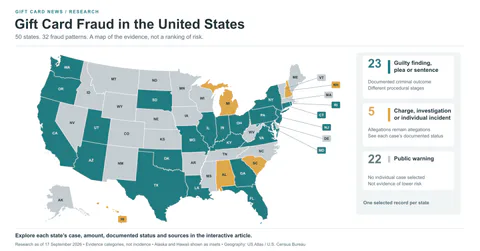
OWASP includes automated guessing of gift card codes within its token-cracking threat category. Shopify provides order fraud assessments, but a risk assessment remains an input to an operational decision rather than a guarantee against loss.
| Stage | Risk | Proposed control |
|---|---|---|
| Purchase | Unauthorized payment | Risk-proportionate approval before activation |
| Balance access | Compromised codes or repeated guessing | Code protection, attempt limits and monitoring |
| Redemption | Duplicate debits or stranded reservations | Atomic balance changes and correct reservation release |
| Administration | Unauthorized issuance or refunds | Permissions, change records and reconciliation |
When the additional payment fails
Consider a hypothetical $120 basket funded by a $100 gift card and a separate $20 payment. If the second payment fails, the system needs a defined treatment for the reserved balance: release it, hold it for a retry or debit it only when the transaction completes.
Repeated technical notifications must not consume the same value twice. Retries, cancellation and reservation release belong in the operating design.
Protect active codes while supporting legitimate gifts
Complete active codes should not appear unnecessarily in marketing reports, general logs or routine exports. Shopify documents that merchants see only the last four characters of a gift card code in its interface.
A legitimate gift buyer and recipient may have different names, addresses or countries. Rules should allow review and resolution rather than treating every difference between the two people as evidence of fraud.
15. Regulation, refunds and communications
The following US rules and documented policies inform program configuration. Their scope, definitions and exceptions matter; they do not amount to a legal opinion about a particular merchant.
Federal protections
For covered instruments, Regulation E distinguishes the underlying funds from the card itself. Funds cannot expire before the later of the applicable five-year period after issuance or last loading and the card or certificate’s expiry date. Definitions and product exclusions matter, and applicable state protections may be stronger.
Dormancy, inactivity and service fees are subject to conditions including the period without activity, disclosure and frequency restrictions. The existence of an expiry setting in a platform does not determine whether a selected period complies with the applicable rules.
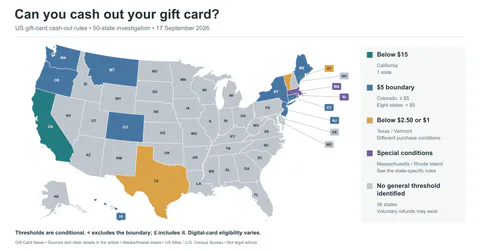
California balances below $15
Effective April 1, 2026, California SB 22 provides for cash redemption of eligible gift certificate balances strictly below $15, subject to the law’s exceptions. A balance of exactly $15 is not below that threshold. California generally prohibits expiry dates for covered purchased gift certificates, while preserving exceptions for specified products. The legislation also addresses electronic cards and separate conditions for some promotional value.
Operationally, an eligible cash-redemption request needs a process that staff and systems can carry out. The rule cannot be implemented solely by adding a sentence to customer terms.
Avoid a second refund on top of live credit
Shopify documents that a later monetary refund does not automatically reverse store credit already issued for the order. An intervention therefore needs to account for the existing credit balance. The store’s chosen refund policy also remains distinct from mandatory customer rights.
Separate delivery from promotion
The FTC’s CAN-SPAM guidance distinguishes commercial and transactional messages by their primary purpose. Combining delivery or confirmation content with promotion does not automatically make the whole message transactional.
Gift card delivery and recovery should be operationally distinguishable from promotional campaigns. Supplying a recipient’s email address for a gift does not, by itself, establish unlimited permission across every marketing channel.
Unredeemed value remains a separate question
An old balance does not automatically become profit. Breakage recognition needs to be distinguished from expiry, refund obligations and any applicable rules for unclaimed value. Best Buy’s reporting refers to redemption history and jurisdictional requirements when explaining its estimates.
16. Build a dashboard around issuance, redemption and outcomes
The following are proposed management definitions rather than market-average performance targets. The records need to preserve the relationship between value issued, value consumed and the associated commercial result.
| Measure | Working definition | Error to avoid |
|---|---|---|
| Face value issued | Sum of issued face values | Combining purchased cards with free bonuses |
| Issuance cash | Actual net cash collected | Treating it as product revenue |
| Average card value | Face value sold divided by card count | Using order count when orders contain several cards |
| Page conversion | Gift card orders divided by eligible sessions | Using all website traffic as the denominator |
| On-time delivery | Deliveries within the promised window divided by deliveries due | Ignoring scheduled dates |
| Value redemption at 90 days | Cohort value used divided by value issued | Comparing cohorts of different ages |
| Card-count redemption | Cards used at least once divided by eligible cards | Confusing it with the proportion of value consumed |
| Time to first use | Median elapsed time | Silently excluding cards that remain unused |
| Additional spending | Basket amount beyond gift card value applied | Calling it incremental revenue |
| New recipients | Recipients with no earlier purchases | Using the original buyer’s identity |
| Second purchase | A return after initial redemption | Counting continued use of the same balance as new loyalty |
| Contribution | Receipts less relevant costs | Omitting discounts and distribution costs |
| Fraud loss | Net confirmed losses divided by relevant volume | Using general fraud reports as the merchant’s own rate |
| Reconciliation | Movement in operational balances and accounting obligations | Adjustments disconnected from their originating transaction |
Analytics and advertising attribution
Shopify provides distinct gift card and outstanding-balance reporting, while WooCommerce documents the separation of issuance and redemption in Analytics. That configuration needs to be understood before interpreting commercial results.
In a hypothetical advertising report, a $100 card purchase followed by a $120 product order could generate $220 of attributed activity. It does not automatically represent $220 of new cash. Issuance and merchandise-purchase events need separate identities and explicit deduplication rules.
Compare cohorts at the same age
A card cohort issued two weeks ago cannot be compared fairly with one issued six months ago without accounting for elapsed time. Useful observation points include 30, 90 and 180 days after issuance, with additional segmentation for purchased cards, bonuses, returns, distribution channel and season.
17. Establish whether the program adds value
For promotional campaigns, a proposed evaluation is random assignment of eligible customers between an offer group and a control group. The primary outcome should be average contribution per eligible person, including campaign costs, rather than revenue only among people who redeemed.
In an illustrative example, the offer group generates $18 of average contribution per person and the control group $16 over the same period. The estimated difference is $2 per eligible person. It is not the full value of orders placed by reward users. Statistical uncertainty, the observation period and differences between new and existing customers still need to be assessed.
| Proposed experiment | Outcome to evaluate |
|---|---|
| More visible navigation | Additional purchases rather than redistributed traffic |
| Alternative denominations | Conversion and full-cycle contribution |
| Scheduled delivery | Conversion and delivery incidents |
| Undiscounted card versus a separate bonus | Contribution and subsequent purchases |
| Customer-selected return credit | Cash, costs and retention |
| Useful balance reminder | Redemption and satisfaction without misleading pressure |
| Subscription gift card | Retention after the funded balance is exhausted |
Introducing every change at once makes attribution difficult. A staged design preserves the ability to connect an observed difference with the intervention that produced it. These are proposed merchant experiments; the research does not claim to have conducted them.
18. Where different retailers can investigate opportunity
The following are commercial hypotheses to evaluate, not a demonstrated ranking of profitability by sector.
| Retailer type | Use to investigate | Main economic question |
|---|---|---|
| Fashion | A gift without choosing a size | Does it preserve purchase intent without excessive subsidy to existing customers? |
| Beauty | Gifting and a move from samples to full-size products | Does a profitable second purchase follow? |
| Pet supplies | Gifting and repeat-purchase rewards | Do recipients continue buying after the balance is used? |
| Home and furniture | A contribution toward a higher-priced product | Is the balance usable, and does it enable a purchase that would not otherwise occur? |
| Subscriptions | A gifted first experience | Does the subscriber remain after the funded period? |
| Premium brands | Gifting without a product discount | Do personalization and service support the purchase? |
| Narrow catalogs | An alternative to choosing a product | Is there enough suitable choice for the recipient? |
For smaller stores, the initial priorities are a dependable buyer-to-recipient journey and reconciliation. Larger programs can investigate distribution, automation, recipient segmentation and the interaction between promotions.
For technology providers, the opportunity extends to specific merchant problems: delivery, balances used across several orders, subscription payments, returns, reconciliation and measurement of contribution. Issuing a code is only one part of the operating requirement.
What makes an ecommerce gift card program valuable?
Three disciplines determine whether the commercial result can be understood. Purchased cards, promotional bonuses and return credit need separate records. Issuance, delivery, redemption and product costs need to be followed across the same cycle. Incremental contribution needs to be evaluated against what would have happened without the intervention.
Earlier cash and a larger redemption basket can be useful, but neither guarantees additional profit. A program earns its commercial value when issued balances lead to measurable customer relationships and contribution, with the costs, remaining obligations and risks visible in the same analysis.
Sources and documents
Collapse
- BHN / NAPCO: 2026 Best Direct Digital Gift Cards Benchmark Report — BHN / NAPCO
- Blackhawk Network: 2026 digital benchmark findings, July 15, 2026 — BHN
- TSG / Bank of America: February 2026 US consumer gift card survey — TSG / Bank of America
- Rise.ai: Dr. Squatch store credit case, Q4 2020 — Rise.ai / Dr. Squatch
- Rise.ai: Kosas sample-to-product credit case, Q4 2021 — Rise.ai / Kosas
- Rise.ai: Bokksu subscription gift card case, early 2021 — Rise.ai / Bokksu
- Chewy: US gift card terms — Chewy
- Etsy: buying gift cards and bulk purchasing — Etsy
- Shopify: gift card overview and considerations — Shopify
- Shopify: redeeming and using gift cards — Shopify
- Shopify: store credit — Shopify
- Shopify: gift card recipient fields and scheduled delivery — Shopify
- WooCommerce Gift Cards: subscription integration and reporting FAQ — WooCommerce
- Adobe Commerce: gift card products — Adobe
- Best Buy: fiscal 2026 Form 10-K, year ended January 31, 2026 — Best Buy / SEC
- Shopify: finance reports — Shopify
- Shopify: order fraud analysis — Shopify
- OWASP: OAT-002 token cracking — OWASP
- CFPB: Regulation E, section 1005.20 — CFPB
- California Legislature: SB 22 gift certificate provisions — California Legislative Information
- FTC: CAN-SPAM compliance guide for businesses — FTC
- Shopify: third-party transaction fees and Shopify Plus waiver conditions — Shopify
In this article

Oliver Reed
Oliver Reed covers industry acquisitions, investment and market research for Gift Card News.